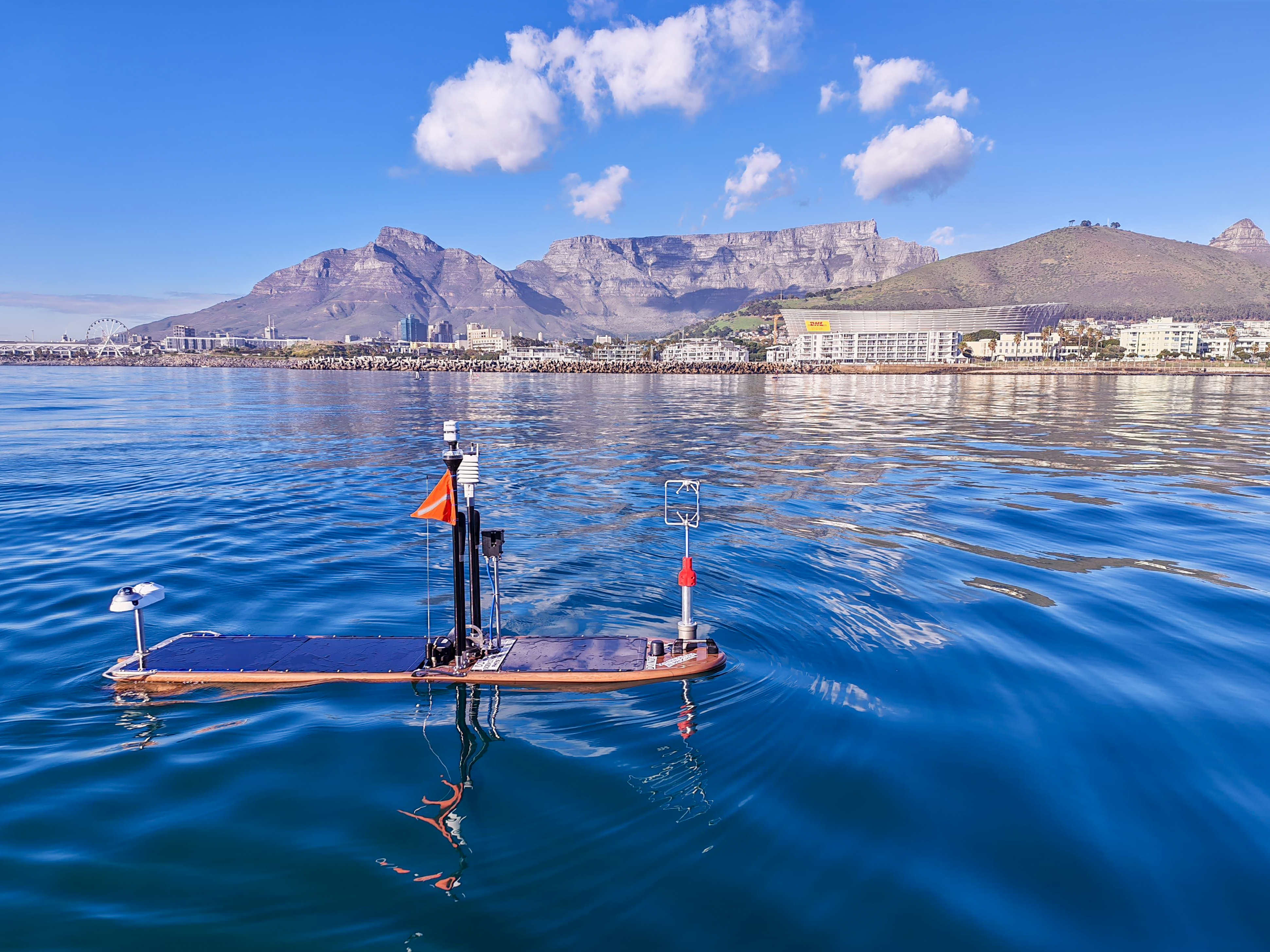
A wave glider off the coast of Cape Town. Together with other autonomous platforms, it forms a network to track the formation, development and dissipation of small-scale ocean structures in near real time.
Photo: WHIRLS project / Sean Lavis (Sea Technology Services), D. Luquet (IMEV), Alseamar, Rockland Scientific.
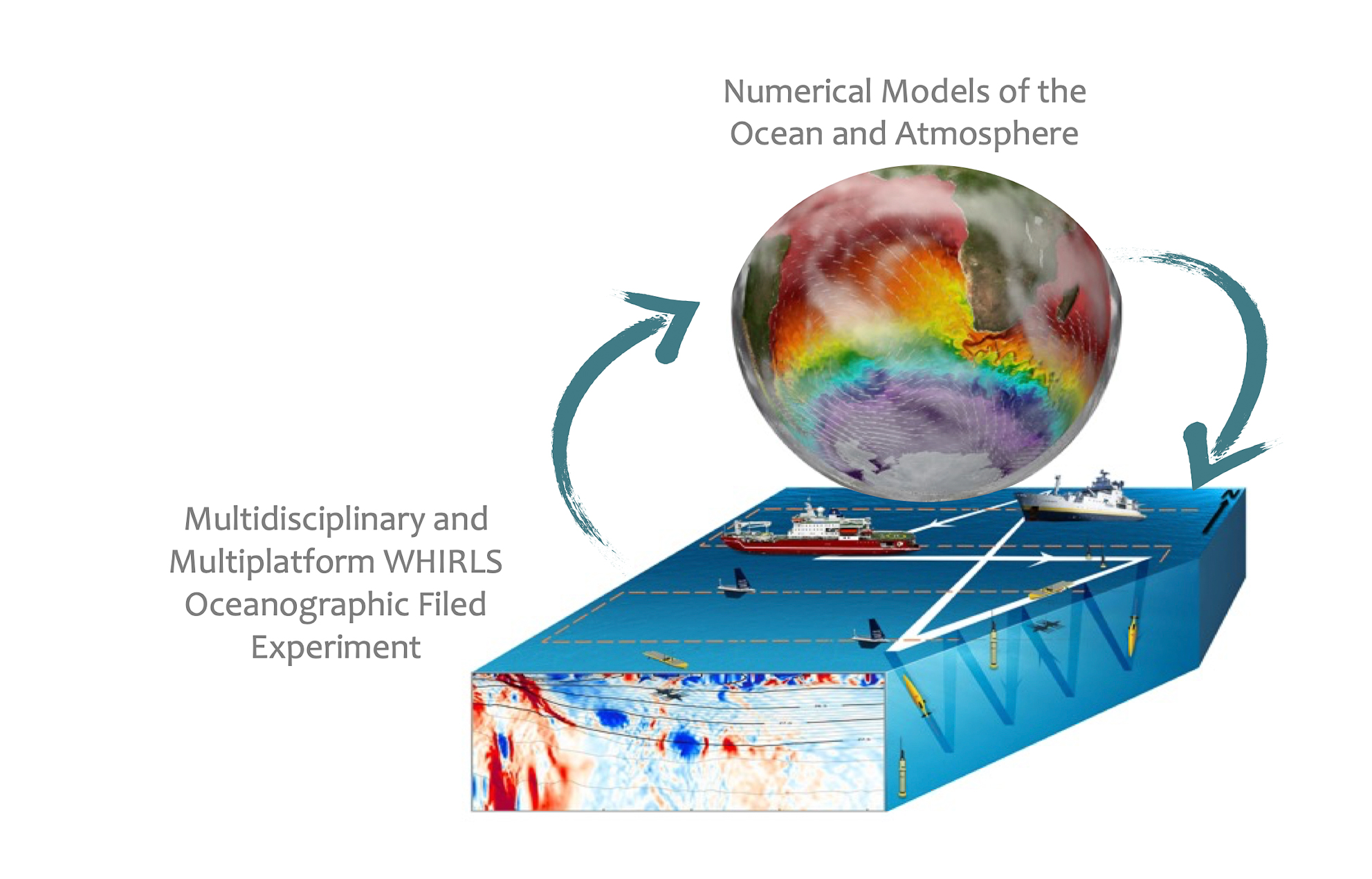
The WHIRLS observation-and-modelling concept. A multidisciplinary, multi-platform oceanographic field experiment (two research vessels, floats, gliders, drifters and drones, sampling the ocean and the lower atmosphere) is combined with coupled numerical models of the ocean and atmosphere. Together they allow WHIRLS to observe physics, chemistry and life simultaneously at very high resolution.
Illustration: Sabrina Speich, LMD-IPSL
A high-resolution view of the ocean
International WHIRLS field campaign investigates small-scale processes and their significance for climate and ecosystems
The ocean is a central component of the Earth system: it absorbs most of the excess heat generated by human activities, absorbs a significant proportion of the carbon dioxide emitted into the atmosphere, and sustains ecosystems that are essential for food security, the economy and biodiversity. Many of these processes are strongly influenced by small-scale oceanic movements.
These structures (eddies, fronts and filaments) span just a few kilometres and develop over a period of days to weeks. Despite their small size, they play a disproportionately large role: they control the exchange of heat and carbon dioxide with the atmosphere, the vertical transport of nutrients from the depths, and the spatial and temporal organisation of marine life. Due to their transience and the difficulty of observing them, they are inadequately documented, and their effects are not yet sufficiently taken into account in climate models.
The WHIRLS project (Unravelling the impact of ocean fine-scale whirls on our climate and ecosystems) examines the ocean, the atmosphere and marine ecosystems precisely at the spatial and temporal scales at which their interactions are most intense.
A natural laboratory off the coast of South Africa
The campaign focuses on the Agulhas Current, one of the most energy-rich ocean currents on Earth. In this region, warm waters from the Indian Ocean meet colder waters from the Atlantic and the Southern Ocean, leading to intense turbulence, steep temperature gradients and vigorous exchange with the atmosphere. Some of this warm water flows into the Atlantic and feeds the great ocean circulation that distributes heat across the entire planet.
During the southern winter – the period chosen for the campaign – the contrasts between the ocean and the atmosphere become more pronounced. Storms occur frequently, and small-scale processes are particularly active. At this time of year, the region thus provides an ideal natural laboratory for investigating the influence of small-scale ocean dynamics on climate and ecosystems.
Two ships and a fleet of autonomous measuring devices
At the heart of the field campaign are two research vessels, the MARION DUFRESNE (France) and the SA AGULHAS II (South Africa), which serve as mobile scientific observatories. Working in close collaboration, they will carry out measurements almost simultaneously across an area of around 40,000 square kilometres, investigating the three-dimensional structure of the upper 1,000 metres of the ocean and the lower atmosphere.
As the ships cannot be everywhere at once, they are supported by a large fleet of autonomous platforms: underwater gliders, wave gliders, sailing buoys, around 200 surface drifters, 18 profiling Argo floats and Saildrone-type marine drones. In addition, around 300 atmospheric soundings are carried out using radiosonde balloons and profilers, supplemented by laser-based wind measurements and aerial drones to characterise the lower atmosphere. Together, this network provides an unprecedented level of spatial and temporal resolution, allowing the formation, development and dissipation of small-scale ocean structures to be tracked almost in real time.
Observing life, from viruses to marine mammals
WHIRLS’ biological and biogeochemical programme is extensive: water samples are analysed for nutrients and their isotopic composition; plankton nets capture larger organisms; and genetic and genomic analyses provide a detailed record of biodiversity, including viruses and bacteria that are otherwise difficult to observe. On a larger scale, acoustic systems detect zooplankton and fish, whilst observers count seabirds and marine mammals.
Small-scale oceanic structures often create zones of high biological concentration that attract predators. Tracking these dynamics from viruses to mammals, in parallel with physical and chemical processes, provides an integrated view of the marine biome that is rarely achieved.
At the heart of the European ERC Synergy Project WHIRLS
The field campaign is a central component of the ERC Synergy Project WHIRLS, which is funded by the European Research Council as part of the ‘Horizon Europe’ programme. The project brings together physical oceanographers, modelling and observation specialists, and biogeochemists from Germany, France, Sweden and South Africa.
The four project leaders are Arne Biastoch (GEOMAR, Kiel), Sabrina Speich (École Normale Supérieure, Paris), Sebastiaan Swart (University of Gothenburg) and Sarah Fawcett (University of Cape Town).
The observation campaign is complemented by a comprehensive system of ocean and climate models, which closely support the campaign and place the data obtained in a broader spatio-temporal context. Arne Biastoch, Professor of Ocean Dynamics at GEOMAR, summarises: “The comprehensive observation of these small-scale ocean processes and the life they support – from viruses to marine mammals – combined with advanced computer models, is unique. By bringing together fields that are usually studied separately, we will be able to understand how the ocean’s smallest structures influence climate and biodiversity.”
A broad-based international collaboration
Beyond the four teams in the ERC consortium, WHIRLS brings together a broad international partnership involving, in particular, South Africa, Germany, Sweden, France, Italy, the United Kingdom, China and the United States, as well as numerous research institutes and space agencies. By simultaneously observing physics, biogeochemistry and ecosystems on a small scale, the campaign will provide essential insights to improve climate forecasts, better understand the ocean’s carbon cycle and predict the responses of marine ecosystems to climate change.
Funding:
WHIRLS is funded under the European Union’s ‘Horizon Europe ERC Synergy Grant’ programme, grant agreement No. 101118693.
A wave glider off the coast of Cape Town. Together with other autonomous platforms, it forms a network to track the formation, development and dissipation of small-scale ocean structures in near real time.
Photo: WHIRLS project / Sean Lavis (Sea Technology Services), D. Luquet (IMEV), Alseamar, Rockland Scientific.
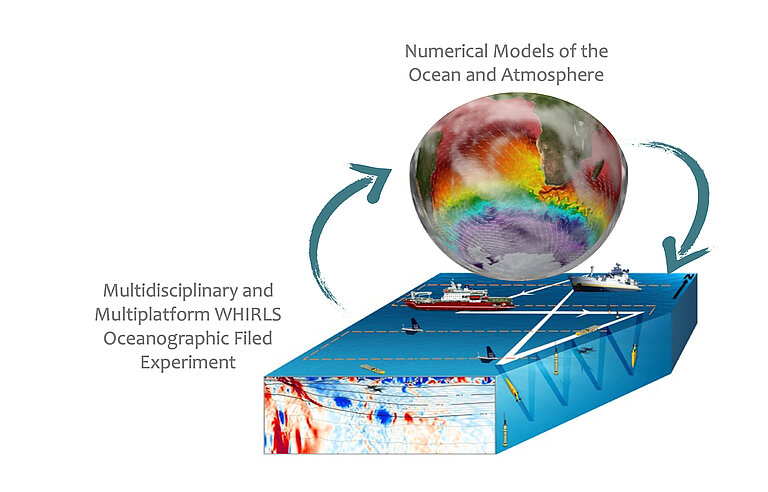
The WHIRLS observation-and-modelling concept. A multidisciplinary, multi-platform oceanographic field experiment (two research vessels, floats, gliders, drifters and drones, sampling the ocean and the lower atmosphere) is combined with coupled numerical models of the ocean and atmosphere. Together they allow WHIRLS to observe physics, chemistry and life simultaneously at very high resolution.
Illustration: Sabrina Speich, LMD-IPSL