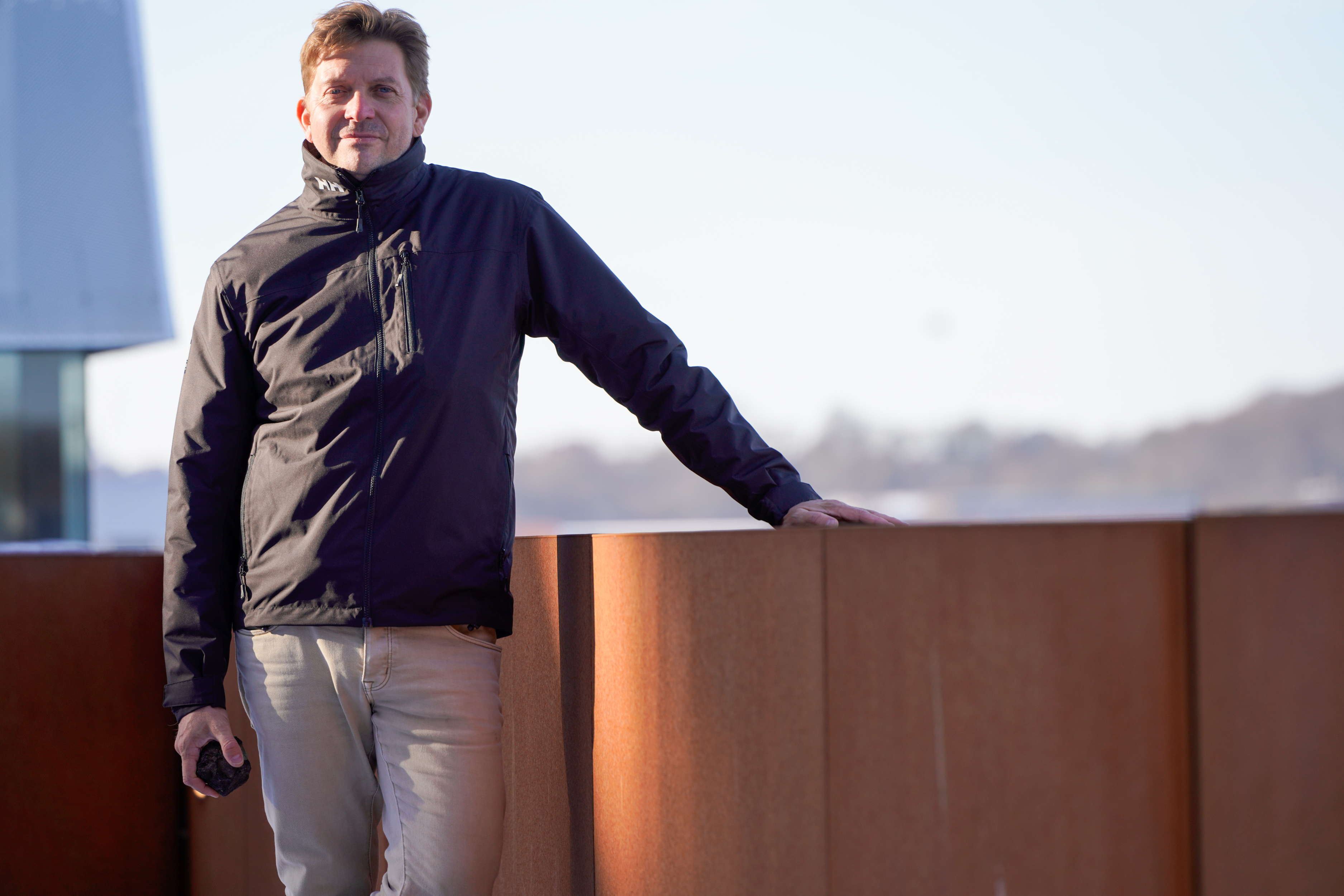
A geologist through and through: Dr Oliver Nebel is the new Professor of Geochemistry at GEOMAR and Kiel University.
Photo: Ilka Thomsen, GEOMAR
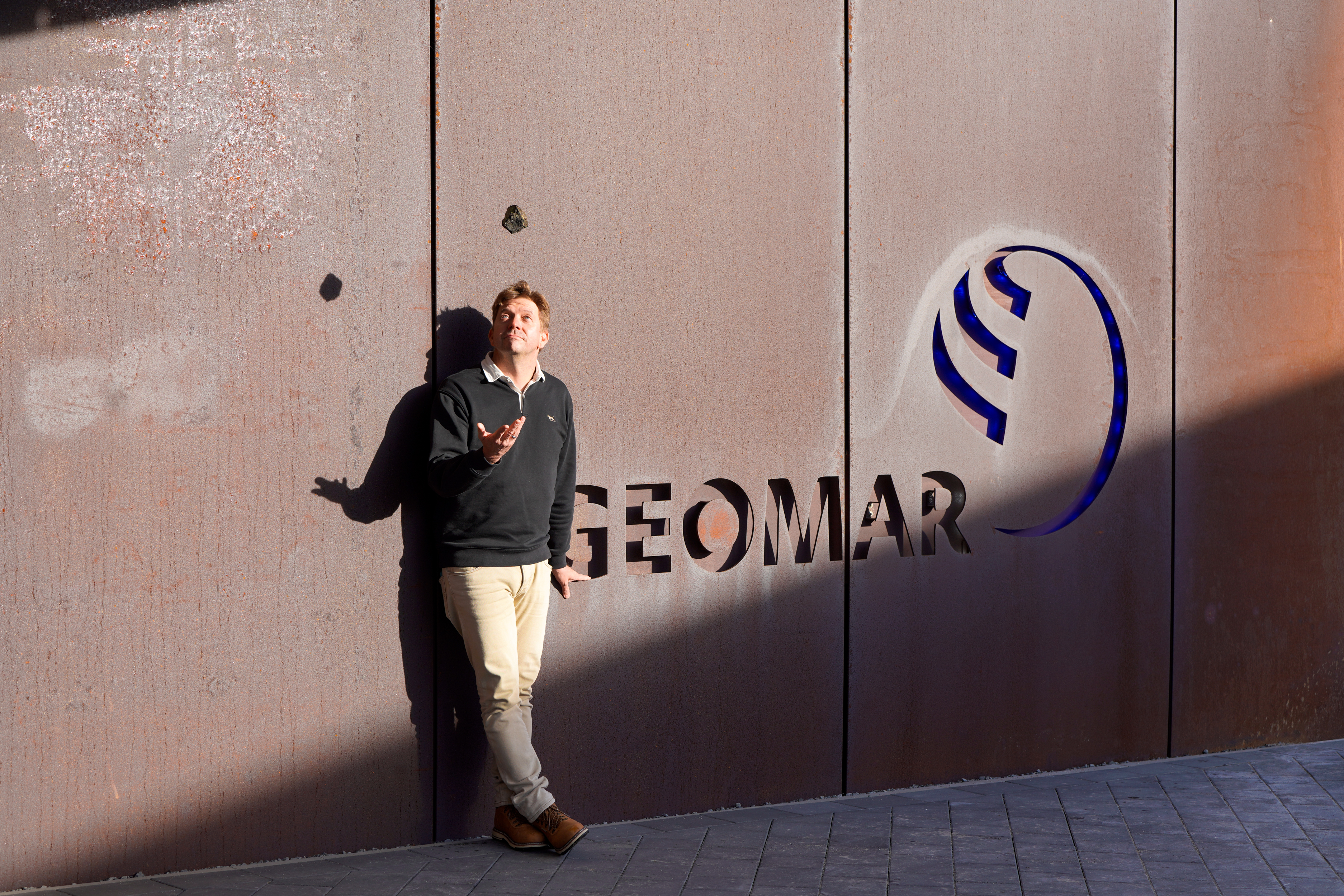
Oliver Nebel is returning to Germany after more than two decades abroad. He investigates how the Earth’s crust and mantle have evolved over millions and billions of years, particularly beneath the seabed.
Photo: Ilka Thomsen, GEOMAR
On the Spectrum between Rock and Water
Geologist Prof. Dr Oliver Nebel is the new Professor of Geochemistry at GEOMAR
“Here at GEOMAR, we focus on the ocean – but what interests me is more the basin around it, in which the ocean floats,” says Dr Oliver Nebel. The new professor of geochemistry at GEOMAR Helmholtz Centre for Ocean Research Kiel and Kiel University (CAU) is a geologist through and through. For him, rocks are the most important thing. However, he is in exactly the right place at a marine research centre, because rocks and the ocean cannot be separated.
Oliver Nebel: “Everything that weathers away from rocks leaves traces in the ocean.” And the boundary where the ocean floor dissolves and seawater begins cannot be clearly defined. “It’s like a rainbow. You can’t say where one colour ends and another begins. And only when I put it all together does it become light again. It’s the same with our Earth.”
From Germany to Australia through the Netherlands—and back
His own journey began quite far from the ocean. Nebel is originally from Hamm in Westphalia. He studied earth sciences in Münster and earned his doctorate there as well. He then spent three years in Amsterdam as a postdoctoral researcher. This was followed by a move to the other side of the world: Australia became his scientific home for many years. He initially worked in Canberra, then moved to Monash University in Melbourne as an associate professor. At Monash he founded and directed the internationally recognized Monash Isotopia Laboratory, a state-of-the-art centre for isotope analysis.
Having spent more than two decades abroad, he returned to Germany in November last year. He now holds a Heisenberg Professorship and the Chair of Magmatic Geochemistry at the Faculty of Mathematics and Natural Sciences at CAU, as well as being a member of the Magmatic and Hydrothermal Systems Research Unit at GEOMAR.
He considers the working conditions for research and teaching within the partnership between the university and the Helmholtz Centre to be ideal. 'This offers the opportunity not only to train the next generation of researchers, but also to exchange ideas with scientists from many related fields and to conduct multidisciplinary research at the highest level. That’s what makes cutting-edge research so rewarding!”
Explosive volcanoes and a hidden ocean deep within the Earth
Throughout his scientific career, Nebel has mostly had solid ground beneath his feet. That is likely to change soon, however. He is about to embark on his first ship-based expedition aboard the German research vessel SONNE. The team plans to collect samples from the volcanic seafloor in the Pacific. He is currently stationed on a small volcanic island in the central Pacific with an international team. There, the researchers will investigate how magma forms deep within the Earth and the role that water plays in this process. This is because water that penetrates deep into the Earth's mantle alongside sinking tectonic plates — especially at their edges — can have explosive consequences for volcanoes.
The big question: How did the ocean and the continents form?
If this water has been trapped deep within the Earth for a long time and is brought back to the surface as a chemical signature in magma after an eruption, it can reveal a great deal about the planet’s history. In doing so, it helps to answer another of the major questions that geologists are grappling with. Nebel: ‘I want to understand why, when and how the continents we walk on today emerged from the water.’ To find answers, Nebel travels back billions of years through experimentation.
He relies on highly precise measurement methods, such as weighing atoms of different types—the isotopes of chemical elements—with an accuracy that reveals differences in the parts-per-million range. Such isotopic proxies—indirect chemical clues—reveal when water has played a role in geological processes. Nebel explains: “When water evaporates or circulates through rock, lighter isotopes are transported slightly more easily than heavier ones. Such differences leave measurable signatures in the rock. We can no longer see the water today, but we can reconstruct that it was once there.” Radiogenic isotopes—those resulting from radioactive decay—also enable precise dating of rocks.
These methods require highly specialised equipment, such as extremely sensitive mass spectrometers and cleanroom laboratories to prevent contamination of the samples, all of which is available to him here at GEOMAR. We also have research vessels that can retrieve deep-sea rocks and reach small islands whose rocks can tell us how the Earth’s mantle works, how materials are recycled over geological time and the role that water plays in this process. Oliver Nebel seizes every opportunity to figure out how it all fits together. “I’ll even go on board a ship for that,” he says with a wink.
A geologist through and through: Dr Oliver Nebel is the new Professor of Geochemistry at GEOMAR and Kiel University.
Photo: Ilka Thomsen, GEOMAR
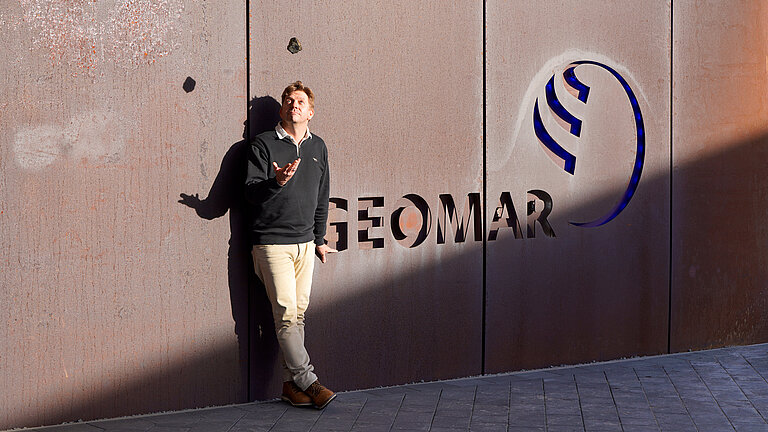
Oliver Nebel is returning to Germany after more than two decades abroad. He investigates how the Earth’s crust and mantle have evolved over millions and billions of years, particularly beneath the seabed.
Photo: Ilka Thomsen, GEOMAR