
At the award ceremony at the IOW (from left to right): Captain Klaus Küper, Briese Research Research Shipping; award winner Dr Iason Gazis and Prof. Dr Helge Arz, Deputy Director of the IOW
Photo: Kristin Beck, IOW
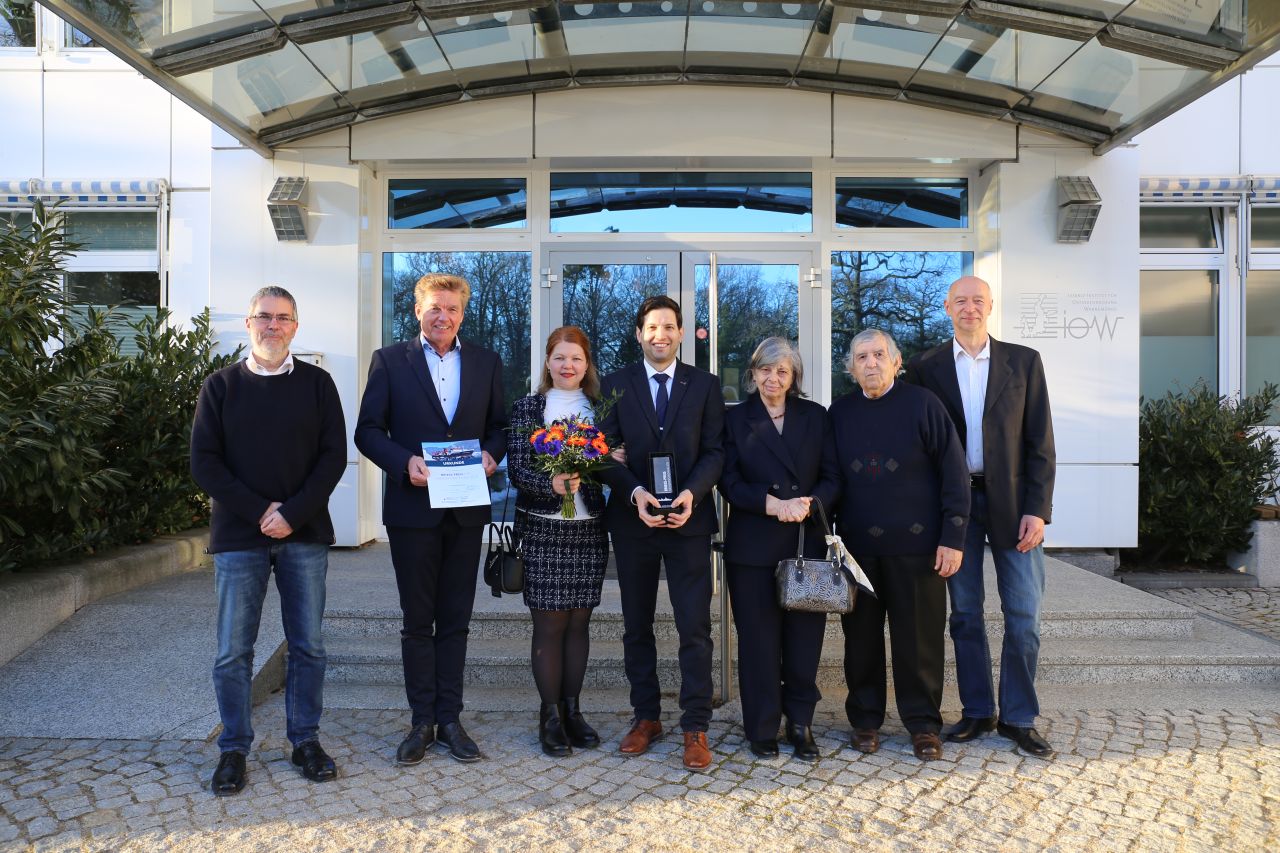
Congratulations from (left to right): Prof. Dr. Jens Greinert, doctoral supervisor and today's laudator; Captain Klaus Küper, Briese Research Research Shipping; Dr Svetlana Kresova, Iason Gazis' wife; award winner Iason Gazis; his parents Anastasia and Sofoklis Gazis; and Prof. Dr Helge Arz, Deputy Director of the IOW
Photo: Kristin Beck, IOW
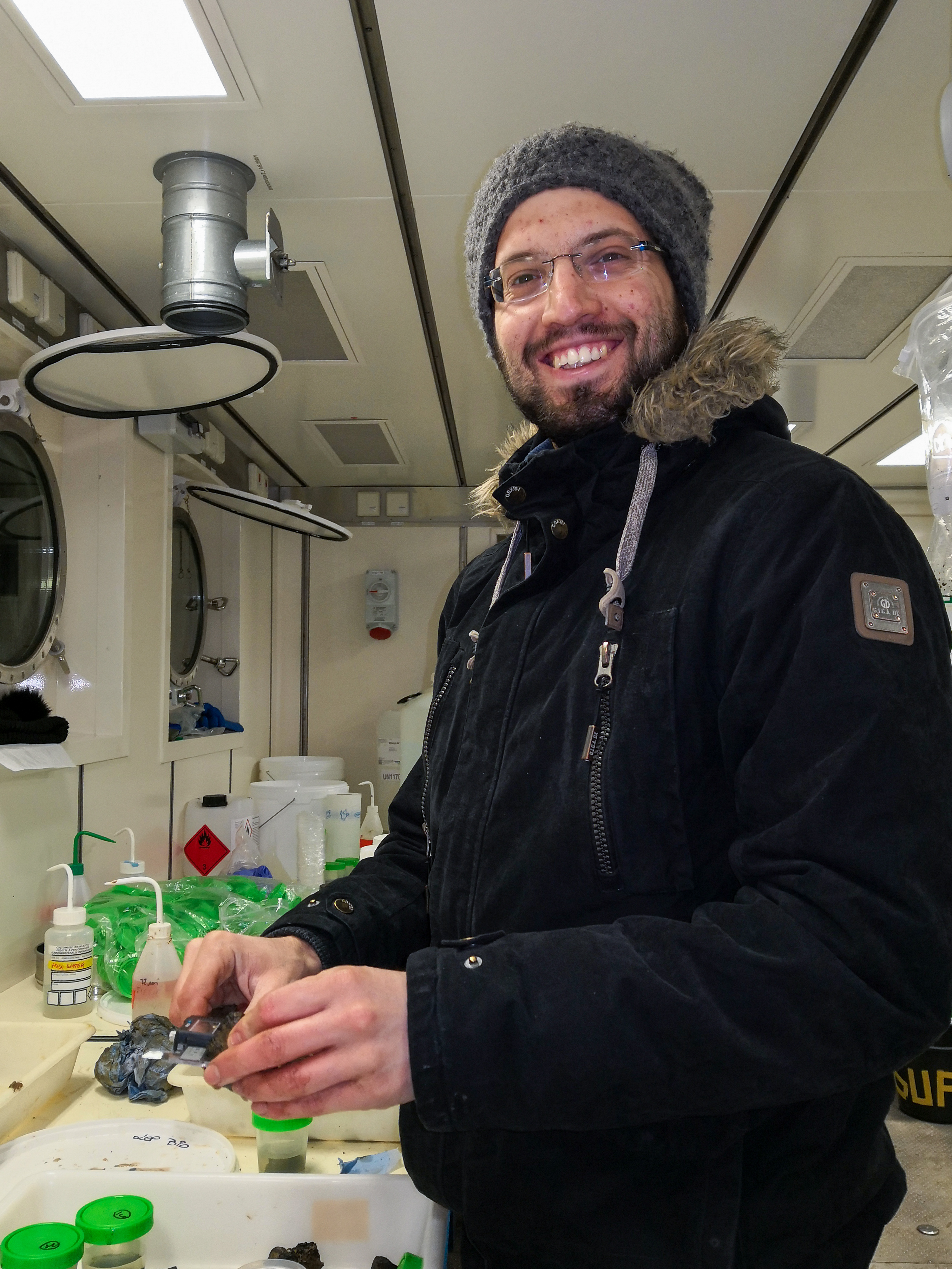
Dr. Iason-Zois Gazis measuring the dimensions of collected nodules during the SO268 expedition in the Clarion-Clipperton Zone in the Pacific Ocean.
Photo: Iason-Zois Gazis
BRIESE Prize 2025 for AI research on deep-sea mining and associated environmental risks
Dr. Iason-Zois Gazis from GEOMAR honored for outstanding dissertation
Against the backdrop of the global energy transition, mineral resources from the deep sea are increasingly coming into focus. Polymetallic nodules, also known as manganese nodules, contain valuable metals such as manganese, nickel, cobalt and copper, which are essential for batteries and other key technologies. However, they are also an integral part of sensitive ecosystems at depths of several thousand metres. However, their distribution varies greatly over small areas and remains poorly understood.
This is precisely where Iason Gazis's award-winning doctoral thesis comes in. He developed innovative methods to map the spatial distribution of these metal-bearing nodules at high resolution, shedding light on the potential environmental impact of mining. His work was based on extensive datasets collected during research expeditions in the Pacific Ocean aboard German research vessels. Modern measuring systems, autonomous underwater vehicles and acoustic sensors were used on board to survey the seafloor at depths of several thousand metres. The focus was on the Clarion-Clipperton Zone in the eastern Pacific, which is one of the world's most important exploration areas for polymetallic nodules. Comparative data from the DISCOL area in the Peru Basin – an internationally significant long-term experiment studying disturbances to the deep-sea floor – was also incorporated into the analyses.
Precise maps using underwater robotics and machine learning
To create a map of the tubers, Gazi combined data from autonomous underwater vehicles, hydroacoustic measurements, and high-resolution photo mosaics of the seafloor, all of which were collected during these expeditions. Using modern machine learning techniques, he analysed these extensive datasets to produce detailed, metre-scale maps of tuber distribution. These models are highly accurate, enabling the nodule distribution to be realistically mapped, even in areas that have not yet been fully surveyed. His analyses show that the nodules are not randomly distributed. Rather, their occurrence is closely related to certain characteristics of the seabed's composition and structure. This makes it much easier to distinguish between areas of high and low tuber density than was previously possible.
In addition to pure mapping, Gazis systematically investigated the methodological limitations of machine learning methods in marine geoscience. He developed approaches to avoid misinterpretations when models are transferred to new areas, for example. By doing so, he is contributing not only to deep-sea research, but also to the advancement of data-driven evaluation methods in environmental science.
Sediment plumes analyzed in situ for the first time in deep-sea mining
The second focus of the dissertation was an investigation into sediment plumes created by nodule collector vehicles. Such plumes are considered one of the key uncertainties in terms of the potential ecological damage that deep-sea mining activities could cause.
During a targeted measurement campaign in the Clarion-Clipperton Zone, a sediment plume typical of nodule mining was monitored in situ and in real time. This plume was generated by an industrial prototype of a nodule collector during a test operation on the seafloor under real conditions. The resulting plumes were monitored from the research vessel using hydroacoustic and optical measurement systems.
Iason Gazis's findings are particularly significant in terms of the development of environmental standards and regulations by the International Seabed Authority (ISA). His research shows that the sediment plume initially spreads as a dense turbidity current perpendicular to the mining tracks, mixing only slightly with the surrounding water. As the sediment cloud moved further away from the mining site, the concentration of particles in the water decreased. Several kilometres away, near-natural background values for the deep sea were measured again. Additionally, Gazis observed for the first time that fine sediment particles clumped together to form larger flakes directly on site. This makes them heavier, causing them to sink back to the bottom more quickly. This process had hardly been taken into account in previous models. This could lead to a larger proportion of the stirred-up material being redeposited in the immediate vicinity of the mining area, resulting in strong localised effects on the seabed and the organisms living there.
High-quality, relevant ship-based research
The BRIESE Prize jury justified its decision to award the 2025 BRIESE Prize as follows: "Iason Gazis's dissertation demonstrates an in-depth understanding of the statistical and data science relationships between the measurements and the observed phenomena. The underlying machine learning methods, which are particularly based on hydroacoustic and optical data, are highly innovative, and the mapping's high-resolution graphical implementation is impressive. In addition, his publications are of a very high standard of quality and originality."
The results of Gazis' work are highly relevant for the development of international regulations. Furthermore, they suggest that future measurement campaigns in the deep sea could be conducted more efficiently and effectively. "Iason Gazis's exceptional work clearly shows how marine research can benefit from technological innovation," says Klaus Küper, head of the research shipping department at the Briese shipping company. "Without powerful research vessels, precise measurement technology and experienced crews, such datasets would not be possible. We are delighted to use the BRIESE Prize to honour research that combines scientific excellence with social responsibility," says Küper.
Dr. Iason-Zois Gazis (Born in 1990) completed his Bachelor's degree in Marine Sciences and his Master's degree in Integrated Coastal Management at the University of the Aegean, subsequently earning his Doctorate at the GEOMAR Helmholtz Centre for Ocean Research Kiel and Christian-Albrechts-Universität zu Kiel. (Original title of doctoral thesis: Deep-sea polymetallic nodules spatial modelling with machine learning algorithms and benthic plume monitoring; Graduation: 12/2024, Grade: „Summa cum laude“, Supervisors: Prof. Dr. Jens Greinert, Prof. Dr.-Ing. Kevin Köser, both GEOMAR Helmholtz-Zentrum für Ozeanforschung Kiel). He has been a postdoctoral researcher in the Deep-Sea Monitoring working group at GEOMAR since January 2025. As part of his doctoral studies, he participated in four sea expeditions. To date, he has published over 40 data sets from these expeditions.
The BRIESE Prize for Marine Research is sponsored by Briese Schiffahrts GmbH & Co. KG. The company operates a fleet of research vessels, including the medium-sized ELISABETH MANN BORGESE and ALKOR, and the larger METEOR, MARIA S. MERIAN and SONNE. The IOW provides scientific support for the award. Since 2010, outstanding doctoral theses in marine research whose results are closely related to the use of research vessels and the application and development of technology and/or data collection at sea have been honoured annually.
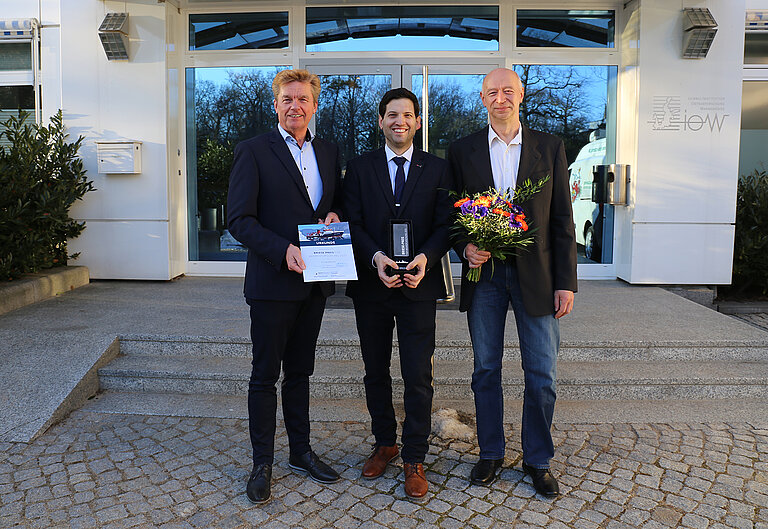
At the award ceremony at the IOW (from left to right): Captain Klaus Küper, Briese Research Research Shipping; award winner Dr Iason Gazis and Prof. Dr Helge Arz, Deputy Director of the IOW
Photo: Kristin Beck, IOW
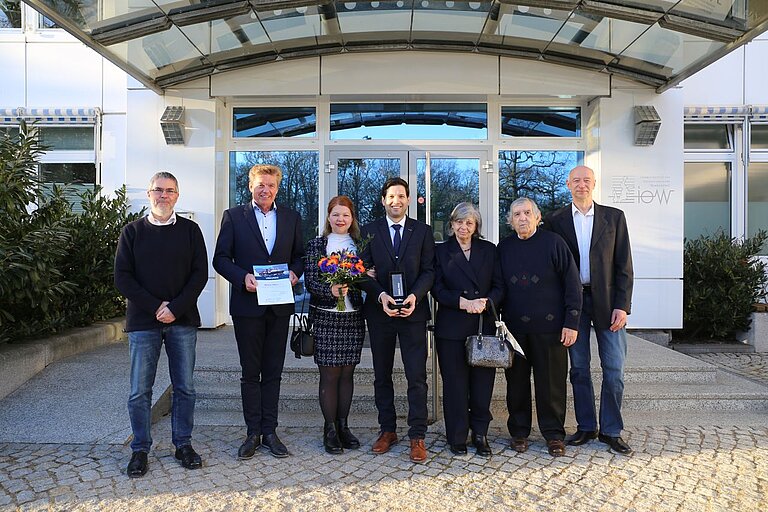
Congratulations from (left to right): Prof. Dr. Jens Greinert, doctoral supervisor and today's laudator; Captain Klaus Küper, Briese Research Research Shipping; Dr Svetlana Kresova, Iason Gazis' wife; award winner Iason Gazis; his parents Anastasia and Sofoklis Gazis; and Prof. Dr Helge Arz, Deputy Director of the IOW
Photo: Kristin Beck, IOW
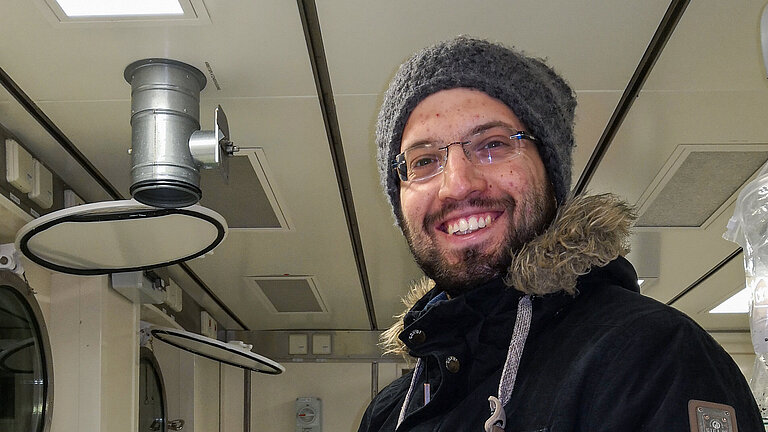
Dr. Iason-Zois Gazis measuring the dimensions of collected nodules during the SO268 expedition in the Clarion-Clipperton Zone in the Pacific Ocean.
Photo: Iason-Zois Gazis