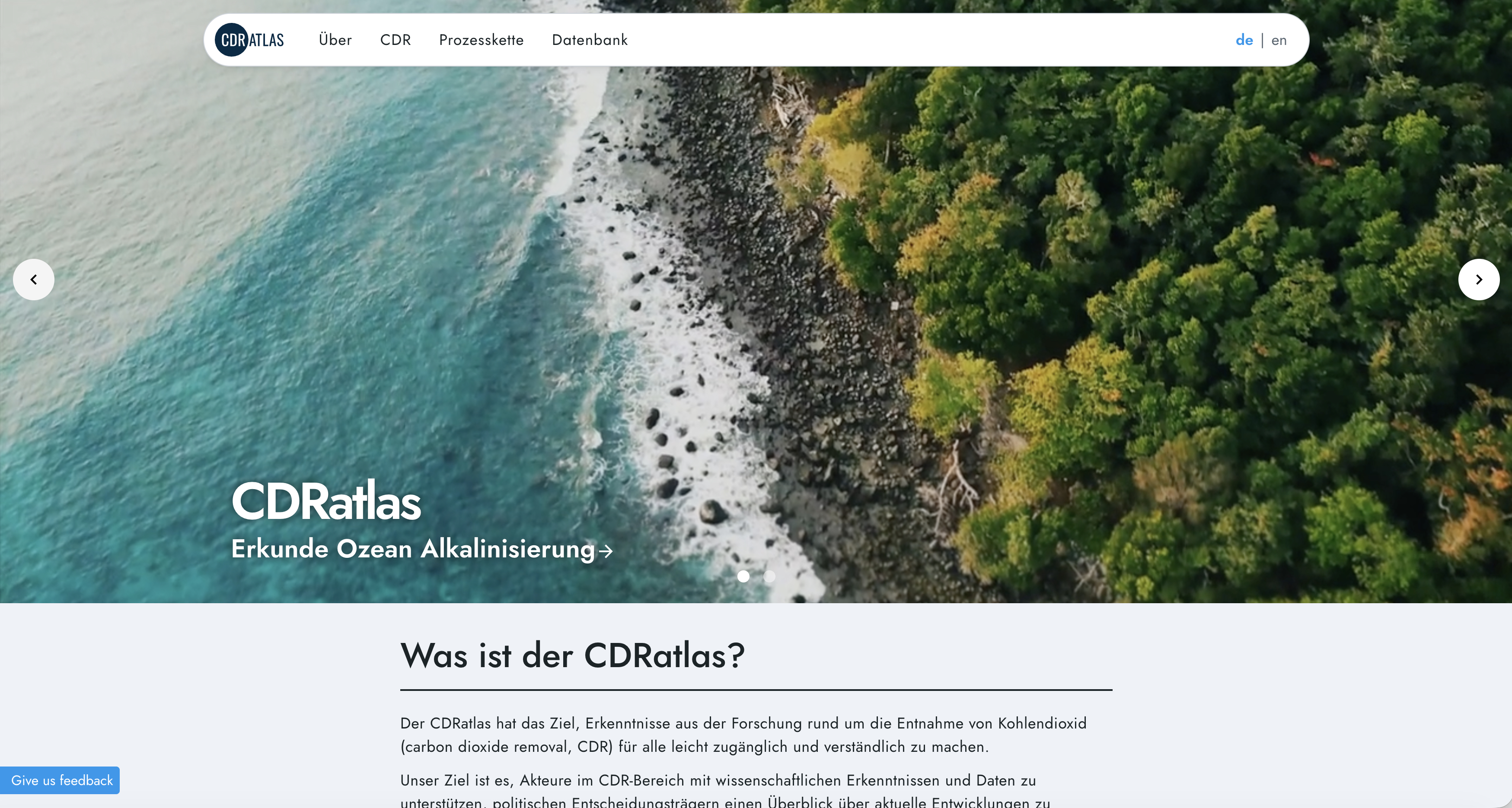
The Carbon Removal Atlas, funded by the Federal Ministry of Research, Technology and Space (BMFTR), has released its new platform, the CDRatlas.
Screenshot: CDRatlas
![[Translate to English:] Unterwasseraufnahme eines Mangrovenwalds, das verzweigte Wurzelwerk ist sichtbar.](/fileadmin/content/service/presse/Pressemitteilungen/2026/07_CDRatlas_Launch/OceanImageBank_MattCurnock_130.jpg "[Translate to English:]")
Mangroves capture and store atmospheric carbon: The CDRatlas puts CO2 removal into perspective – showing how it can be achieved and where its limits lie.
Foto: Matt Curnock, OceanImageBank
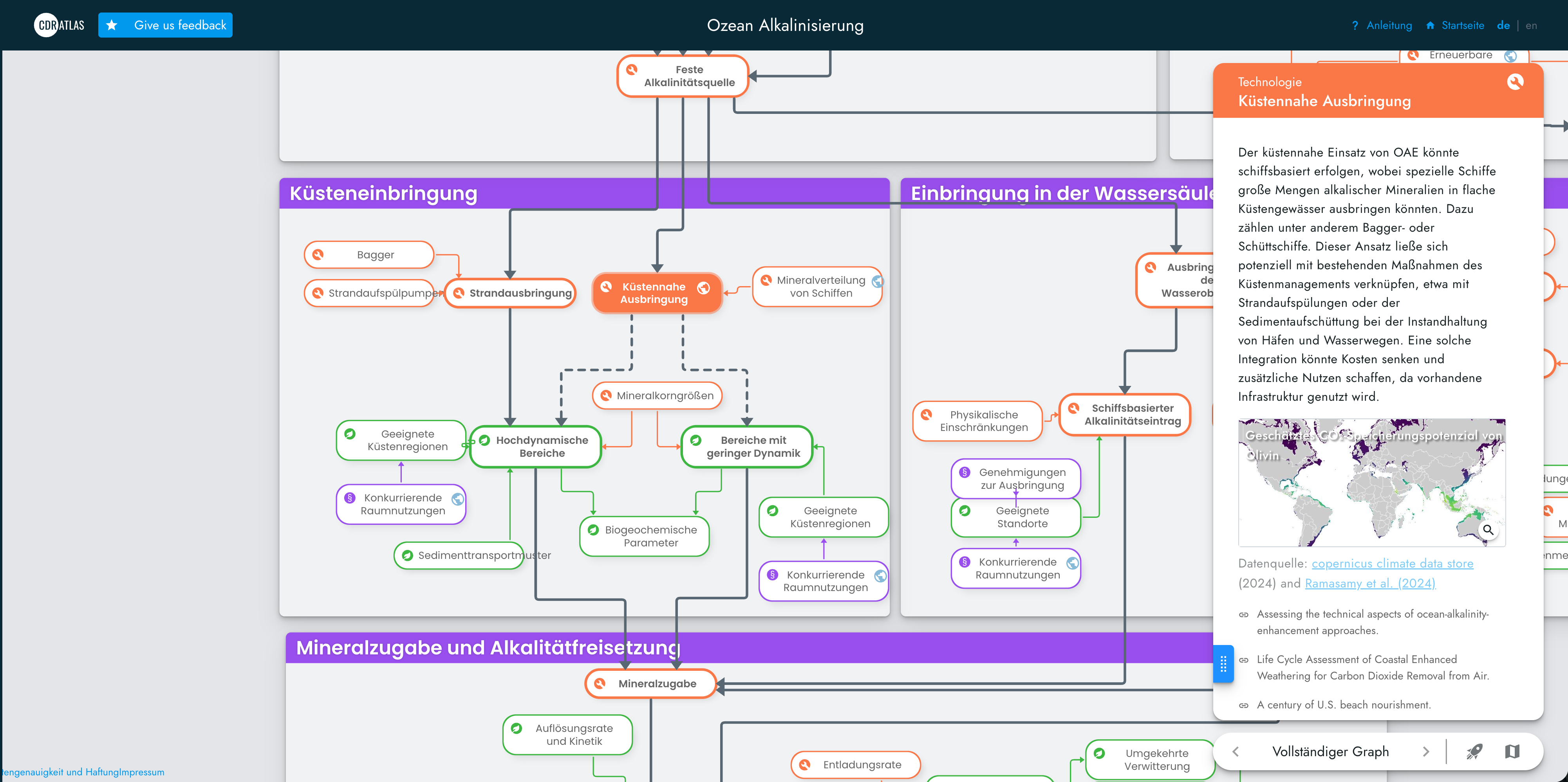
Detailed process chains for various CDR methods are at the heart of the platform. These illustrate the necessary steps, from planning and implementation to monitoring CO2 storage.
Screenshot: CDRatlas
CDRatlas: A Guide to CO2 Removal Methods on Land and in the Ocean
New online platform makes CDR approaches transparent and comparable
Even with ambitious climate action, some greenhouse gas emissions in sectors such as cement production, the steel industry and agriculture cannot be eliminated completely. In order to achieve climate targets and limit the impact of human-induced climate change, alongside the rapid and drastic reduction of CO₂ emissions, removing CO₂ from the atmosphere will play an important role.
But which approaches are available? How do they work in practice? And what natural, technical or legal conditions are required for their implementation? The new Carbon Removal Atlas (CDRatlas) addresses these questions. This openly accessible platform presents the potential and limitations of carbon dioxide removal (CDR) methods visually and interactively. The CDRatlas draws in particular on results from CDRmare, the research mission of the German Marine Research Alliance (DAM), and from the CDRterra research programme.
“There is no shortage of ideas for removing CO2, but until now there has been no comprehensive overview that spatially resolves their potential and limitations” says Dr Steffen Swoboda, project leader at the GEOMAR Helmholtz Centre for Ocean Research Kiel. “The CDRatlas helps to better assess the individual methods and to identify knowledge gaps.”
An atlas that makes processes understandable
At the heart of the platform are detailed process chains for various CDR methods. These illustrate the necessary steps, from planning and implementation to monitoring CO2 storage. In technical terms, this monitoring process is known as Monitoring, Reporting and Verification (MRV). In the CDRatlas, this concept is explained in clear, accessible language and set in context.
Many of the approaches are still at the experimental stage. Therefore, in numerous workshops, researchers worked alongside industry and practice experts to explore what real-world implementation could look like.
At the launch of the platform, the CDRatlas includes ocean alkalinity enhancement and mangrove (re-)establishment. Further approaches will follow over the course of the year, including reforestation, bioenergy with carbon capture and storage (BECCS), the restoration of seagrass meadows and the aquaculture of macroalgae.
Maps show what is possible locally – and what is not
Whether a CO2 removal approach can be implemented sensibly depends strongly on location, including environmental conditions, existing infrastructure, legal frameworks and societal constraints. The CDRatlas therefore uses a map-based presentation. Users can see at a glance where potential exists – and where clear limits apply. All information shown is backed by sources. The CDRatlas itself does not provide raw data, but transparently links to the respective original data sources.
The platform is complemented by a literature database that is continuously updated. Users can also subscribe to a weekly newsletter highlighting new scientific publications.
A collaborative effort by the scientific community
The CDRatlas is the result of a nationwide collaboration between various research institutions in Germany. Alongside GEOMAR, contributors include the Helmholtz Centre for Environmental Research (UFZ), the Leibniz Centre for Tropical Marine Research (ZMT), Ludwig Maximilian University of Munich (LMU), the Alfred Wegener Institute for Polar and Marine Research (AWI), as well as other institutions and individual experts. The CDRatlas is therefore a jointly supported project of the scientific community, based on federal funding.
Continuously evolving tool for policy and society
The CDRatlas will continue to grow in terms of both content and technical functionality. By providing a realistic assessment of the opportunities and limitations of CO2 removal methods, the CDRatlas aims to support informed and responsible decision-making based on scientific evidence.
“CO2 removal cannot replace climate mitigation, but it can complement it,” says Steffen Swoboda. “The CDRatlas makes opportunities, risks and open questions transparent.”
About: The Carbon Removal Atlas project
The Carbon Removal Atlas project has received approximately €1.7 million in funding from the Federal Ministry of Research, Technology and Space (BMFTR). The project will run for three years, from March 2024 to February 2027. During this period, the CDRatlas will be continuously expanded and updated.
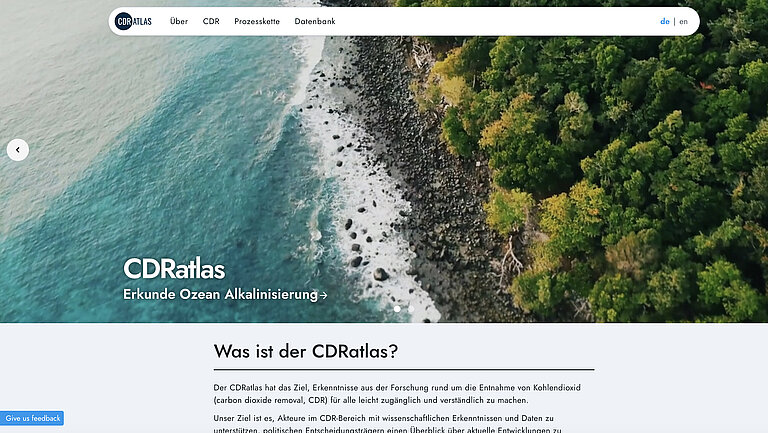
The Carbon Removal Atlas, funded by the Federal Ministry of Research, Technology and Space (BMFTR), has released its new platform, the CDRatlas.
Screenshot: CDRatlas
![[Translate to English:] Unterwasseraufnahme eines Mangrovenwalds, das verzweigte Wurzelwerk ist sichtbar.](/fileadmin/_processed_/7/4/csm_OceanImageBank_MattCurnock_130_e0a66e25a5.jpg "[Translate to English:]")
Mangroves capture and store atmospheric carbon: The CDRatlas puts CO2 removal into perspective – showing how it can be achieved and where its limits lie.
Foto: Matt Curnock, OceanImageBank
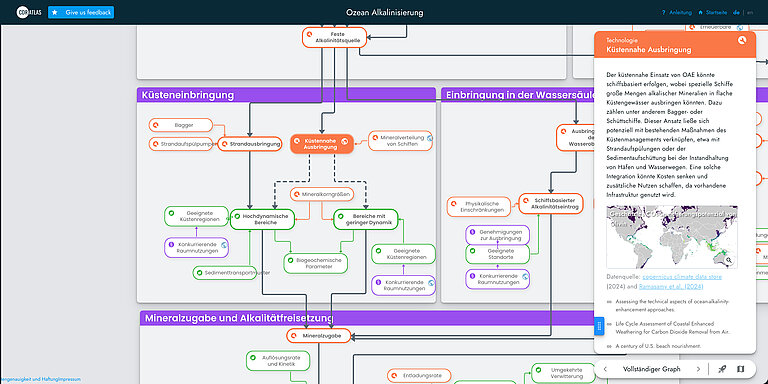
Detailed process chains for various CDR methods are at the heart of the platform. These illustrate the necessary steps, from planning and implementation to monitoring CO2 storage.
Screenshot: CDRatlas