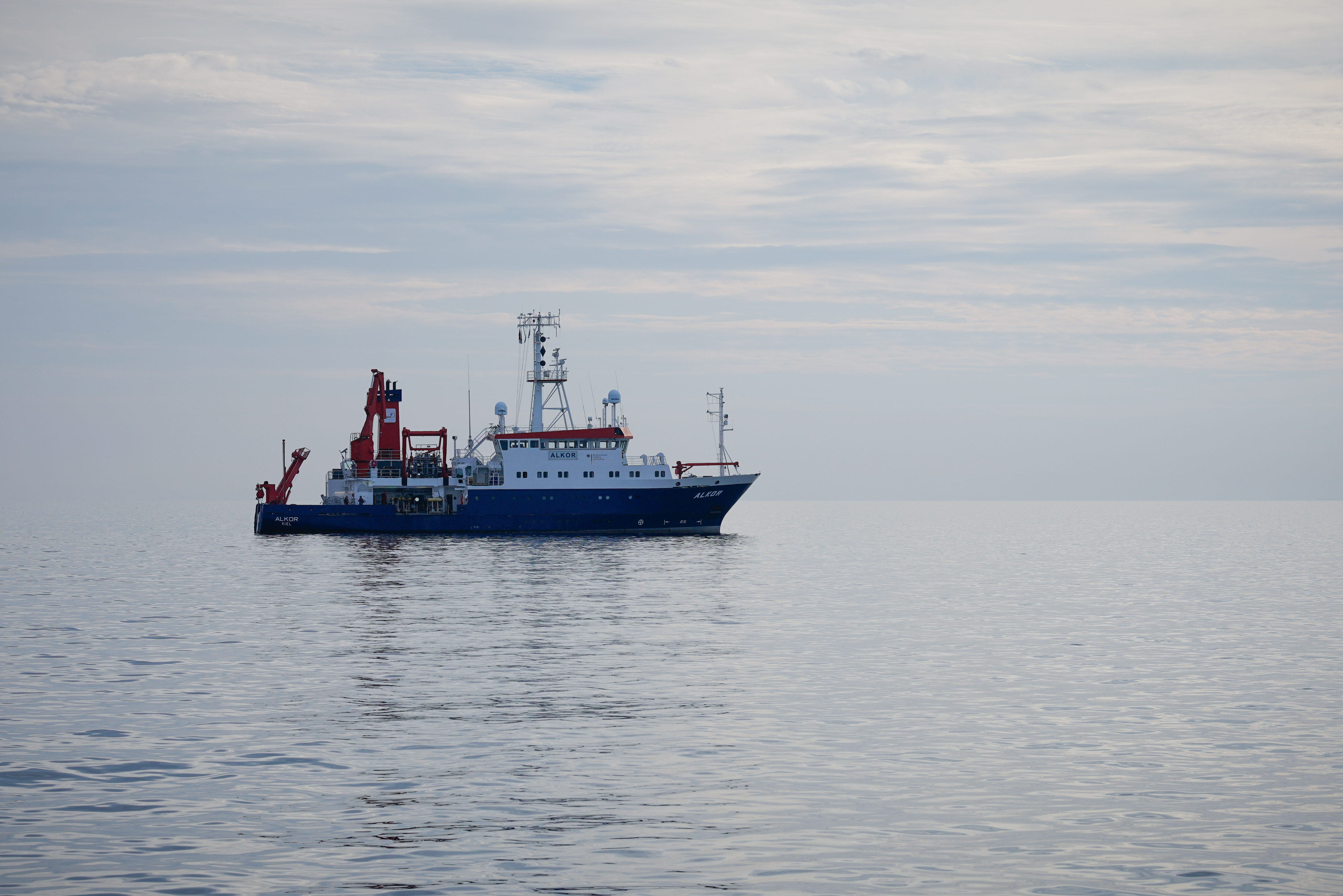
Today, expedition AL642 sets sail for the southern Baltic Sea with the research vessel ALKOR.
Photo: Julia Gehringer, GEOMAR
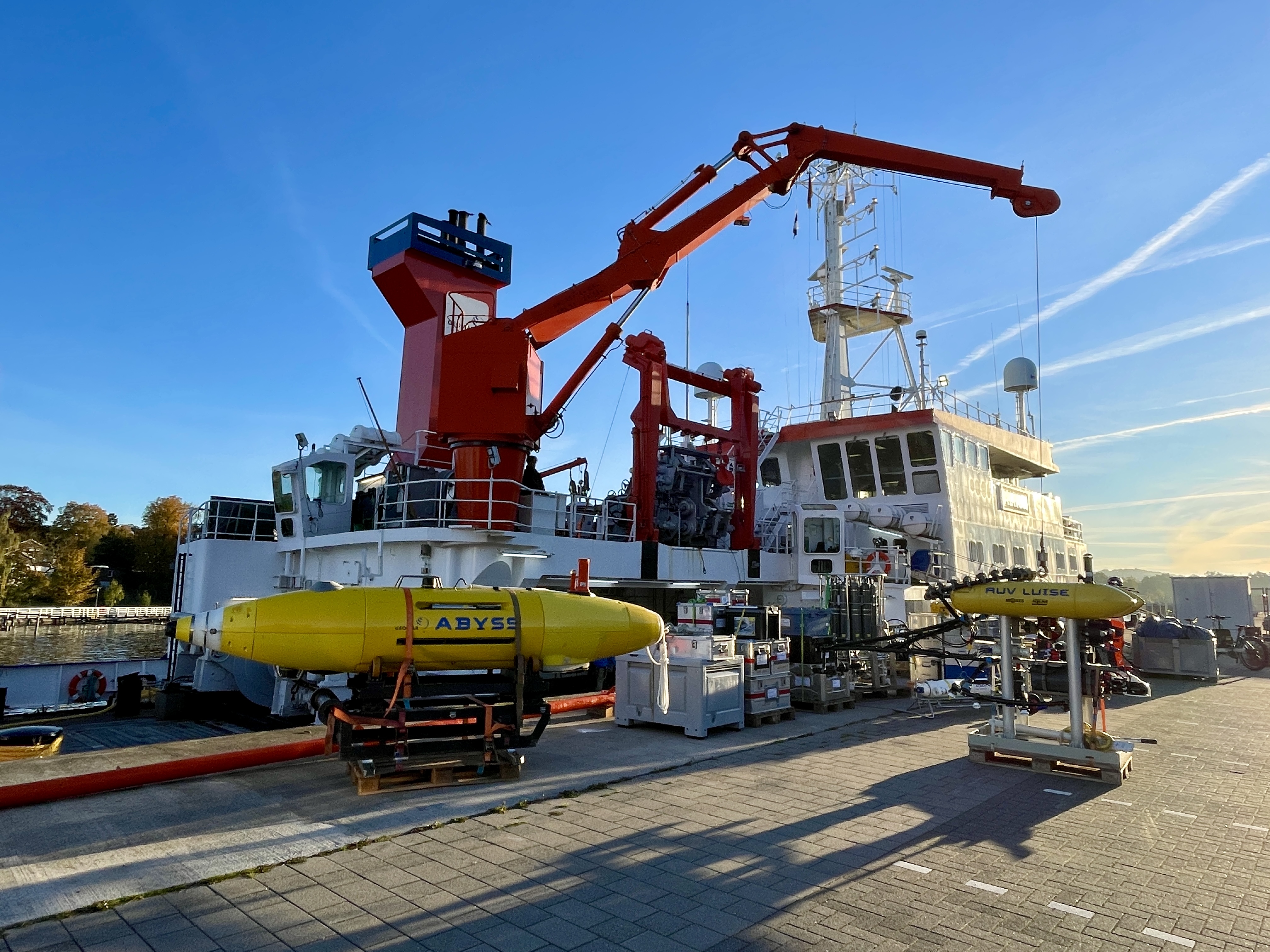
The research vessel ALKOR at the pier at the fish market in Kiel on the day before the research trip. Before an expedition, all research equipment must be loaded onto the ship. The autonomous underwater vehicles AUV Abyss and AUV Luise are waiting to be packed.
Photo: Sarah Uphoff, GEOMAR.
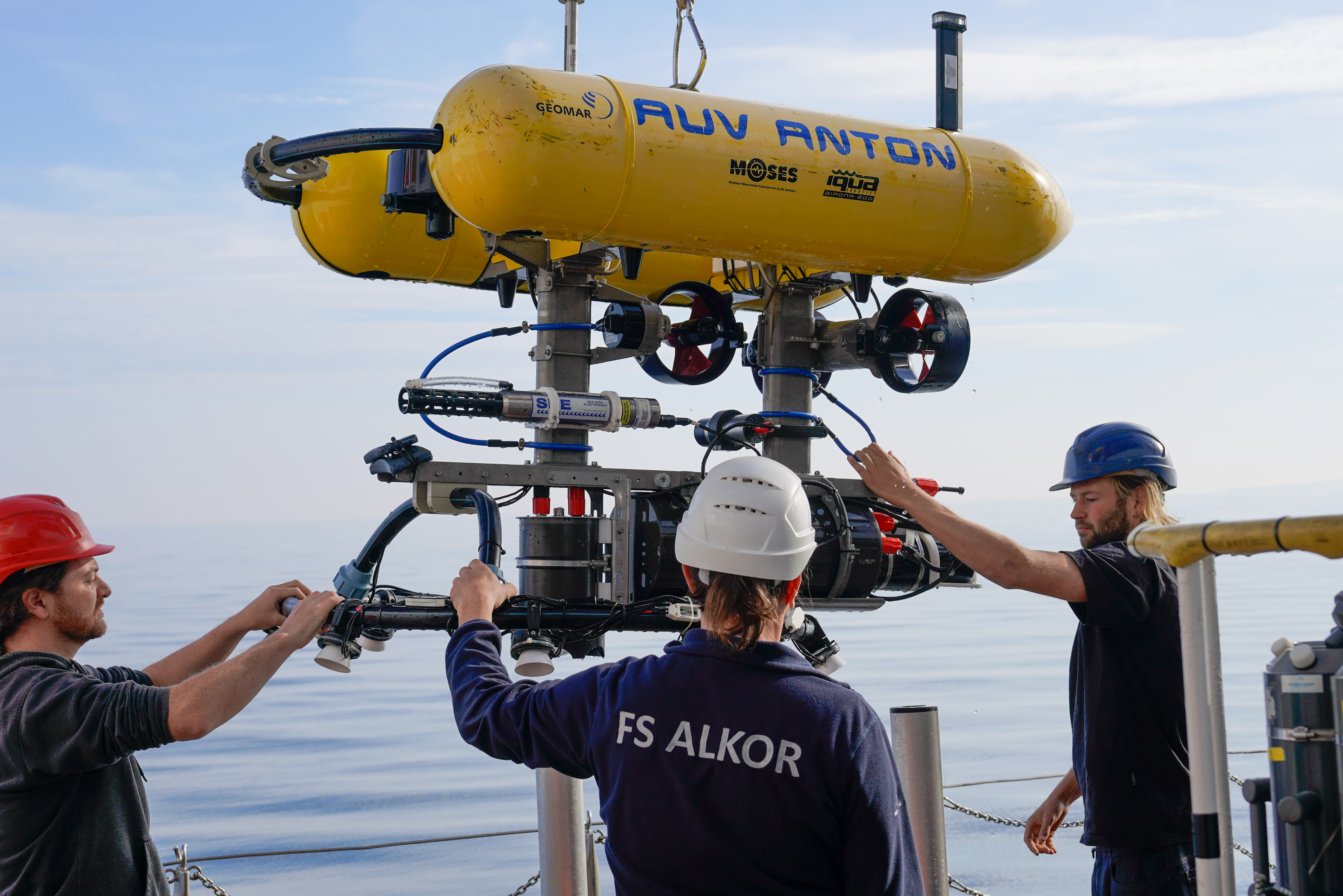
AUV Luise returns to the deck after a mission. The autonomous underwater vehicle has taken high-resolution images of the seabed. The photo was taken during the AL622 expedition in the Bay of Lübeck.
Photo: Julia Gehringer, GEOMAR
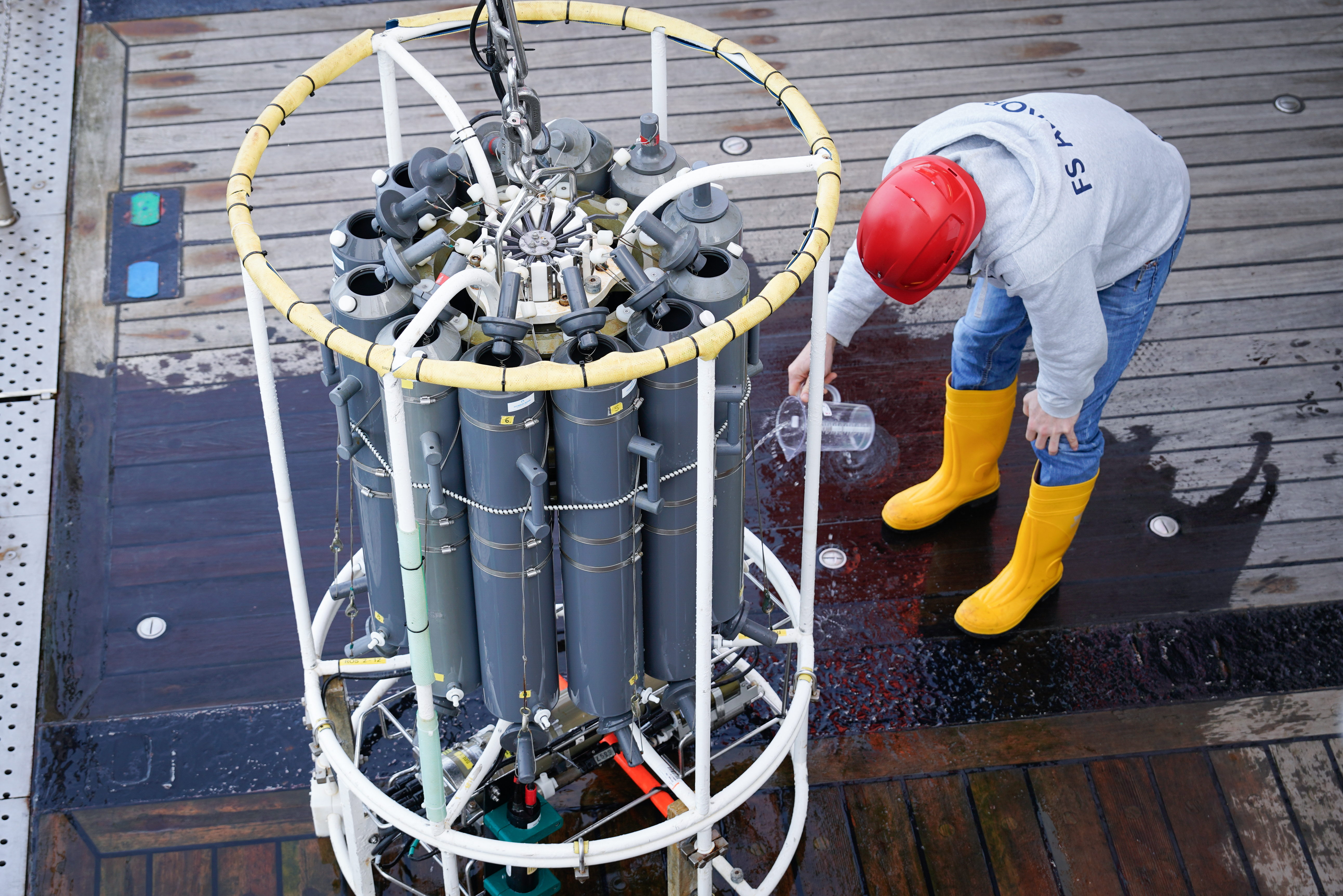
A CTD rosette is deployed for measurements and water sampling. CTD stands for conductivity, temperature and depth.
Photo: Julia Gehringer, GEOMAR
Chemical Munitions and Clearance Effects in Focus
ALKOR Research Cruise Investigates Legacy Munitions in the Baltic Sea
Hundreds of thousands of tons of conventional and chemical munitions have lain on the seabed of the Baltic Sea since the World Wars. The metal casings corrode after decades in saltwater, releasing toxic substances in the process. To better assess the burden of unexploded ordnance on the Baltic Sea, GEOMAR Helmholtz Centre for Ocean Research Kiel is undertaking three additional research cruises in 2025 and 2026. Today, the second expedition departs from Kiel with the research vessel ALKOR.
Advancing Underwater Technology
During the 14-day expedition, researchers aim to investigate in three operational areas – Poland and the Bornholm Basin, the Bay of Lübeck, and the Little Belt – what ecological consequences old munitions stocks have, how new technologies perform in the field, and what effects the first trial clearances show on the environment.
Autonomous and remotely operated underwater robots will be used, which can acoustically map the seabed, provide high-resolution images and videos, and take water samples. Onboard, these samples can be analyzed for explosive residues such as TNT or RDX using a specially developed mobile analysis device. A focus of the cruise is the further development of the underwater vehicles. In the future, these are intended to independently detect and classify objects and adjust their mapping strategies in real time.
Focus on Chemical Munitions in Polish and Danish Waters
In the first week, sampling in Polish waters and the Bornholm Basin is planned. Chemical weapons were dumped there after the war – how much remains on the seabed and in what condition the agents are is little studied. “We want to improve the data basis for these areas and find out how heavily the marine environment is actually affected,” says expedition leader Prof. Dr. Jens Greinert, marine geologist and head of the Deep Sea Monitoring working group at GEOMAR.
Evaluating the Effects of Pilot Recoveries
In the second week, the expedition focuses on the Bay of Lübeck, particularly the area in front of Boltenhagen. Here, during the summer, dumped munitions were cleared with the help of divers as part of the German emergency program. “We want to see how it looks down there now,” says Greinert.
As part of the CAMMera project, researchers are also preparing exemplary investigations of large rocket warheads, which are to be specifically recovered under the new CAMMera project. “This could effectively reduce environmental contamination because the concentration of pollutants in the surrounding area rapidly decreases. We want to prepare scientifically for a clearance planned for 2027,” Greinert adds.
At the end of the cruise, the expedition will head to Danish waters in the Little Belt, where larger amounts of chemical munitions also lie, which have so far been scarcely studied systematically.
Understanding Risks, Preparing Solutions
The expeditions support several major research projects, including CONMAR, MuniRisk, and MMinE-SwEEPER. Partner institutes from Germany and Poland are involved. The results feed into national and European strategies for dealing with legacy munitions.
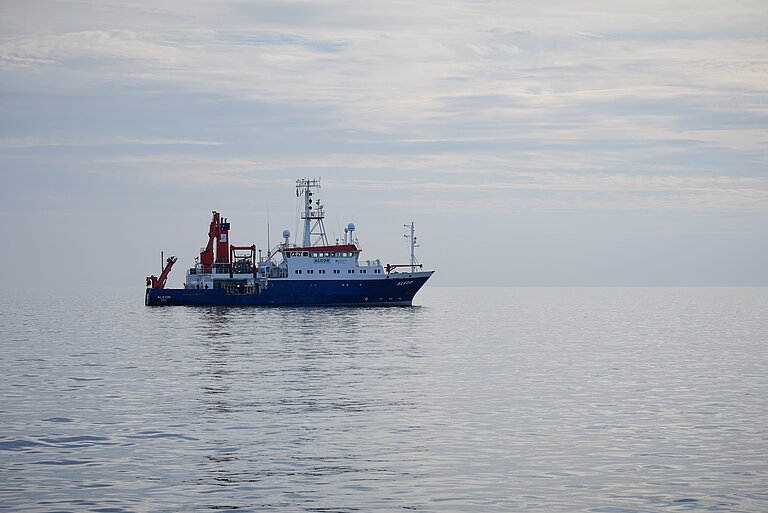
Today, expedition AL642 sets sail for the southern Baltic Sea with the research vessel ALKOR.
Photo: Julia Gehringer, GEOMAR
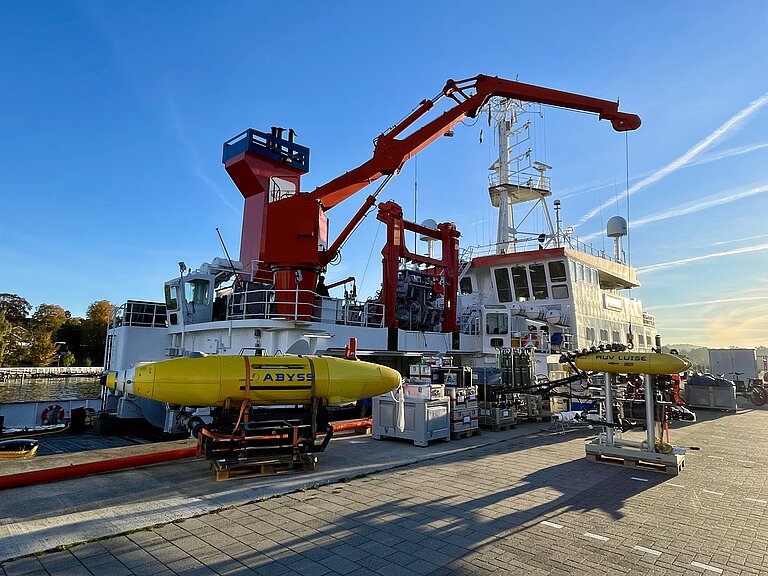
The research vessel ALKOR at the pier at the fish market in Kiel on the day before the research trip. Before an expedition, all research equipment must be loaded onto the ship. The autonomous underwater vehicles AUV Abyss and AUV Luise are waiting to be packed.
Photo: Sarah Uphoff, GEOMAR.
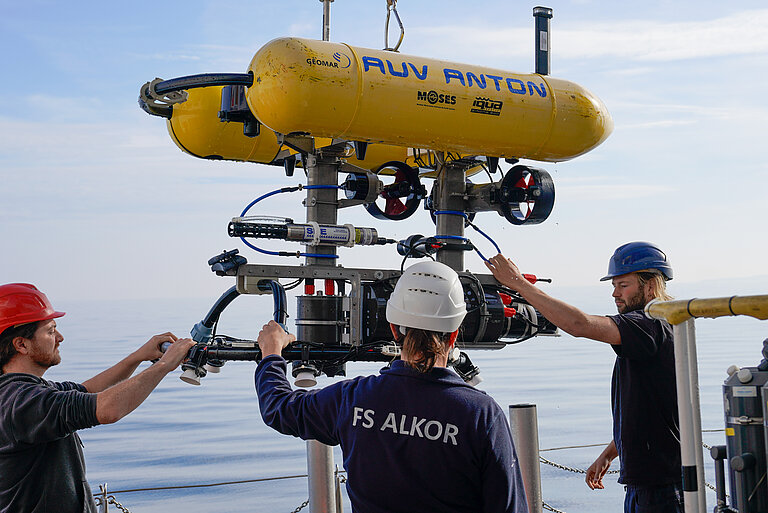
AUV Luise returns to the deck after a mission. The autonomous underwater vehicle has taken high-resolution images of the seabed. The photo was taken during the AL622 expedition in the Bay of Lübeck.
Photo: Julia Gehringer, GEOMAR
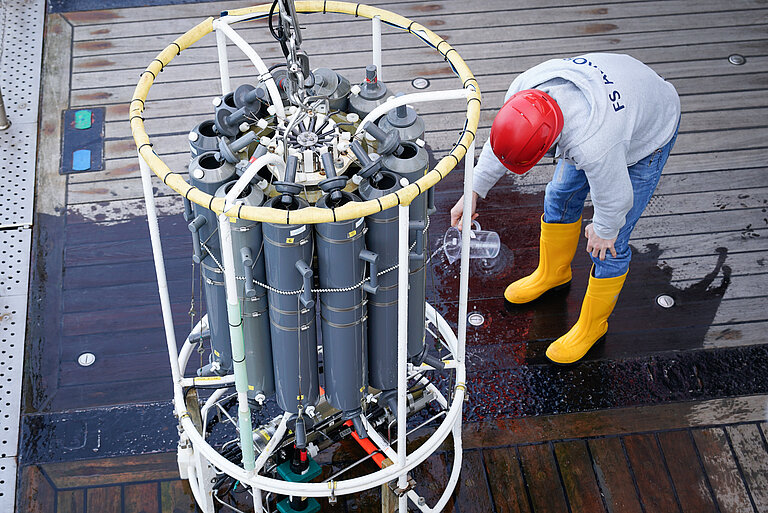
A CTD rosette is deployed for measurements and water sampling. CTD stands for conductivity, temperature and depth.
Photo: Julia Gehringer, GEOMAR