
Seagrass meadows are among the most important marine habitats. However, their numbers are declining dramatically. This is due to excessive nutrient levels, increased human activity in coastal areas and heat stress caused by rising water temperatures.
Photo: Sarah Uphoff, GEOMAR

In order to counteract the decline in seagrass populations, projects are underway to restore seagrass meadows. At the European level, the EU Nature Restoration Law requires member states to restore damaged ecosystems, including marine habitats.
Photo: Sarah Uphoff, GEOMAR
Europe Unites Behind First Continent-wide Seagrass Restoration Recommendations
Alliance of scientists from 17 countries calls on policymakers to protect and restore one of Europe’s most vital marine ecosystems
Seagrass meadows rank among the most productive ecosystems in the ocean. They filter coastal waters, store carbon, provide habitat and nursery grounds for countless species, and help to reduce wave energy along coastlines. Yet across Europe, these underwater meadows have declined significantly over recent decades. Rising water temperatures, eutrophication, coastal development, and intensive use continue to place growing pressure on these habitats.
To address this trend, the European Seagrass Restoration Alliance (ESRA) has developed the European Seagrass Recommendations 2026 – the first continent-wide scientific consensus on how to protect, monitor, and restore seagrass meadows across Europe. The document, co-created by more than 50 scientists from 17 European countries, sets out eight concrete recommendations to guide policymakers, managers, and funders in reversing decades of seagrass loss.
“We now have the science, the tools, and the momentum to turn the tide,” says Dr Esther Thomsen, marine biologist at GEOMAR Helmholtz Centre for Ocean Research Kiel, who contributed to the recommendations.
Her colleague Dr Maike Paul from the Ludwig Franzius Institute at Leibniz University Hannover adds: “Success requires political will, sustained investment, and governance frameworks that actually enable restoration rather than obstruct it. These recommendations provide a clear, evidence-based roadmap for that action.” The timely publication of the European Seagrass Recommendations will contribute to facilitating the implementation of the EU Nature Restoration Regulation but are also equally applicable to non-member states.
From protection to restoration practice: a roadmap for restoring Europe’s seagrass meadows
The recommendations cover the full restoration continuum – from safeguarding existing meadows and reducing human pressures, to large-scale active planting, long-term monitoring, and the development of sustainable donor material supply chains. They call for stronger alignment between European environmental policy and restoration practice, streamlined permitting, and substantial increases in long-term funding. The document also emphasises the importance of community involvement, ethical standards, and open data sharing.
European cooperation as a key driver
The recommendations were developed following the 2nd European Seagrass Restoration Workshop in April 2025 in France and finalised at a drafting meeting in February 2026 in the Netherlands. They align with the EU Nature Restoration Regulation, the UN Decade on Ecosystem Restoration, and the Kunming-Montreal Global Biodiversity Framework. Prof. Dr. Thorsten Reusch from GEOMAR supported the process as a scientific reviewer.
“The importance of European collaboration on seagrass is clear,” says Thomsen, “alone we can do so little, together we can do so much.“
ESRA fosters collaboration across disciplines and helps bridge the gap between science and policy. The jointly developed recommendations aim to strengthen awareness and support actors in restoring seagrass meadows effectively and responsibly.
Original Publication:
Govers, L., Fauvel, T., Mayot, N., Lilley, S. J., & Lilley, R. (2026). European Seagrass Recommendations 2026 – On the future of seagrass restoration in Europe (Version 2026). Zenodo. https://doi.org/10.5281/zenodo.20055164
About: ESRA
The European Seagrass Restoration Alliance (ESRA) is a collaborative platform bridging research and large-scale restoration practice. ESRA provides a platform for the European seagrass restoration community to collaborate and engage in knowledge exchange.
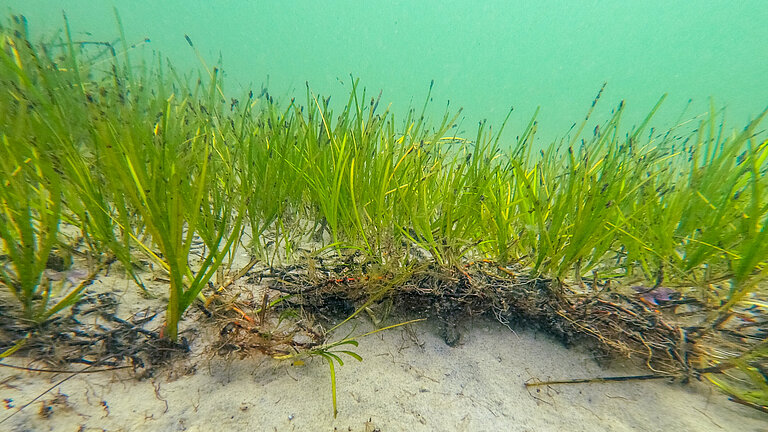
Seagrass meadows are among the most important marine habitats. However, their numbers are declining dramatically. This is due to excessive nutrient levels, increased human activity in coastal areas and heat stress caused by rising water temperatures.
Photo: Sarah Uphoff, GEOMAR
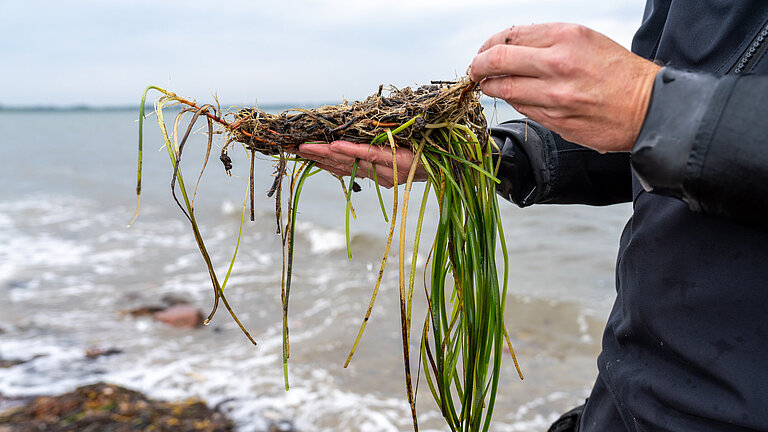
In order to counteract the decline in seagrass populations, projects are underway to restore seagrass meadows. At the European level, the EU Nature Restoration Law requires member states to restore damaged ecosystems, including marine habitats.
Photo: Sarah Uphoff, GEOMAR