
A large-scale operation is set to recover and dispose of munitions in the Baltic Sea off the coast of Schleswig-Holstein. At the MUNIMAR workshop, Professor Dr Jens Greinert gave an opening address in which he presented the knowledge that scientists have gathered in recent years.
Photo: Lauren Peck/GEOMAR
![[Translate to English:] Im Vordergrund ein meereswissenschaftliches Grät, unscharf dahinter ein Konferenzraum, mit Publikum gefüllt](/fileadmin/content/service/presse/Pressemitteilungen/2026/24_MUNIMAR/2026_04_14_Munimar_Conference-9_Lauren_Peck.jpg "[Translate to English:]")
Representatives from the government, industry and research institutions met at GEOMAR to draw up a joint roadmap for the large-scale clearance of munitions from the sea.
Photo: Lauren Peck, GEOMAR
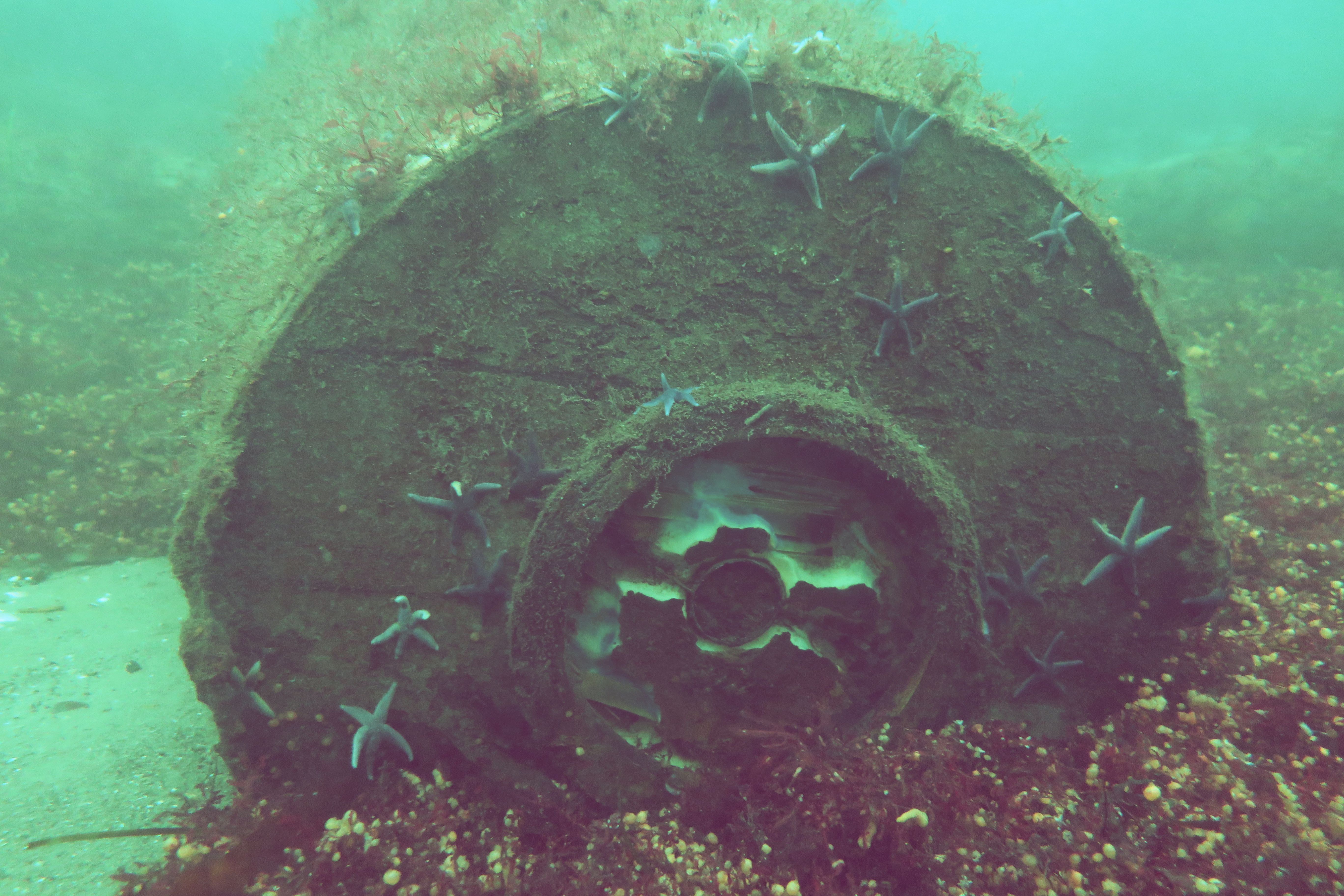
This depth charge, covered in algae and starfish, has been lying on the seabed for 80 years. Research into unexploded ordnance (UXO) began in Schleswig-Holstein ten years ago. Today, the location of different types of munitions in the German Baltic Sea is well known and documented.
Photo: GEOMAR
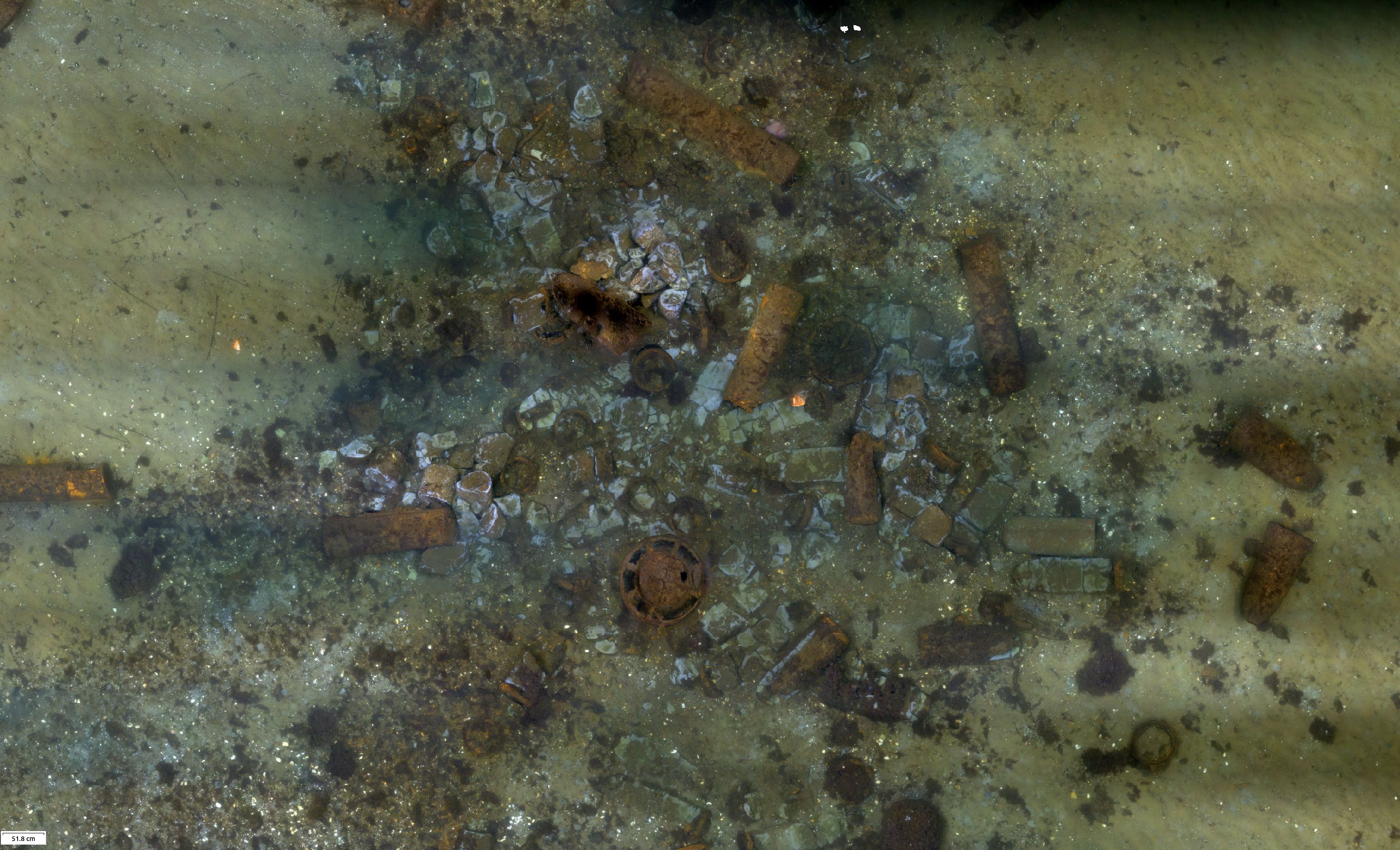
A photo mosaic composed of numerous individual images: the seabed in the Kolberger Heide area (Kiel Bay) showing exposed explosives, an exposed sea mine and mines containing TNT.
Photo: Deep Sea Monitoring Group, GEOMAR

Footage taken by the AUV ANTON in Lübeck Bay: two Fieseler ("V1") warheads can be seen. One is so badly corroded that the explosive material, which is gradually dissolving in the water, is visible.
Photo: DSM/AUV Team/GEOMAR
Roadmap for Munition Recovery
Schleswig-Holstein prepares for large-scale recovery of legacy munitions
As unreal as these images may seem, they are very real: rusting bombs, decaying crates filled with shells, and massive warheads covered in algae and colonised by starfish and fish. This is the reality in many areas off our Baltic coast. After being largely ignored for decades, the issue of legacy munitions in the sea has received growing attention and financial support over the past ten years. Today, the locations of such munitions on or beneath the Baltic Sea seabed off the German coast are reasonably well known and documented, as are the measurable harmful effects. The ministries, research institutions and companies involved fully recognise the scale and complexity of the problem, and there is broad agreement that decisive and comprehensive action is required. This means that Schleswig-Holstein will now plan the large-scale clearance of legacy munitions from the sea.
To develop a concrete roadmap, around 50 stakeholders from industry, science and administration are gathering today at the GEOMAR Helmholtz Centre for Ocean Research Kiel for the MUNIMAR workshop.
Tobias Goldschmidt, Minister for Marine Protection of Schleswig-Holstein:
“Some 1.6 million tonnes of legacy World War munitions lie on the seabed of German waters, and time is pressing. For this reason, Schleswig-Holstein has long been actively advancing the issue of munition recovery. With MUNIMAR, we are continuing this work in a focused manner and within a strong network. One thing is clear: removing these legacy munitions from the North Sea and Baltic Sea is a generational task that can only be achieved through joint efforts. Schleswig-Holstein stands ready to assume a leading role together with the Federal Government.”
Prof. Dr Katja Matthes, Director of the GEOMAR Helmholtz Centre for Ocean Research Kiel:
“The issue of munitions in the sea has developed enormously over the past ten years, both politically and scientifically, and I am very proud of the key role GEOMAR has played in this progress. In 2016, we hardly understood the true scale of the challenge. Today, we not only know the extent of the problem but also what needs to be done. We are now talking about large-scale clearance to address risks to the environment and the public. This is far more than a regional project in the German Baltic Sea. The recovery of legacy munitions remains an unresolved global challenge, and the expertise we are building here in northern Germany is therefore of potential international significance.”
Dr Sabine Schulz, Lead for the Maritime Economy at the Chamber of Commerce and Industry (IHK) Schleswig-Holstein:
“MUNIMAR demonstrates the potential that emerges when industry, science and public administration collaborate at an early stage. For companies based in the region, this opens up a new and highly innovative field of activity with international reach. The key now is to ensure that this approach does not remain limited to Schleswig-Holstein. Federal policymakers are called upon to build on the experience gained here and to establish reliable framework conditions for large-scale clearance of legacy munitions.”
Turning point in 2024: From knowledge to concrete action
In 2024, legacy munitions were recovered from a designated dumping site in the Bay of Lübeck. After years of research and preparation, these pilot recoveries marked a turning point. They were made possible through the Federal Government’s Immediate Action Programme, for which the Federal Ministry for the Environment provided funding of €100 million.
The technology deployed proved fundamentally effective, while also revealing areas requiring further development. The operations provided valuable insights into the condition of the munitions and the characteristics of the seabed. Both aspects are crucial for ensuring that future recoveries can be conducted safely and with minimal environmental impact.
Pioneering work without a blueprint
At the same time, it became clear that the challenge extends far beyond technical issues. “It is not surprising that unresolved questions emerged during the pilot recovery,” says Professor Dr Jens Greinert, marine geologist at GEOMAR and head of the DeepSea Monitoring research group. “After all, we are the first to attempt the recovery of 80-year-old legacy munitions from dumping sites in the sea. There is no blueprint for this.”
To create the best possible framework for this task, MUNIMAR was established in October 2024. The Schleswig-Holstein competence centre for the management of munition in the marine environment—supported by the Ministry for Energy Transition, Climate Protection, Environment and Nature of the State of Schleswig-Holstein (MEKUN), GEOMAR, and the Chamber of Commerce and Industry Schleswig-Holstein (IHK)—brings together all relevant stakeholders from administration, science and industry. While the administrative sector establishes the legal and organisational framework, the scientific community provides data and supports the operations through research, development and monitoring. Industry develops the technology and implements the recovery. MUNIMAR ensures that these three sectors work together as effectively as possible.
MUNIMAR: Three pillars, one goal
“We are now examining what worked well and where further coordination is needed,” says Greinert. In particular, cooperation between companies and authorities must be improved. Recovery operations had to be temporarily halted, and the recovered munitions could not be brought ashore as planned. A large proportion of the cleared munitions is therefore currently stored in so-called wet storage facilities on the seabed. Their contents are intended to be destroyed on a disposal platform, the legal framework for which still needs to be clarified.
Other aspects have already proven successful. Greinert explains: “Through years of mapping, we researchers have provided a very solid foundation. The companies involved therefore knew quite precisely where the munitions were located and were able to incorporate this information into their planning and bids. During the recovery operations, we carry out environmental monitoring to closely assess the impact on the marine environment through the removal activities itself.”
Close coordination between science and public administration has also proven effective. Based on scientific data, specific areas suitable for pilot recoveries were identified. This prioritisation process will now continue, as it is clear that without reliable planning and well-defined procedures, there will be no investment in the infrastructure required for large-scale operations.
Autonomous recovery platform: The next step towards large-scale clearance
The necessary infrastructure still needs to be developed. In the future, an autonomous recovery platform is expected to enable the disposal of munitions directly at sea. The development and construction of this platform were also tendered in parallel with the pilot recoveries, using funds from the Federal Government’s Immediate Action Programme. The successful bidder is expected to be announced in the coming weeks. If such a facility is to become operational by 2028, the framework conditions must be established now. This is precisely why stakeholders are meeting in Kiel today. In working groups, they exchange experiences, identify challenges and develop solutions. As Jens Greinert summarises: “Now the real work begins.”
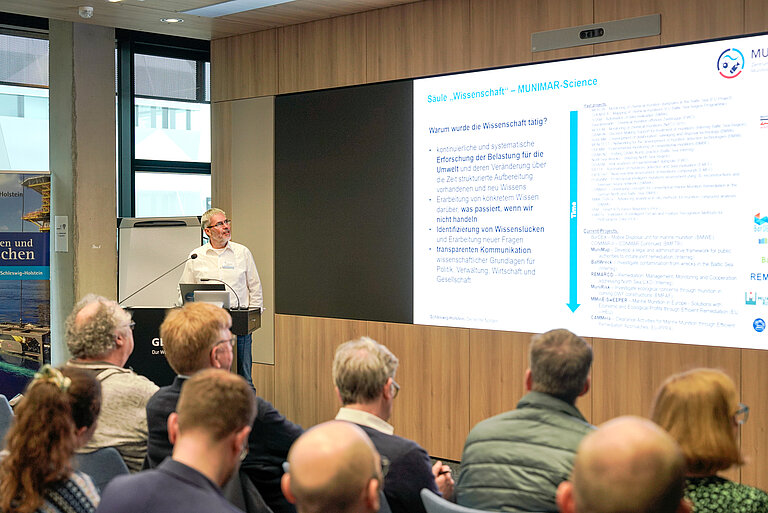
A large-scale operation is set to recover and dispose of munitions in the Baltic Sea off the coast of Schleswig-Holstein. At the MUNIMAR workshop, Professor Dr Jens Greinert gave an opening address in which he presented the knowledge that scientists have gathered in recent years.
Photo: Lauren Peck/GEOMAR
![[Translate to English:] Im Vordergrund ein meereswissenschaftliches Grät, unscharf dahinter ein Konferenzraum, mit Publikum gefüllt](/fileadmin/_processed_/7/2/csm_2026_04_14_Munimar_Conference-9_Lauren_Peck_925dba6d50.jpg "[Translate to English:]")
Representatives from the government, industry and research institutions met at GEOMAR to draw up a joint roadmap for the large-scale clearance of munitions from the sea.
Photo: Lauren Peck, GEOMAR
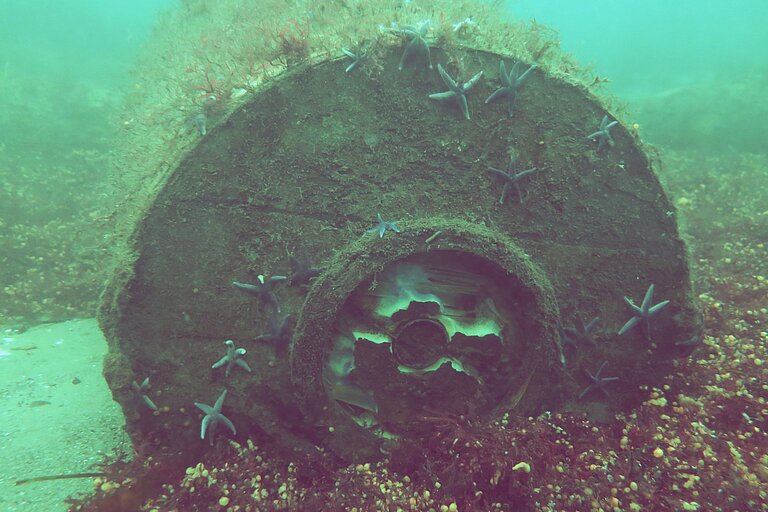
This depth charge, covered in algae and starfish, has been lying on the seabed for 80 years. Research into unexploded ordnance (UXO) began in Schleswig-Holstein ten years ago. Today, the location of different types of munitions in the German Baltic Sea is well known and documented.
Photo: GEOMAR
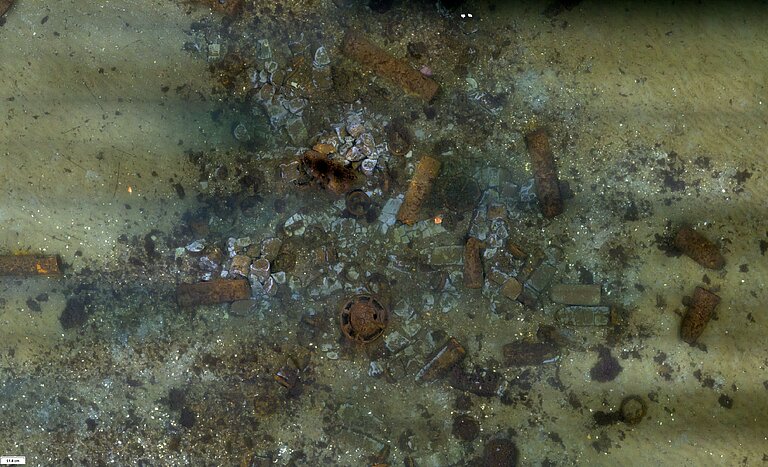
A photo mosaic composed of numerous individual images: the seabed in the Kolberger Heide area (Kiel Bay) showing exposed explosives, an exposed sea mine and mines containing TNT.
Photo: Deep Sea Monitoring Group, GEOMAR
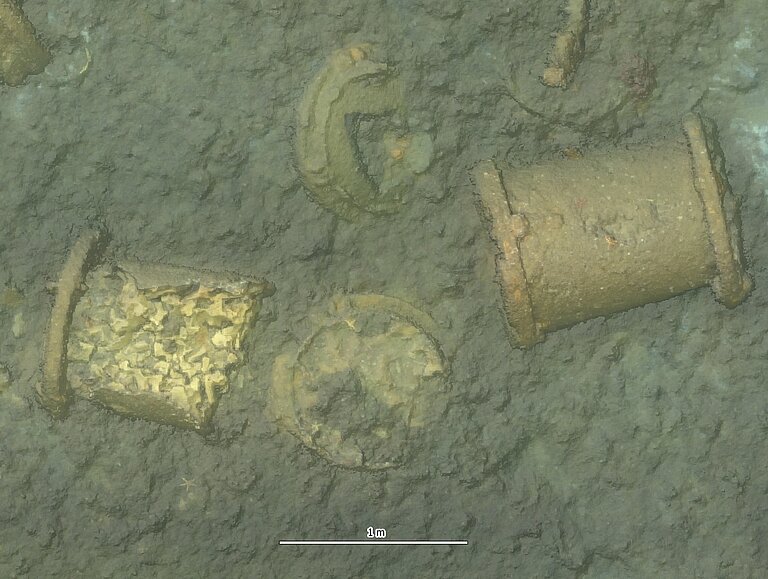
Footage taken by the AUV ANTON in Lübeck Bay: two Fieseler ("V1") warheads can be seen. One is so badly corroded that the explosive material, which is gradually dissolving in the water, is visible.
Photo: DSM/AUV Team/GEOMAR