

The microcosms have been filled: under the supervision of Dr Leila Kittu from GEOMAR, Kenyan researchers have carried out the first experiment on increasing alkalinity in tropical waters.
Foto: Technical University of Mombasa

An alkaline substance is added to the microcosms. The increase in alkalinity mimics the natural weathering of rock. Under controlled conditions, the seawater samples were used to investigate how plankton communities react to the changing chemical conditions.
Photo: Leila Kittu, GEOMAR

Researchers from GEOMAR, Technical University of Mombasa and the Kenya Marine and Fisheries Research Institute are preparing the mesocosms for filling with surface water.
Photo: Technical University of Mombasa
Climate research in Kenya
GEOMAR contributes to the first African experiment in a global inter-comparison study on ocean alkalinity enhancement
A first for Africa
The experiment, conducted in February 2026, was hosted at the Kenya Marine and Fisheries Research Institute (KMFRI) in Mombasa, Kenya’s second-largest city and East-Africa’s principal port, on the western Indian Ocean. In addition to GEOMAR and KMFRI, the Kenyan study involves the Technical University of Mombasa (TUM) and the Ocean Climate Innovation Hub Kenya.
The OAEPIIP study investigates how marine organisms – particularly plankton, respond to altered alkalinity levels.
“We carried out this OAE research in Kenya and on the African continent for the first time,” says Dr Leila Kittu, a marine biogeochemist at GEOMAR Helmholtz Centre for Ocean Research Kiel. Virtually all existing OAE research has been conducted in temperate Northern Hemisphere waters. This Kenyan experiment fills a significant gap, generating the first data from a tropical ocean environment and from Africa, says Kittu, who also conducted the same experiment in the Baltic Sea a year ago alongside her colleague Dr Giulia Faucher, and brings this experience to the Kenyan collaboration. “Seventeen countries are currently involved in the global inter-comparison project, covering all continents,” Kittu explains. “That breadth matters: our findings won't just tell us about one ecosystem, but about how different ocean ecosystems globally may respond to this technology.”
Standardisation for global comparability
“We use this experimental approach to better understand how living communities respond when seawater chemistry changes due to alkalinity addition,” says Kittu. “Only then can we assess whether OAE could become a safe and effective component of climate mitigation.”
In the KMFRI laboratory, 60-litre tanks, known as microcosms, were filled with surface seawater and set up under standardised and controlled laboratory conditions. After the addition of alkaline minerals, the seawater was sampled at regular intervals over 14 days to monitor how plankton communities respond to the altered chemistry. The OAEPIIP experiments are designed to follow a shared protocol, allowing direct comparison with results from other sites, from temperate regions to tropical waters. The data collected will feed into a global meta-analysis, providing a comprehensive picture of ecological responses to OAE and helping to determine whether and how this technology can be deployed responsibly.
About: Ocean Alkalinity Enhancement
Ocean Alkalinity Enhancement (OAE) mimics the natural weathering of rocks, which over geological timescales increases the alkalinity of the ocean. However, human-driven CO₂ emissions occur roughly one hundred times faster than this natural process. OAE therefore accelerates this mechanism by directly adding alkaline minerals to seawater. This addition increases the pH value and the concentration of carbonate ions, enabling the water to chemically bind more CO₂. At the same time, the rise in pH can locally buffer the effects of ocean acidification.
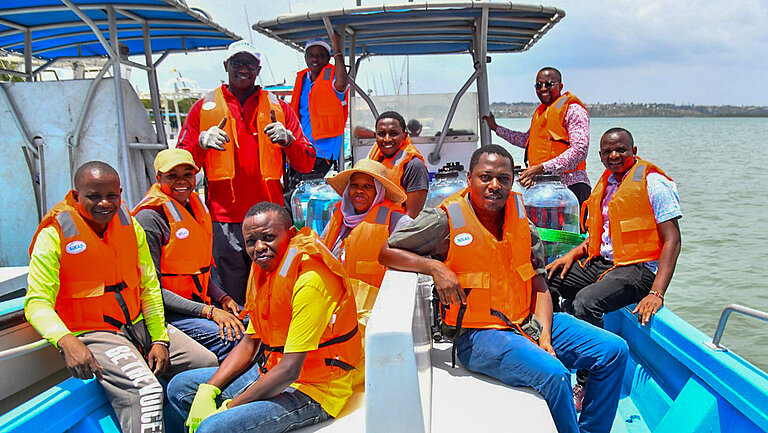
The microcosms have been filled: under the supervision of Dr Leila Kittu from GEOMAR, Kenyan researchers have carried out the first experiment on increasing alkalinity in tropical waters.
Foto: Technical University of Mombasa
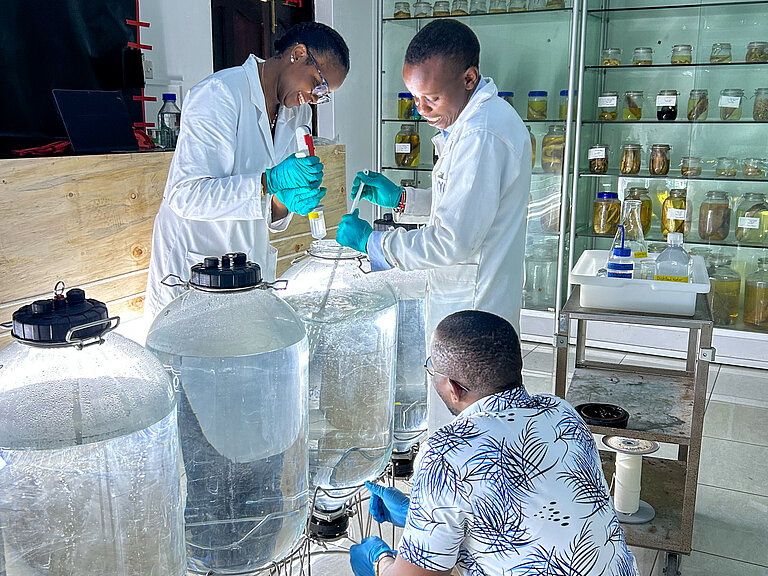
An alkaline substance is added to the microcosms. The increase in alkalinity mimics the natural weathering of rock. Under controlled conditions, the seawater samples were used to investigate how plankton communities react to the changing chemical conditions.
Photo: Leila Kittu, GEOMAR
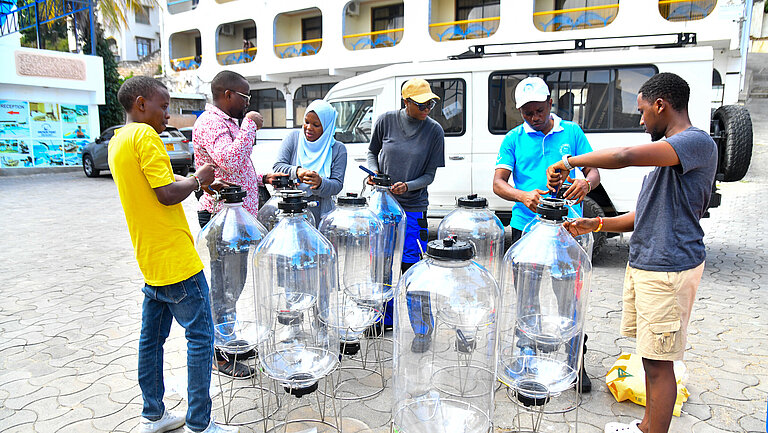
Researchers from GEOMAR, Technical University of Mombasa and the Kenya Marine and Fisheries Research Institute are preparing the mesocosms for filling with surface water.
Photo: Technical University of Mombasa