
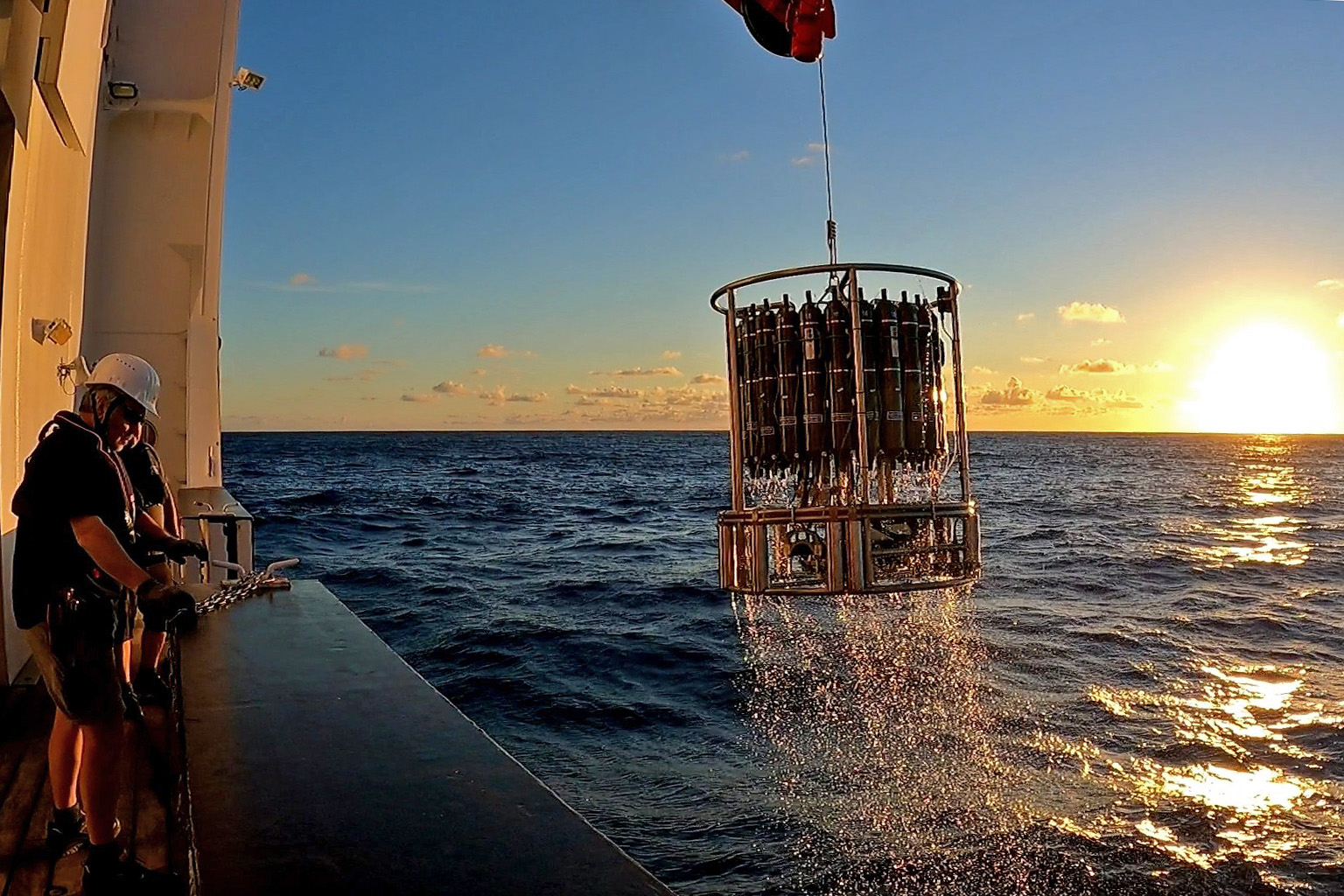
A rosette water sampler with water samples is brought back on board the German research vessel SONNE on expedition SO289 in the South Pacific.
Photo: Lea Blum / GEOMAR
Novel Approach unpicks Iron Chemistry in the South Pacific Ocean
Organic matter diversity determines how much iron is available for marine life
Iron is an essential nutrient for many marine organisms and plays a key role in regulating biological productivity in the ocean, from phytoplankton at the base of the food web onwards. In oxygen-rich seawater, iron spontaneously transforms into rust-like solid minerals, reducing its availability to marine life. This process is counterbalanced by reactions with organic matter—a highly complex mixture of molecules produced as a result of marine biological activity.
“We found that the diversity of organic matter is crucial for predicting both iron binding and competition with iron mineral formation,” says Dr Martha Gledhill, marine chemist at GEOMAR and lead author of the study.
Why previous models fall short
So far, reactions between iron and organic matter have typically been represented in highly simplified ways, assuming uniform chemical properties for all organic molecules. This approach ignores the fact that organic matter consists of a wide spectrum of compounds that bind dissolved iron with very different strengths, thereby competing more or less effectively with mineral formation.
In addition, previous representations have largely neglected the influence of key environmental conditions such as seawater acidity and temperature, even though both are known to strongly affect chemical reaction pathways in the ocean.
The research team therefore investigated how molecular diversity in organic matter controls iron binding and the formation of rust-like iron minerals under realistic ocean conditions.
A new model tested with GEOTRACES observations
To address this, the team developed a chemical model that represents organic matter as a diverse mixture of molecules with a spectrum of iron-binding strengths. The model explicitly accounts for in-situ seawater temperature and acidity, enabling more realistic predictions of iron chemistry.
The approach was applied to data from a 2022 expedition on the German Research Ship RV SONNE (SO289) conducted as part of the international GEOTRACES programme, which crossed the Pacific Ocean along 30°S.
Results: predicting dissolved and particulate iron
The results show that the chemical diversity of organic matter is essential for accurately predicting how iron is partitioned between its dissolved (soluble) and particulate forms across large parts of the South Pacific.
The model further reveals that iron mineral formation is particularly intense near natural iron sources, including hydrothermal vents and an underwater volcano.
By explicitly accounting for organic matter diversity, the team was able to reproduce observed patterns of iron distribution and mineral formation that had previously been difficult to explain using simplified chemical assumptions.
Implications for climate and ocean models
These findings improve our understanding of the marine iron cycle and provide an important step towards more comprehensive biogeochemical models of iron and other trace metals in the ocean.
Because iron availability influences phytoplankton growth and thus the ocean’s uptake of carbon dioxide, the results are also relevant for projections of future climate change.
“These findings demonstrate that how we represent the chemical properties of the complex and diverse pool of organic matter in the ocean is critical for understanding its role in regulating the marine iron cycle,” emphasises Dr Gledhill.
“We do not yet have a fully comprehensive chemical model for iron and other metals in the ocean. Our work provides a pathway towards such models. However, we need a better understanding of the variability in iron-binding properties of marine organic matter before we can fully predict iron chemistry and its broader implications for other metals in the ocean.”
Original publication:
Gledhill, M., Gosnell, K., Humphreys, M. P., Delaigue, L., Helle, N., Zhu, K., Lodeiro, P., Rey-Castro, C., & Achterberg, E. P. (2026). Chemical controls on iron distributions across the subsurface South Pacific Ocean. Nature Communications, 17, 3533.
https://doi.org/10.1038/s41467-026-72070-y
Funding:
German Federal Ministry of Research, Technology and Space (BMFTR) and GEOMAR Helmholtz Centre for Ocean Research Kiel.
A rosette water sampler with water samples is brought back on board the German research vessel SONNE on expedition SO289 in the South Pacific.
Photo: Lea Blum / GEOMAR