
Cordula Zenk
Cape Verde Coordinator at GEOMAR
Tel: +49 431 600-4209
E-mail: czenk@geomar.de
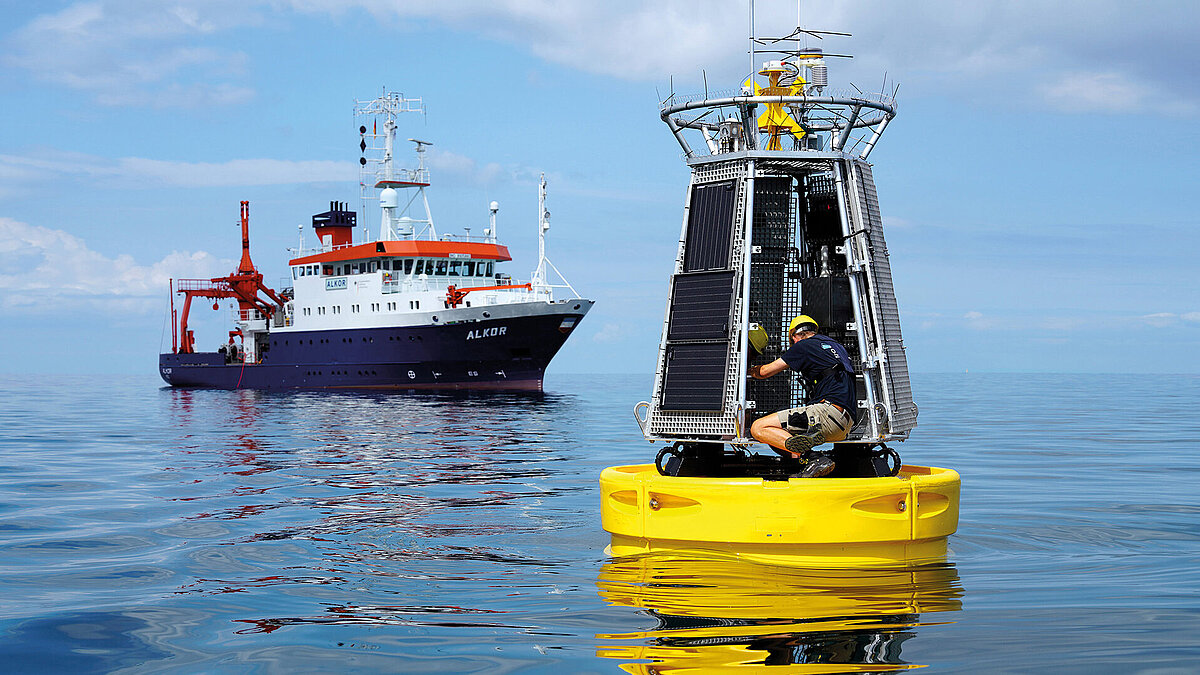
CVOO Buoy in the Kiel Fjord, Photo Louisa Trippe / GEOMAR
CVOO Buoy
This innovative surface buoy was developed at GEOMAR as part of the Helmholtz infrastructure MUSE. It is intended to help understand how rising carbon dioxide (CO2) levels in the atmosphere and the resulting climate change are affecting the tropical Atlantic. In 2026, the buoy will become part of the Cape Verde Ocean Observatory (CVOO), a long-term series station near the island nation of Cabo Verde, operated by GEOMAR.
Specifications
- Dimensions (approx.): diameter 3 meters,height 7.5 meters, weight 3.5 tons
- Measuring instruments for CO2, oxygen, meteorological data (DWD), salinity, temperature, waves
- Real-time data via satellite connection
- Safety: AIS, radar reflector, signal lantern
- 18 solar panels for autonomous power supply
About the measurement data from the atmosphere (air)
Air temperature (Tₐᵢᵣ): Shows how warm or cold the air is. Important to understand how many gases (e.g. CO₂) are dissolved in it.
Relative humidity (Rh): Indicates how much water vapor is currently in the air - compared to what would be the maximum possible. The warmer the air, the more moisture it can absorb.
Air pressure (pₐₜₘ): The pressure that the air exerts on the earth due to its weight. It depends on how high up you are and the weather conditions.
CO₂ content in the air (xCO₂ₐₜₘ): Shows how much carbon dioxide is in the air - measured in “ppm” (particles per million).
About the measurement data from the ocean (seawater)
Water temperature (Tₕ₂ₒ): Shows how warm the sea is. This influences how dense the water is and how many gases (e.g. CO₂) can be dissolved in it.
Conductivity (Cₕ₂ₒ): Measures how well seawater conducts electricity – depending on its salinity. This can also be used to calculate the density of the water in order to determine different water masses.
Oxygen content (O₂ₕ₂ₒ): Shows how much oxygen is in the water. This is important for animals, plants and chemical processes in the sea.
CO₂ content in water (xCO₂ₕ₂ₒ): Indicates how much carbon dioxide is in seawater. By comparing this with measurements in the air, it is possible to determine whether the sea is currently absorbing or releasing CO₂.

-
The Ocean Science Centre Mindelo:
www.oscm.cvOSCM on Twitter
https://twitter.com/oscm_OSCM on Facebook
https://de-de.facebook.com/OSCMindeloCape Verde at Oceanblogs
www.oceanblogs.org/capeverde