
Looking towards the future: Federal Research Minister Dorothee Bär (left) on the bridge of the research vessel ALKOR with Captain Marc Petrikowski (centre) and GEOMAR Director Prof Dr Katja Matthes (right).
Photo: Pat Scheidemann, GEOMAR

After being welcomed by Prof. Dr Katja Matthes, Director of GEOMAR, and Frank Spiekermann, the centre's Administrative Director, Minister Dorothee Bär (right) learned about current research projects on a tour with Dirk Schrödter (left), the Minister for Digital Affairs and Head of the State Chancellery in Schleswig-Holstein.
Photo: Pat Scheidemann, GEOMAR
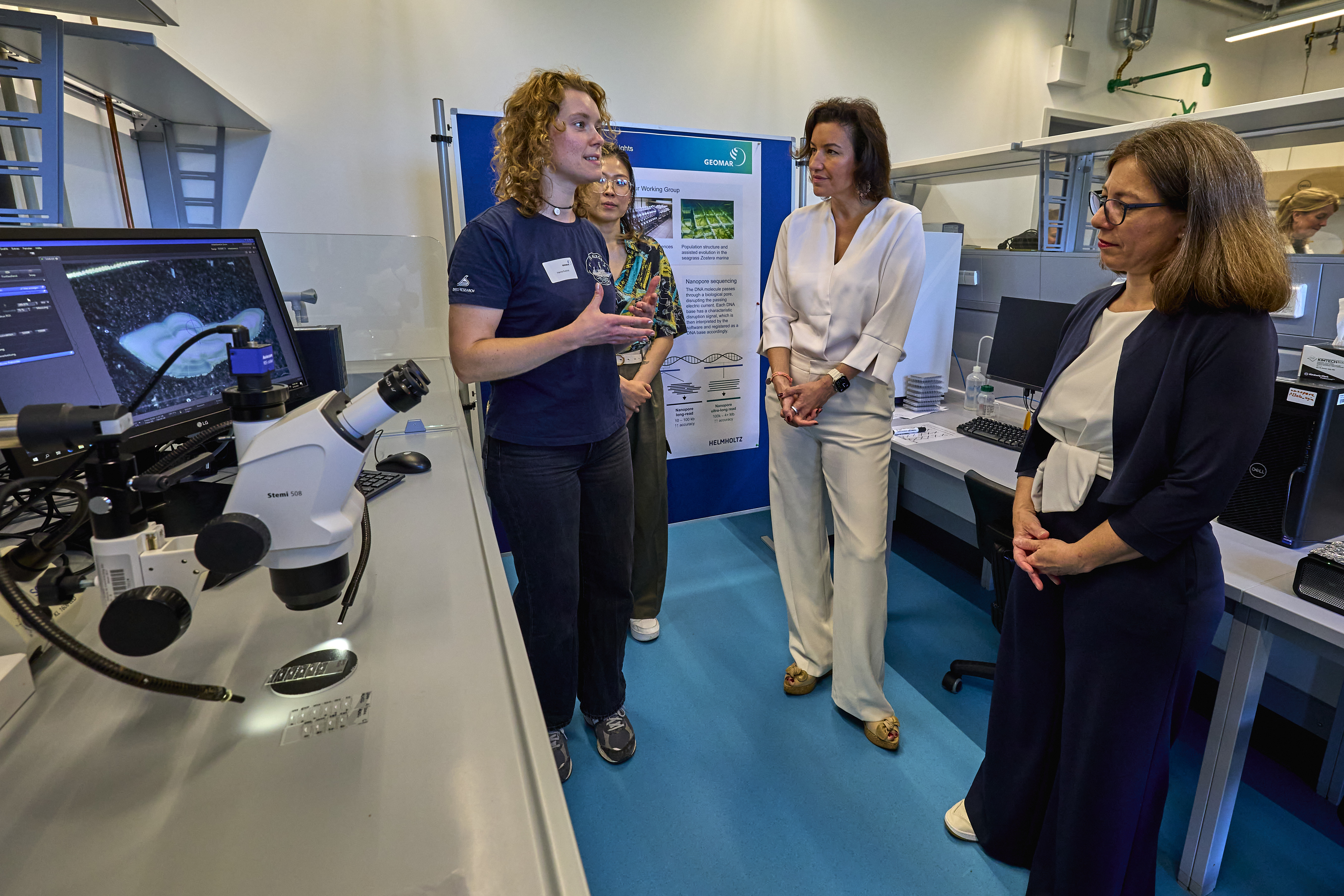
In the molecular genetics laboratory, master's students Hanna Rudnick (left) and Erika Endo Kokubun talked about the evolutionary consequences of overfishing, using cod as an example.
Photo: Pat Scheidemann, GEOMAR

The ROV KIEL 6000 is a diving robot designed for scientific missions in the deep sea. In the assembly hall of Seagoing Technologies, the minister learned about the specific technical requirements of marine research.
Photo: Pat Scheidemann, GEOMAR

MOLAs are compact landers that can be fitted with different types of measurement technology. Developed at GEOMAR, they are used to monitor earthquakes and develop intelligent early warning systems for tsunamis. From left to right: Digital Minister Dirk Schrödter; GEOMAR Director, Prof. Dr. Katja Matthes; Federal Research Minister, Dorothee Bär; State Secretary, Guido Wendt; and geophysicist, Dr. Jens Karstens.
Photo: Pat Scheidemann, GEOMAR

In addition to scientific topics, Federal Research Minister Dorothee Bär's visit to GEOMAR also focused on the construction of the new German research vessel METEOR IV. From 2026, the vessel will be based in Kiel and operated by GEOMAR as part of the German research fleet.
Photo: Pat Scheidemann, GEOMAR
Federal Research Minister Dorothee Bär visits GEOMAR
Key research areas and the new research vessel METEOR IV in focus
On the occasion of The Ocean Race Europe setting off from Kiel, the Minister came to GEOMAR Helmholtz Centre for Ocean Research Kiel to gain insights into the centre’s research. GEOMAR is institutionally funded by the Federal Republic of Germany (90 percent via the Federal Ministry of Research) and the state of Schleswig-Holstein (10 percent).
After being welcomed by Prof. Dr Katja Matthes, Director of GEOMAR, and Frank Spiekermann, the centre's Administrative Director, Dorothee Bär learned about current research projects on a tour with Dirk Schrödter, the Minister for Digital Affairs and Head of the State Chancellery in Schleswig-Holstein.
At the information point on marine CO2 removal and storage, Prof. Dr Klaus Wallmann explained methods that could contribute to the long-term storage of greenhouse gases beneath the seabed. In the molecular genetics lab, Prof. Dr Thorsten Reusch and two Master’s students presented research on the evolutionary impacts of overfishing, using cod as an example. In the centre’s Ocean Research Technology Hall, Prof. Dr Laura Wallace and Dr Jens Karstens introduced a compact underwater observatory developed at GEOMAR. This system – known as MOLA (Modular Ocean Lander) – enables real-time monitoring of earthquakes and tsunamis and supports the development of intelligent early warning systems. Dr Aaron Beck provided insights into the mapping and environmental implications of legacy munitions dumped at sea.
Another key topic in the discussion with the Minister was the construction of the new German research vessel METEOR IV, which will be based in Kiel from 2026 and operated by GEOMAR as part of the national research fleet.
The Minister also visited the research vessel ALKOR, which is primarily deployed in the North Sea and the Baltic Sea, and crossed over to the western shore of Kiel to attend the official start of The Ocean Race Europe.
Federal Research Minister Dorothee Bär stated: “Oceans are critical to climate and biodiversity, but also vital as a source of food, a space for economic activity, and a habitat. We need science to protect and use the ocean sustainably. Germany is a leader in ocean research – and GEOMAR is a prime example. It is one of the world’s leading institutions in this field. I am particularly pleased that GEOMAR will operate the highly innovative new research vessel METEOR IV from 2026. We will ensure that GEOMAR continues to deliver top-level ocean research with our full support.”
Minister Dirk Schrödter emphasised the importance of GEOMAR in understanding the oceans and climate change, and praised the cooperation in addressing current environmental and marine protection challenges. He said: “The munitions on the ocean floor are a ticking time bomb for our environment. With state-of-the-art technologies such as AI and robotics, the maritime industry can contribute to defusing the situation and promote marine conservation, safety, growth and employment. The interaction between industry, science and administration is crucial here, and Schleswig-Holstein offers the best conditions for this.”
GEOMAR Director Prof. Dr Katja Matthes said: “We are delighted by the Minister’s interest in our work. It sends a strong signal about the growing importance of ocean research. We are investigating the alarming pace of change in the ocean and working on solutions to safeguard it as a foundation of life – both for humanity and for the marine ecosystem. Today’s exchange clearly showed that scientific innovation is high on the political agenda – and that there is a strong will to translate research into policy. That gives me great confidence.”
About: The Ocean Race Europe and the new observation buoy in Kiel Fjord
The Ocean Race Europe is a seven-week regatta that combines elite sailing with ocean protection. Participating yachts collect valuable scientific data along the way. In 2025, the race starts from Kiel for the first time, before moving on to Portsmouth, Matosinhos, Cartagena, Nice, Genoa, and finally Boka Bay in Montenegro.
GEOMAR is a scientific partner of the Ocean Race Europe and contributes to the programme with research outreach, interactive activities, film screenings, and open ship events on board the research vessel ALKOR.
To mark the occasion, GEOMAR deployed a newly developed oceanographic surface buoy for testing in Kiel Fjord. The buoy stands 7.5 metres tall, weighs 3.5 tonnes, and is designed for long-term observation in the tropical Atlantic. From 2026, it will become part of the Cape Verde Ocean Observatory (CVOO) operated by GEOMAR. Equipped with advanced sensors, the buoy measures CO2 levels, temperature, salinity, wave activity and meteorological parameters. The aim is to better understand how climate change affects sensitive oceanic processes in the tropics – and how this, in turn, impacts the global climate system.
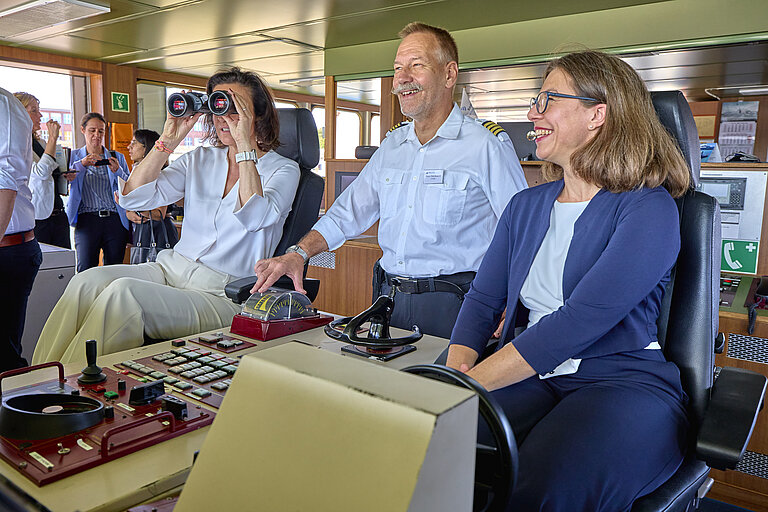
Looking towards the future: Federal Research Minister Dorothee Bär (left) on the bridge of the research vessel ALKOR with Captain Marc Petrikowski (centre) and GEOMAR Director Prof Dr Katja Matthes (right).
Photo: Pat Scheidemann, GEOMAR

After being welcomed by Prof. Dr Katja Matthes, Director of GEOMAR, and Frank Spiekermann, the centre's Administrative Director, Minister Dorothee Bär (right) learned about current research projects on a tour with Dirk Schrödter (left), the Minister for Digital Affairs and Head of the State Chancellery in Schleswig-Holstein.
Photo: Pat Scheidemann, GEOMAR
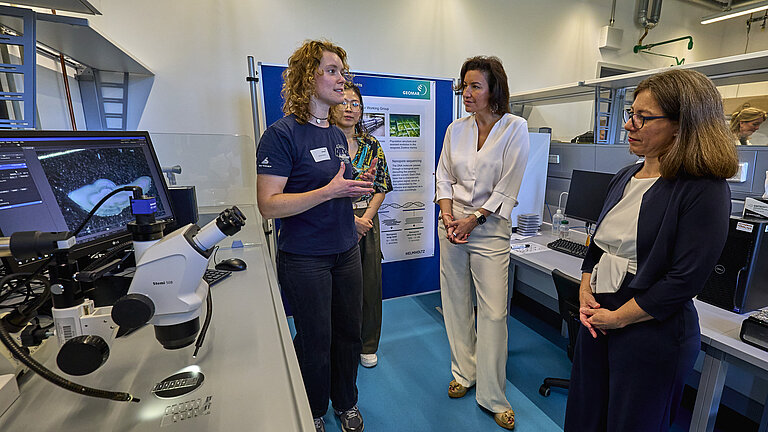
In the molecular genetics laboratory, master's students Hanna Rudnick (left) and Erika Endo Kokubun talked about the evolutionary consequences of overfishing, using cod as an example.
Photo: Pat Scheidemann, GEOMAR
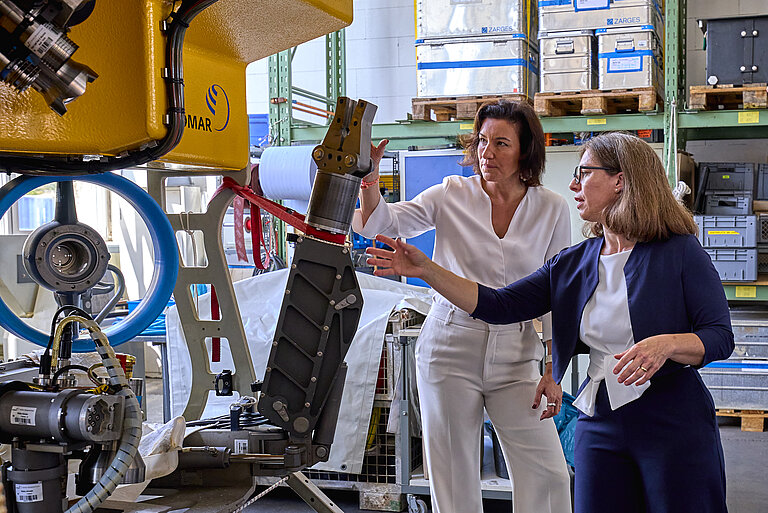
The ROV KIEL 6000 is a diving robot designed for scientific missions in the deep sea. In the assembly hall of Seagoing Technologies, the minister learned about the specific technical requirements of marine research.
Photo: Pat Scheidemann, GEOMAR
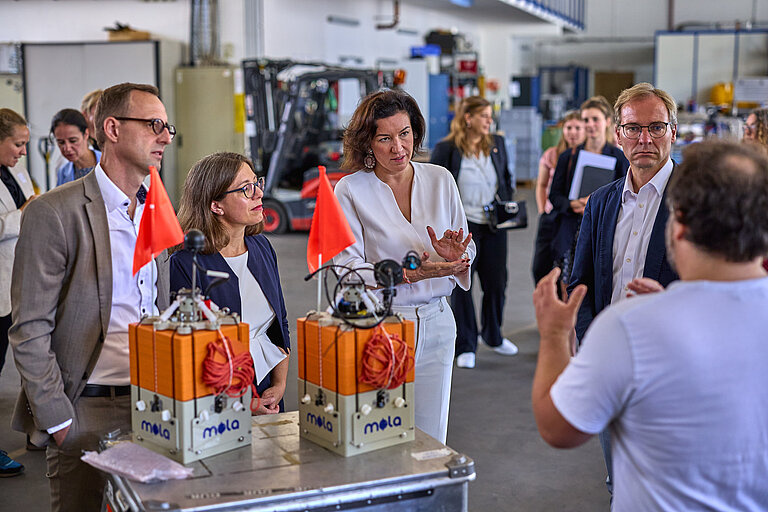
MOLAs are compact landers that can be fitted with different types of measurement technology. Developed at GEOMAR, they are used to monitor earthquakes and develop intelligent early warning systems for tsunamis. From left to right: Digital Minister Dirk Schrödter; GEOMAR Director, Prof. Dr. Katja Matthes; Federal Research Minister, Dorothee Bär; State Secretary, Guido Wendt; and geophysicist, Dr. Jens Karstens.
Photo: Pat Scheidemann, GEOMAR
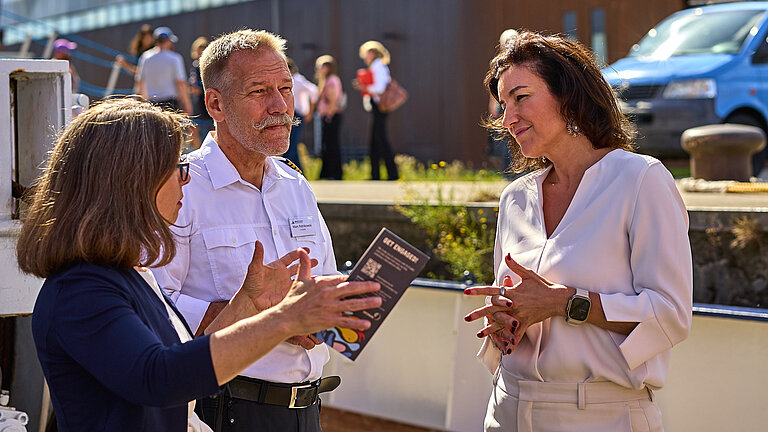
In addition to scientific topics, Federal Research Minister Dorothee Bär's visit to GEOMAR also focused on the construction of the new German research vessel METEOR IV. From 2026, the vessel will be based in Kiel and operated by GEOMAR as part of the German research fleet.
Photo: Pat Scheidemann, GEOMAR