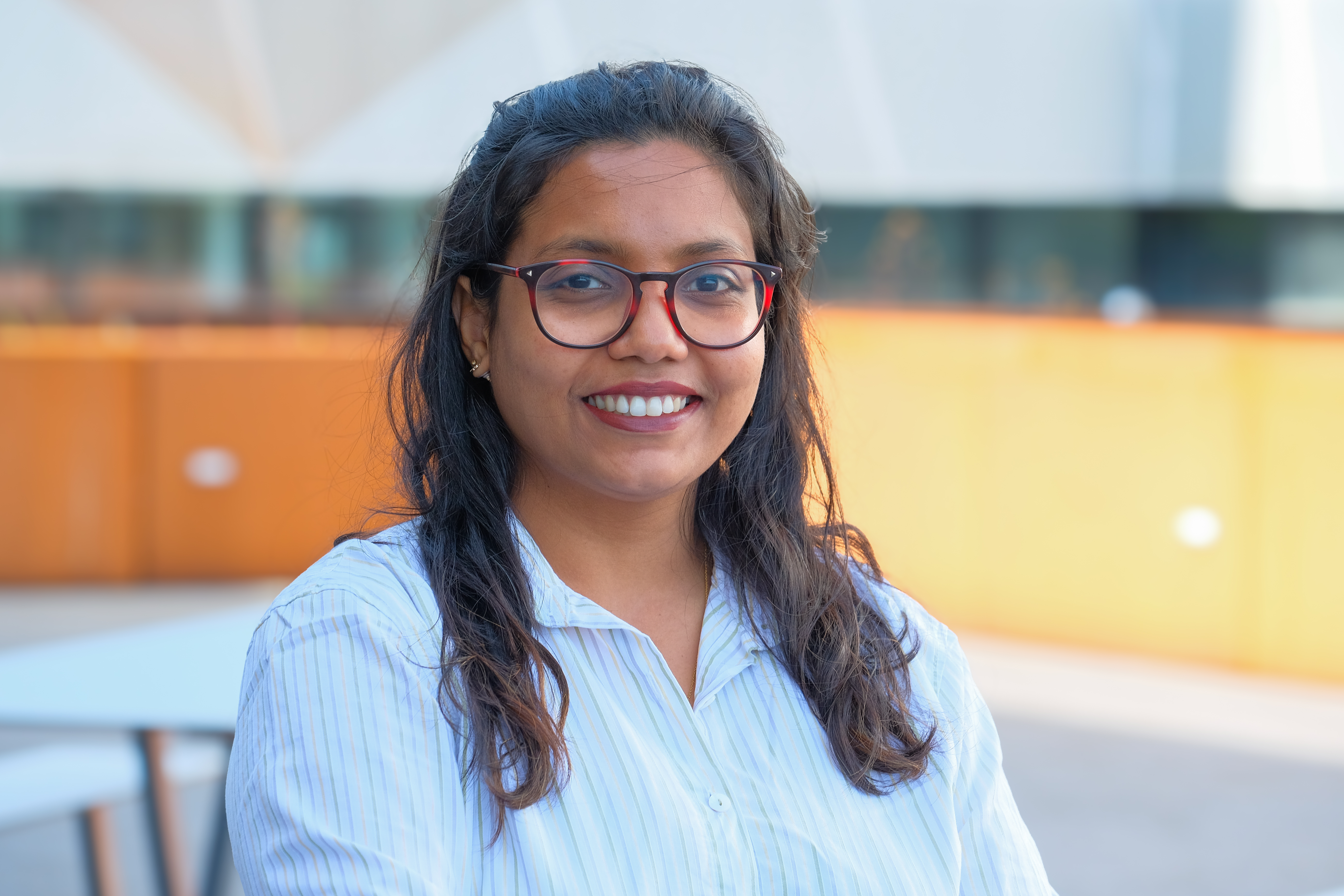
Amavi Silva is a biogeochemist working in the Marine Biogeochemistry research division. She specialises in the ocean’s micro-surface, investigating how the organic structure of this thin boundary layer influences the exchange of gases between the ocean and the atmosphere — particularly carbon dioxide.
Photo: Julia Gehringer, GEOMAR
Data Analysis and Dragon Worlds: Amavi Silva
Showcasing Diversity: People at GEOMAR
Amavi Silva grew up in Sri Lanka. After school, she studied oceanography and marine geology at Faculty of Fisheries and Marine Sciences and Technology – a fairly new faculty at her university, and an unusual subject for young women at the time. She has travelled extensively, spending time in Taiwan, France, Spain, and Belgium. She wrote her master’s thesis in Southampton, UK, as part of an international Erasmus Mundus program, and later returned there for her PhD.
As an early-career researcher, she has been working since 2025 in the Marine Biogeochemistry research division at GEOMAR.
Outside of her research, Amavi loves literature and music. She writes and translates fantasy novels, plays the violin, and shares her enthusiasm for science, academia and life in general with a large social media community.
What do you research, and how do you go about it?
Amavi: I am doing a postdoctoral project in organic biogeochemistry, with a focus on air-sea gas exchange. For my PhD, I studied air-sea gas exchange of the upper ocean, from an inorganic biogeochemical perspective, working with oxygen, carbon and nutrients. Here at GEOMAR, my postdoc focuses on the sea surface microlayer, the topmost one millimetre of the ocean. Here, I dive into its complex organic structure and its eventual implication on global gas fluxes, primarily carbon dioxide.
What motivates you?
Amavi: My motivation stems from the challenges I faced as an undergraduate in Sri Lanka. From the very beginning, I was passionate about chemical oceanography. But fifteen years ago, when I was pursuing my bachelor’s degree, chemical oceanography or marine biogeochemistry hardly existed as a field in Sri Lanka. Nevertheless, I chose to do my thesis in organic biogeochemistry, only to realize that even the most basic analytical instruments for chemical oceanography research were a luxury in my country. After a bumpy journey—with broken instruments too expensive to repair, 76 samples left unanalysed, failed negotiations for alternative tests, and research that had to be redone from scratch—I still completed a thesis on marine biogeochemistry that received the highest marks. It was then that I realized I was made for research, with all the failures and triumphs it may bring along the way.
You are very active on social media. How does that connect to your work?
Amavi: My preferred social media platform is Facebook where I currently have almost 20K followers. My goal has always been to share what I see by living my life and what I learn from the people I meet. I’ve been doing this for about ten years. I write in Sinhala, my mother tongue, because my expectations as a content creator is to speak to my local community in a language that everyone can understand, regardless of their educational background. I believe in sharing positivity and hope through my content. At the end of the day, it is the least I can do to help make my community a little better and brighter.
How did that start? What inspired you?
Amavi: I’ve always enjoyed sharing my experiences with my family and friends. For example, during my bachelor’s years, the more I learned about the ocean, the more I enjoyed planning trips and taking my relatives to the sea to show them things they might have overlooked. I still remember how impressed my parents were when I planned a trip where I introduced them to mangroves and salt marshes, took them on boat rides and snorkelling excursions in the reefs – anything connected to water – to show them how much I loved what I did. After all, this vibrant world beneath the blue waters is not something everyone has access to and I wanted my family to feel the same sense of completeness I felt near the sea. And I could see that when someone discovers something new and exciting, their joy and enthusiasm often ripple outward, inspiring many others. It is this very chain of shared wonder that keeps me inspired and motivated as a social media content creator.
What was it like to study at an oceanography institute in Sri Lanka as a young woman?
Amavi: I did a four-year bachelor’s at University of Ruhuna, Sri Lanka, focusing on oceanography and marine geology, and then joined the same university as a teaching assistant. I was part of the sixth cohort of the then-new oceanography faculty, and only about 40 people from across the country were selected for the program.
At the time, it was very unusual for women in my country to pursue a career in oceanography. I remember some relatives asking me if I was the only woman in my cohort. They could hardly believe a girl would do something like oceanography, because it is such a field-based profession. I grew up in a Sri Lanka where teaching, medicine, or office jobs – but certainly not fieldwork – were considered ideal occupations for women. Fortunately, things have become much more progressive today! But, I didn’t mind – I was never one to stay rooted in a comfort zone. I was more of an adventurer and a risk taker.
I also want to emphasize how grateful I am to my parents; they have always supported me and trusted me, even when they had doubts about where it might take me.
You’ve worked in many countries after your studies. Where have you been?
Amavi: After completing my bachelor’s, I worked at the same university for one and a half years, before undertaking a two-month internship in Taiwan. I then received an Erasmus Mundus master’s scholarship which took me to France, then Spain and Belgium, finishing my master’s thesis in Southampton, UK. After finishing the Erasmus program, I returned to Sri Lanka. However, I already knew that I wanted to pursue a PhD. Since the kind of oceanography PhD program, I was looking for was not available in Sri Lanka, I decided to pursue my PhD abroad. As a result, I returned to Southampton under the university’s Presidential PhD Scholarship scheme to continue working with my master’s supervisor.
What differences in research culture did you notice?
Amawi: Taiwan was bit of a culture shock. The labs are open 24/7; you can eat and sleep there, and you just do your own thing. I actually ate and slept in the office. There’s definitely pressure – the culture is very work-oriented. But, for the first time in my life, I discovered my full capacity and realised I can be a workaholic if I need to be.
I brought that work ethic with me to France, where the regulated workdays felt much more relaxed. In Spain, there was the famous ‘Siesta’ – the midday break when everything closes – which was a real surprise and actually quite nice. The course work there was also structured differently. Instead of being scattered throughout the semester, they were scheduled sequentially. If you chose the courses that were aligned at the beginning of the semester, you could complete them all at once and have the rest of the semester free. At first, this was perfect for an enthusiastic traveller like me. But after weeks and sometimes months of ‘all play and no work’, life eventually started to feel a little boring. On the other hand, the semester in Belgium felt like the perfect balance between the systems in France and Spain.
In Southampton, I learned to balance work and life. At first, out of habit, I would finish a week’s work in a few days, and my supervisor eventually said: “Take a holiday, go to London, and don’t work until you get back. Your PhD isn’t your life, it’s your work. Do your hours, go home, and enjoy your social life and hobbies.” Mental health is taken very seriously there. From my PhD colleagues, I learned that while delivering high-quality work is important, it is equally important not to overwork yourself, especially when the extra effort is not recognized or compensated. This was an eye-opener for me, given that in Sri Lankan working culture, you are often expected to deliver perfect work, whether paid or not.
I brought all this work wisdom with me to Germany, and my boss fully supports it. Here I feel much more relaxed. I have developed new hobbies, made friends both inside and outside work and I have plenty of time for myself.
I love travelling the world! Although I now have other personal commitments and want to settle down a bit, I am fortunate that my husband also loves to travel.
What experiences could we learn from here at GEOMAR?
Amavi: I’ve realised that having a cohort makes a huge difference! During Erasmus years, I was very active because I had a group around me. Here at GEOMAR, there are already places that bring people together – for example the library or the shared kitchen areas between the different research groups and the terrace! Spaces like these make it easier to meet colleagues beyond one’s own team. The social events organized by the Postdoc Plus Team are also an excellent platform for meeting and connecting with others. At the same time, it would be wonderful to have even more opportunities and moments where people from across the institute interact.
In Southampton, we had a separate lounge for postgraduate researchers where students across different academic years, fields and degree or grant programs would meet once a week over coffee and cookies. Sometimes we chatted leisurely, sometimes we vented our research frustrations and sometimes we simply enjoyed each other’s quite company. It created a strong sense of belonging during the long and often exhausting years of research. Those informal encounters help people feel less alone and more at ease – and they can spark great ideas as well.
Amavi Silva is a biogeochemist working in the Marine Biogeochemistry research division. She specialises in the ocean’s micro-surface, investigating how the organic structure of this thin boundary layer influences the exchange of gases between the ocean and the atmosphere — particularly carbon dioxide.
Photo: Julia Gehringer, GEOMAR