
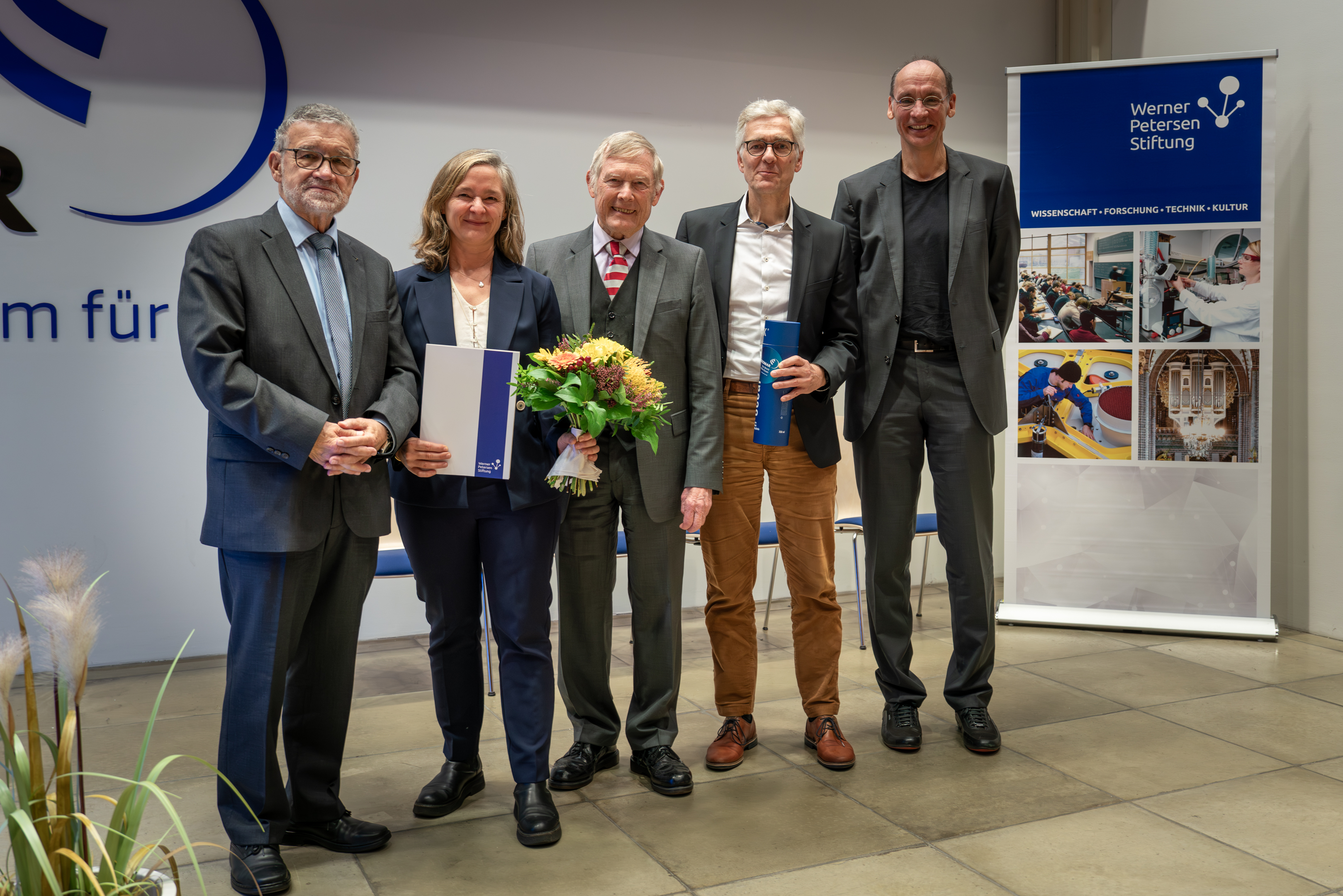
Dr Karina von Schuckmann (second from left) received the award alongside congratulations from Dr h.c. Klaus Wichmann, Dr Christian Zöllner (Petersen Foundation), Frank Spiekermann (Administrative Director of GEOMAR) and Prof. Dr Peter Brandt (laudator).
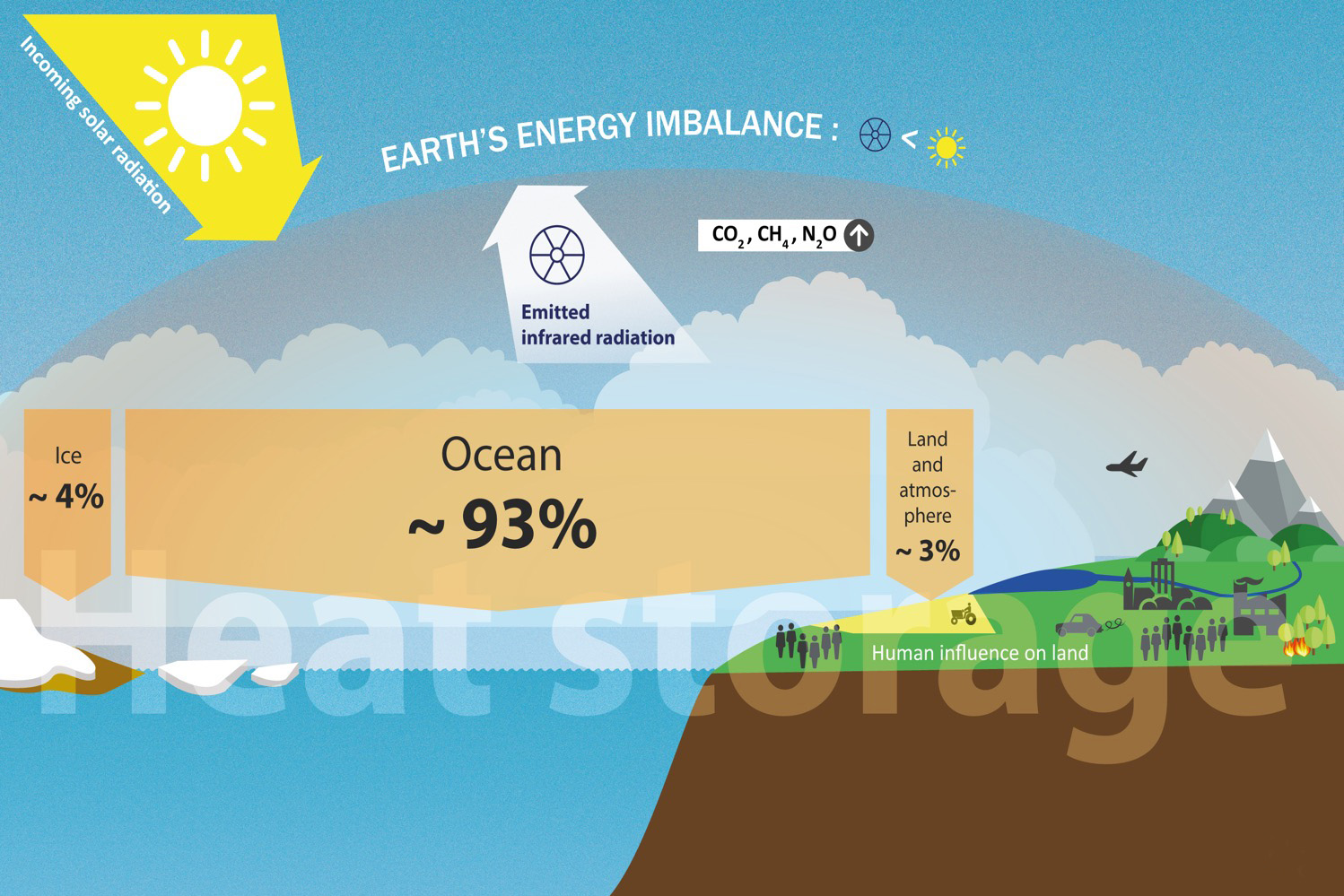
This schematic representation shows the energy flow and storage in the Earth system, including the energy imbalance caused by humans. Around 90% of excess heat is stored in the global ocean, while the rest warms the land and atmosphere and melts ice.
Source: von Schuckmann et al., 2016.
The Ocean: Guardian of Global Warming
Dr Karina von Schuckmann honoured with the Petersen Excellence Professorship
The ocean is the most sensitive indicator of ongoing climate change. Around 90 percent of the excess energy trapped in the Earth system by the greenhouse effect is stored in the ocean.
This heat uptake alters the ocean itself and affects weather patterns, ocean currents, sea level and ecosystems worldwide.
“The warming of the ocean clearly shows that the Earth has fallen out of its energy balance. It is perhaps the clearest evidence that we have entered a new climate state,” says Dr Karina von Schuckmann, Senior Advisor at Mercator Ocean International in Toulouse, who is today honoured at GEOMAR with the 32nd Excellence Professorship of the Prof. Dr Werner Petersen Foundation.
A researcher at the interface of science and policy
Dr von Schuckmann studied at GEOMAR and Kiel University (CAU), where she obtained her doctorate on physical processes in the tropical ocean. She completed her habilitation at Sorbonne University, Paris, in 2021. She is one of the leading experts in physical oceanography and the global energy balance. As Director of the Copernicus Ocean State Report, she coordinates the most comprehensive European assessment of the state of the ocean each year. She was a Lead Author of the Sixth Assessment Report (AR6) of the Intergovernmental Panel on Climate Change (IPCC) and has also been appointed Lead Author for the upcoming IPCC report. In 2023, she received the Climate Prize of the French Academy of Sciences.
Her research provides essential foundations for understanding changes in the climate system and for enabling evidence-based policy decisions.
“The ocean is a central actor in climate change – and at the same time one of its greatest victims. Its warming is a process that will accompany us for centuries to come,” says von Schuckmann.
Foundation honours world-leading research
Dr h.c. Klaus Wichmann, Chair of the Prof. Dr Werner Petersen Foundation, says:
“With Dr Karina von Schuckmann, we are honouring a scientist whose work exemplifies the global importance of marine research. Her commitment to understanding the complex changes in the ocean and making them visible to policymakers and the public is outstanding. Since 2009, the Excellence Initiative of our Foundation has supported exceptional scientific achievements and helped to strengthen Schleswig-Holstein as a hub of international top-level research.”
Prof. Dr Katja Matthes, Director of GEOMAR, congratulates the awardee:
“Today at GEOMAR we are honouring an extraordinary scientist. With her outstanding work on the Earth’s energy balance and ocean warming, Karina von Schuckmann stands for excellent, solution-oriented science. I am very much looking forward to welcoming her back to Kiel soon for a longer stay.”
The laudation is given by her former doctoral supervisor, Prof. Dr Peter Brandt, Head of the Research Unit Physical Oceanography at GEOMAR:
“Karina’s work is central to our understanding of global warming. She has played a decisive role in quantifying the Earth’s energy balance and in identifying the ocean as the main heat reservoir of the climate system. Her research uniquely combines observations, modelling and policy relevance. At the same time, she is an untiring ambassador for a better public understanding of human-induced climate change.”
Science for a sustainable future
In her lecture, von Schuckmann addresses ocean warming not only as a physical process but also as a societal challenge. It affects sea level, marine ecosystems, the global carbon cycle and the living conditions of billions of people.
“Only through continuous observation, international cooperation and decisive action can we ensure the long-term stability of the Earth system,” she says.
About: Prof. Dr Werner Petersen Excellence Professorship
Launched in 2009, the Excellence Initiative of the Prof. Dr Werner Petersen Foundation supports outstanding scientists and promotes international cooperation, particularly in the field of marine research. The €20,000 Excellence Professorship includes a research stay of around six weeks at the GEOMAR Helmholtz Centre for Ocean Research Kiel. During this time, awardees offer specialist courses for early-career researchers, give public lectures, and develop joint research projects with colleagues in Kiel.
Dr Karina von Schuckmann (second from left) received the award alongside congratulations from Dr h.c. Klaus Wichmann, Dr Christian Zöllner (Petersen Foundation), Frank Spiekermann (Administrative Director of GEOMAR) and Prof. Dr Peter Brandt (laudator).
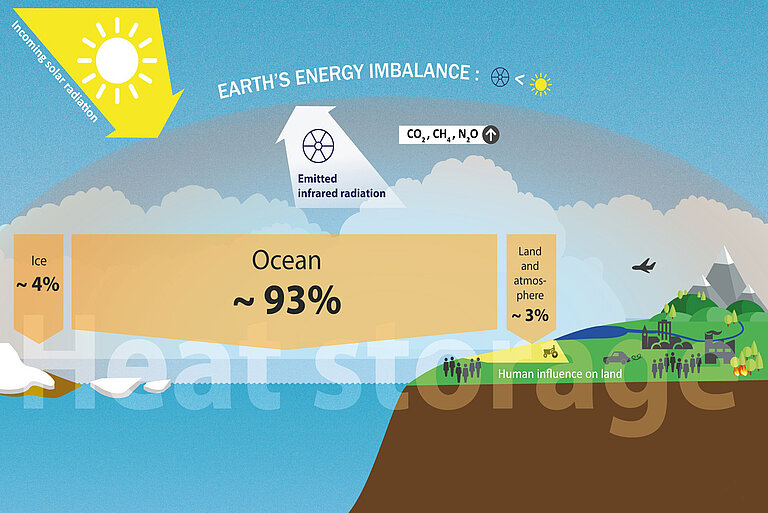
This schematic representation shows the energy flow and storage in the Earth system, including the energy imbalance caused by humans. Around 90% of excess heat is stored in the global ocean, while the rest warms the land and atmosphere and melts ice.
Source: von Schuckmann et al., 2016.