

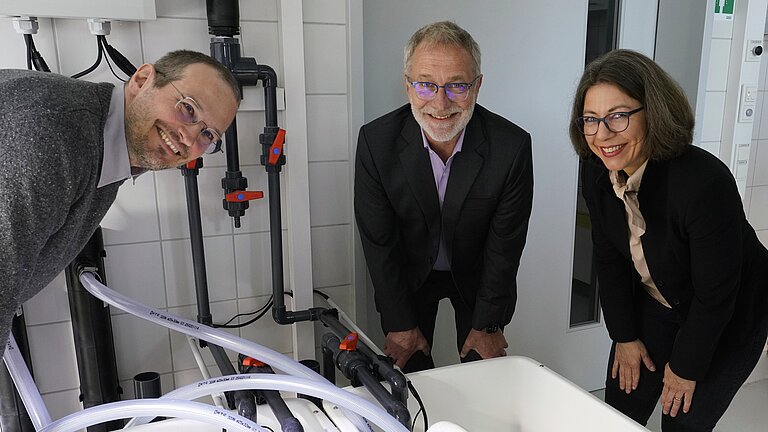
Let the water flow! To mark the inauguration of the new infrastructure at GEOMAR, Helmholtz President Martin Keller opened the tap on a seawater pipe in the laboratory.
Photo: Sarah Uphoff, GEOMAR
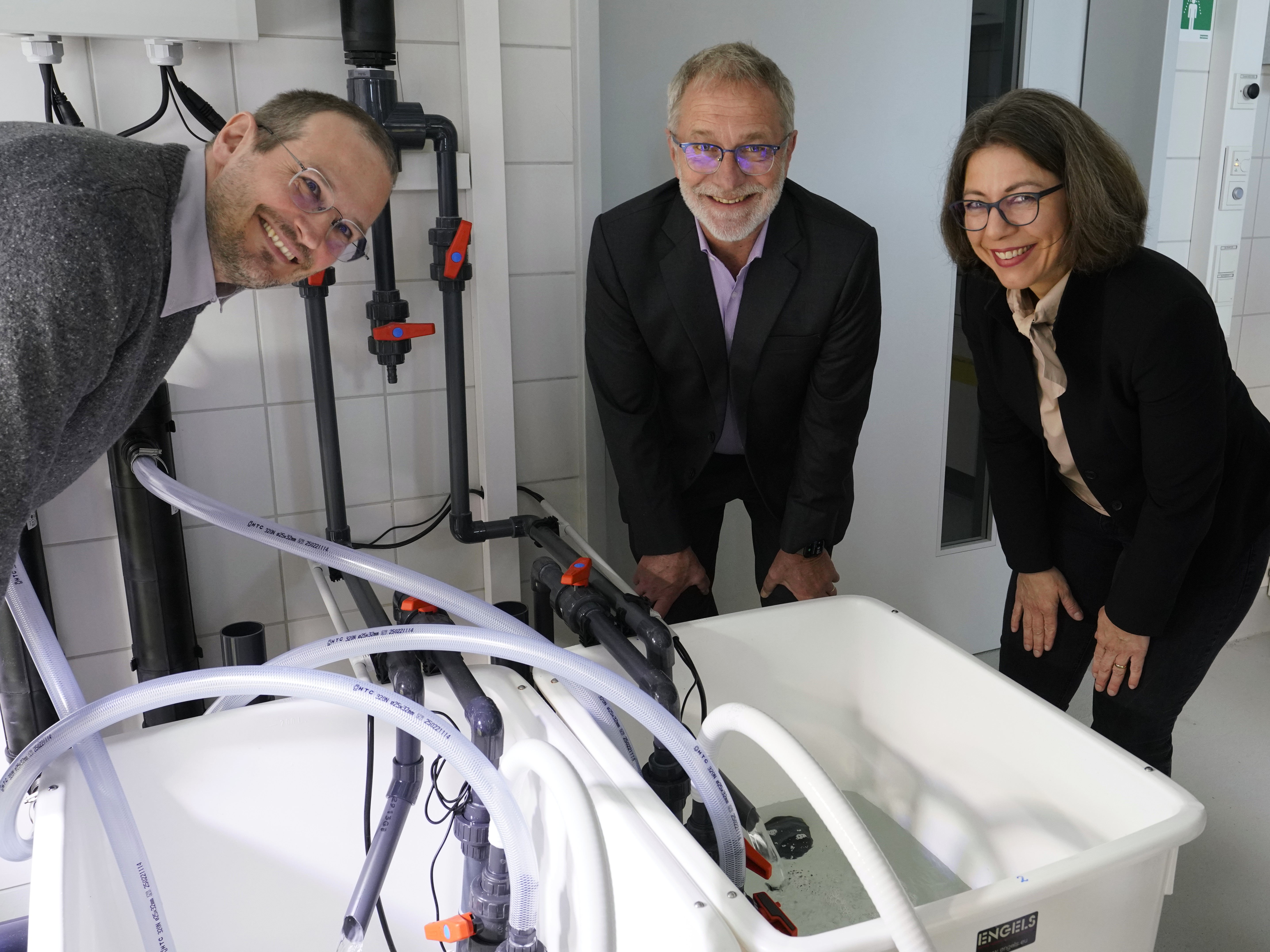
A steady supply of fresh Baltic Sea water is essential for the marine research centre's experimental research. Claas Hiebenthal (Head of the Marine Organism Culture Centre at GEOMAR), Martin Keller (President of the Helmholtz Association) and Katja Matthes (Director of GEOMAR) are delighted to now have this secure supply (from left to right).
Photo: Sarah Uphoff, GEOMAR
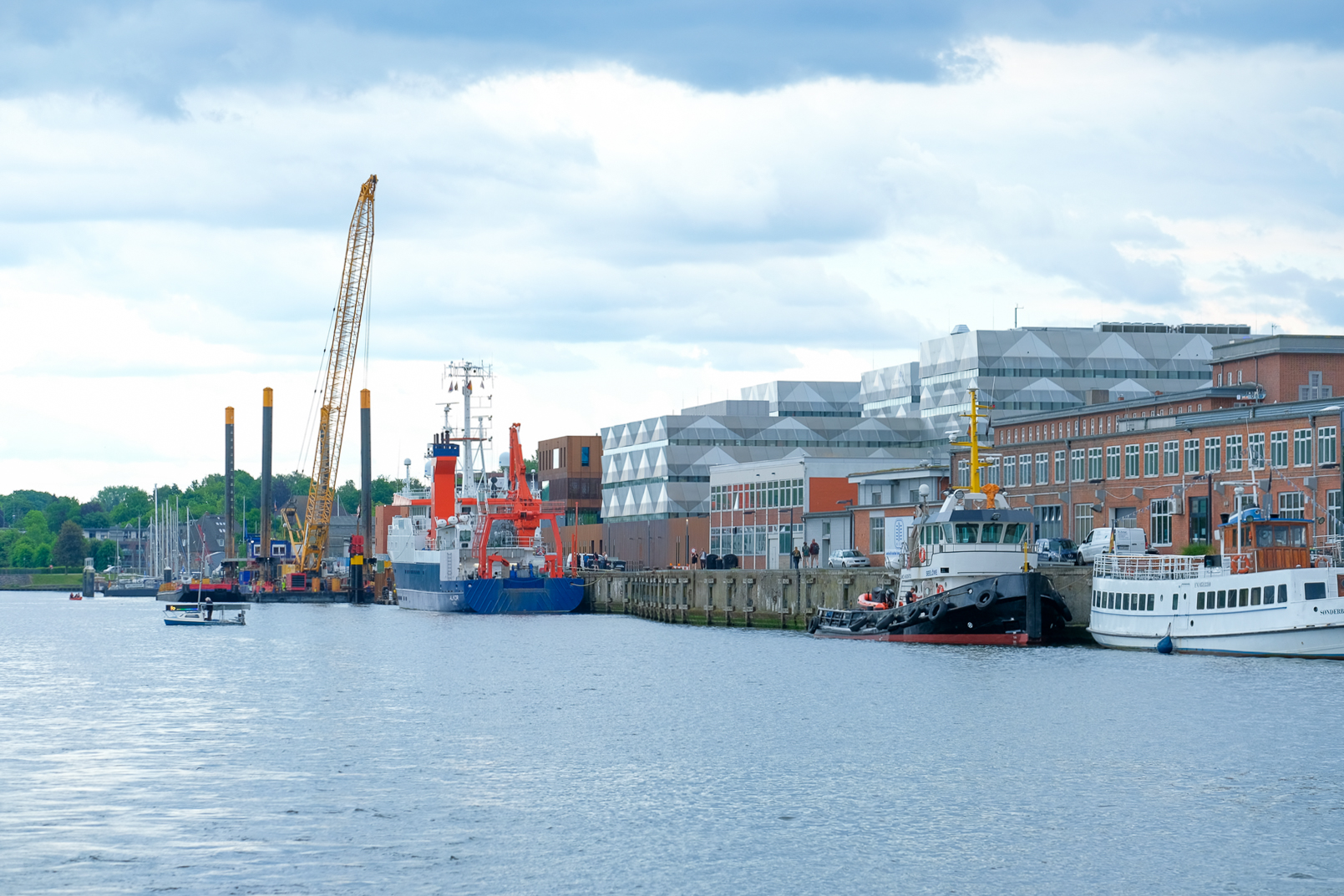
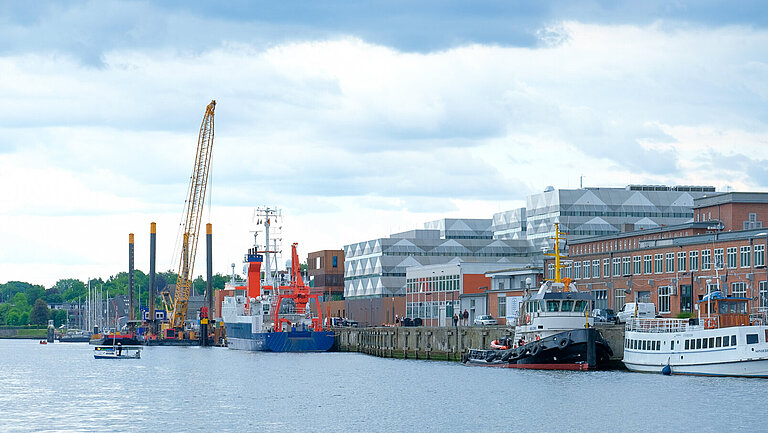
A structure has been built at the edge of the quay in front of the GEOMAR building. This will stabilise the water’s edge and allow pipes to be routed into the building.
Photo: Julia Gehringer, GEOMAR
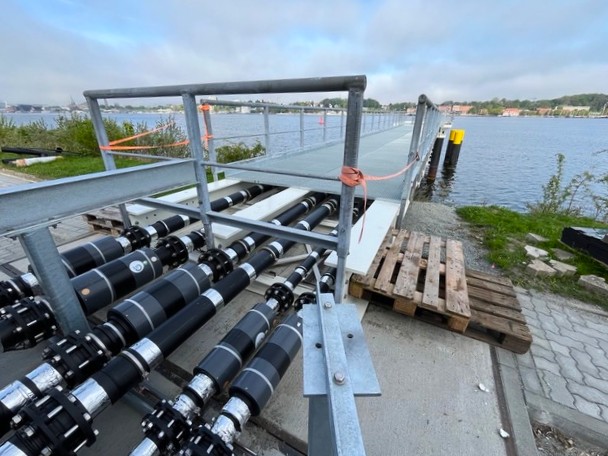
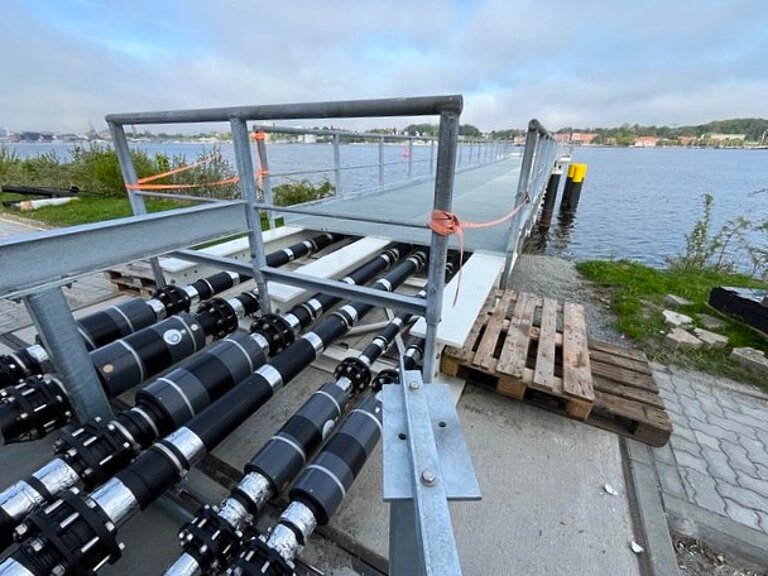
The intake station at the naval arsenal has its own jetty. Seawater is drawn from the fjord here, filtered, and then piped into the GEOMAR building.
Photo: Frank Melzner, GEOMAR
Fresh Seawater for Research
Seawater pipeline officially inaugurated at GEOMAR
How does the sea get into the laboratory? At the GEOMAR Helmholtz Centre for Ocean Research Kiel, a 1.4-kilometre-long pipeline runs directly from the fjord to the seawater plant in the basement of the new building on the banks of the Schwentine. From the seawater plant, the water flows through a ring-main system into climate-controlled culture rooms and laboratories, where it is available for experiments with marine organisms. Today, this extraordinary infrastructure was officially inaugurated.
“Research infrastructures such as the new seawater pipeline at GEOMAR create the essential conditions for studying marine processes in the laboratory,” says Prof. Dr Martin Keller, President of the Helmholtz Association. “The oceans are central to life on Earth: they regulate the climate, produce a large proportion of our oxygen and provide food for billions of people. Their condition therefore plays a decisive role in determining the stability of our environment and the future of our society. This makes it all the more important to gain a comprehensive understanding of the diverse processes from the seabed to the atmosphere. This is precisely where GEOMAR comes in: with its focus on researching the global ocean, it makes a significant contribution to understanding its role in the Earth system. Thanks to its excellent scientists, strong international partnerships and state-of-the-art infrastructure, it is carrying out pioneering work in this field worldwide.”
Why experiments need fresh seawater
For many areas of marine research, experiments conducted under controlled conditions are essential. In climate-controlled chambers, for example, researchers investigate how changes in temperature, salinity or nutrient levels affect marine organisms. To ensure that such experiments yield scientifically reliable results, they must be carried out in multiple sets simultaneously. This requires a continuous supply of large quantities of fresh seawater.
“Experimental research is key to understanding the effects of climate change on the ocean. With the new seawater pipeline, we now have a unique facility that enables us to conduct research on marine organisms under realistic conditions in our laboratories – including at our new site at the mouth of the Schwentine,” says Professor Dr Katja Matthes, Director of GEOMAR.
Challenges at the mouth of the Schwentine
The pipeline connects the intake point on the grounds of the naval arsenal in the Kiel Fjord with the GEOMAR building at the Seefischmarkt, which was completed in 2023. It runs for 1,400 metres through the fjord and the Schwentine – a small river that is still contaminated with historical munitions, which made the construction project a particular challenge.
The Explosive Ordnance Disposal team had to be called out on several occasions to recover bombs from the Second World War. In addition, the pipework had to be rerouted during construction to avoid pieces of rubble that could not be removed. A new shaft structure was erected at the quay edge in front of the GEOMAR building to stabilise the water’s edge and allow the pipework to be routed into the building. After two years of construction, the main works are now complete. The costs to date amount to approximately eleven million euros.
“Without the support of the Federal Ministry of Research, Technology and Space, this extraordinary project would have been almost impossible to undertake,” says Frank Spiekermann, Administrative Director of GEOMAR. “The Ministry has not only helped us to overcome the financial challenges involved in the implementation, but has also supported the project with great understanding – for which we are very grateful. I would also like to extend my special thanks to my colleagues in GEOMAR’s Technical Services, who have successfully completed this demanding construction project with patience and great perseverance.”
The journey of seawater from the Baltic Sea to the laboratory
The pumping and filtration station is located on the banks of the Kiel Fjord, on the grounds of the naval arsenal. The 100-square-metre grey building, complete with a jetty, is clearly visible from the water. This is where the seawater is drawn in and purified through two stages of filtration before entering the pipeline. This is intended to prevent mussels, barnacles or other organisms from settling in the pipeline and clogging it up over time. The pipeline consists of four total pipes, which can be operated alternately to ensure security of supply and to allow the individual pipe strings to be cleaned whilst the system is in operation. Up to 20 cubic metres of water per hour can thus be transported to GEOMAR.
Once inside the building, the water flows into the seawater plant in the basement. This is the heart of GEOMAR’s seawater supply system. Here, three types of seawater are made available to the scientists: in addition to the continuously flowing Baltic Sea water, there is also water from the North Sea and artificially produced seawater. The North Sea water is delivered by research vessels and pumped directly into the seawater plant via a connection at the jetty. Artificial seawater is mixed on site to the desired salinity.
The seawater facility comprises several large tanks. The largest holds around 80,000 litres of North Sea water. In addition, up to 20,000 litres of artificial seawater can be produced. Three further tanks, each with a capacity of around 10,000 litres, can be used to store special types of water brought to Kiel by expeditions from other parts of the ocean.
The water is further treated to supply the laboratories and climate-controlled culture rooms: proteins are skimmed off, sediments are removed, and UV purifiers reduce the number of microorganisms. Powerful pumps then feed the water into a looped piping system that runs through the building. This system keeps the water constantly in motion, ensuring it remains fresh and oxygen-rich.
In the laboratories and climate-controlled culture rooms, researchers can finally draw seawater directly from one of the three taps – Baltic Sea water, North Sea water or artificial seawater, as required.
“Supplying our climate-controlled culture chambers with fresh seawater – whilst also having access to state-of-the-art analytical facilities under the same roof – represents a key locational advantage for marine biological research at GEOMAR,” says Dr Claas Hiebenthal, Head of the Central Laboratory for the Cultivation of Marine Organisms, a key facility at GEOMAR.
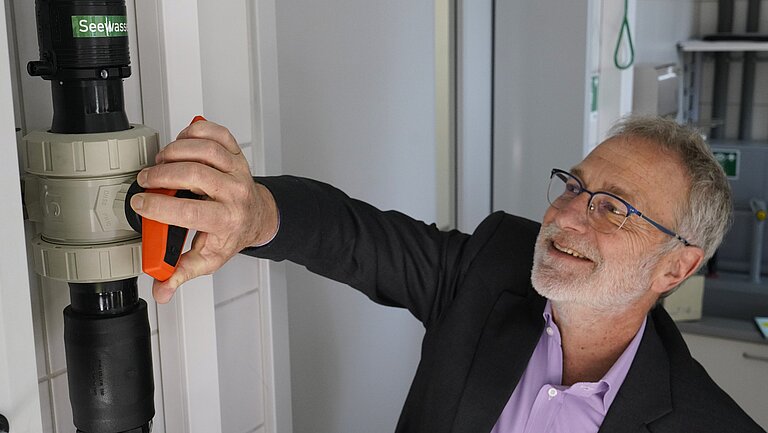
Let the water flow! To mark the inauguration of the new infrastructure at GEOMAR, Helmholtz President Martin Keller opened the tap on a seawater pipe in the laboratory.
Photo: Sarah Uphoff, GEOMAR
A steady supply of fresh Baltic Sea water is essential for the marine research centre's experimental research. Claas Hiebenthal (Head of the Marine Organism Culture Centre at GEOMAR), Martin Keller (President of the Helmholtz Association) and Katja Matthes (Director of GEOMAR) are delighted to now have this secure supply (from left to right).
Photo: Sarah Uphoff, GEOMAR
A structure has been built at the edge of the quay in front of the GEOMAR building. This will stabilise the water’s edge and allow pipes to be routed into the building.
Photo: Julia Gehringer, GEOMAR
The intake station at the naval arsenal has its own jetty. Seawater is drawn from the fjord here, filtered, and then piped into the GEOMAR building.
Photo: Frank Melzner, GEOMAR