
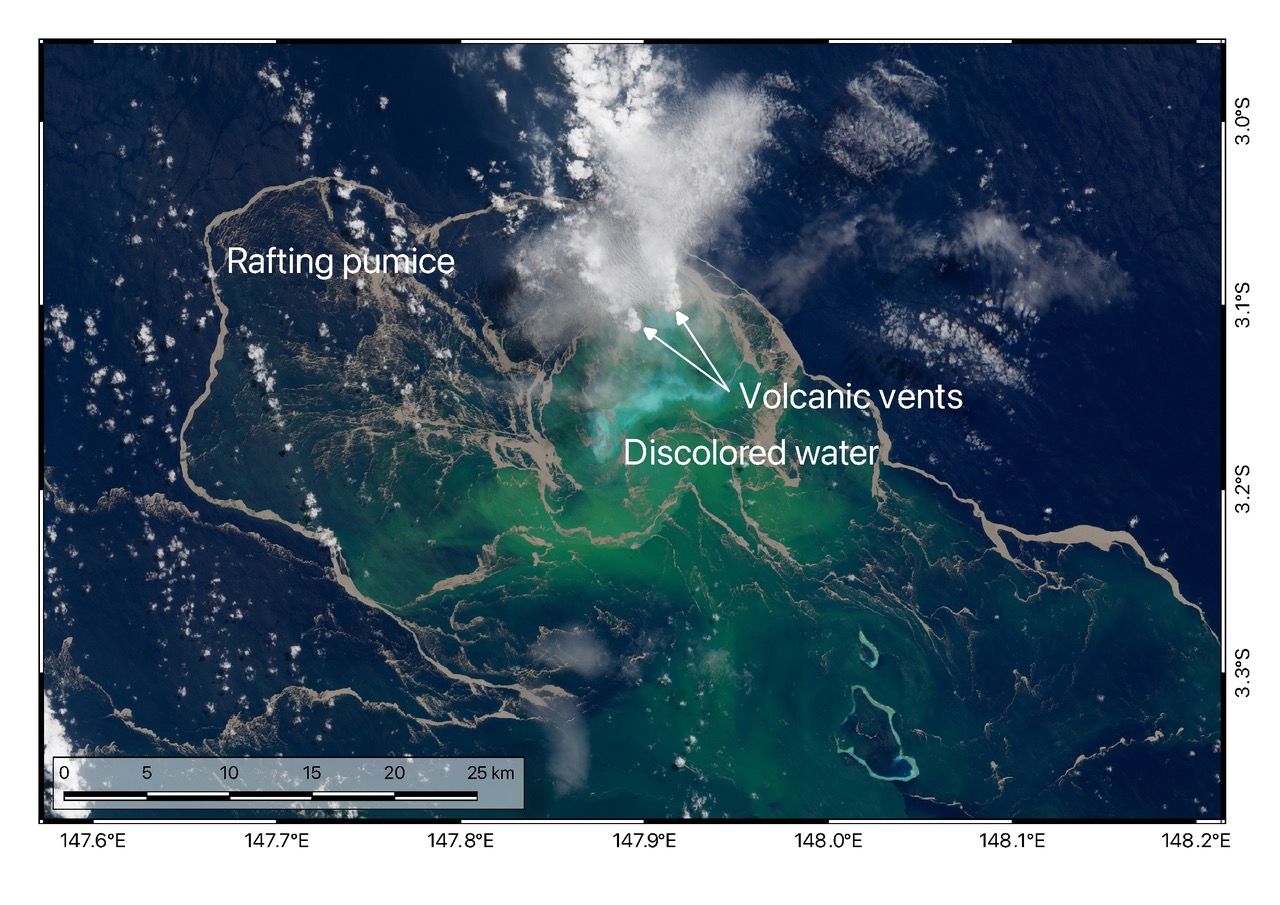
This satellite image shows the affected area in the Bismarck Sea. Two eruption sites are visible on the surface of the water, with water vapour being carried away by the wind. Large areas of the sea have changed colour and there are extensive patches of light brown pumice floating on the surface.
Satellite image from 22 May 2026 (ESA, modified Copernicus Sentinel data, 2026)
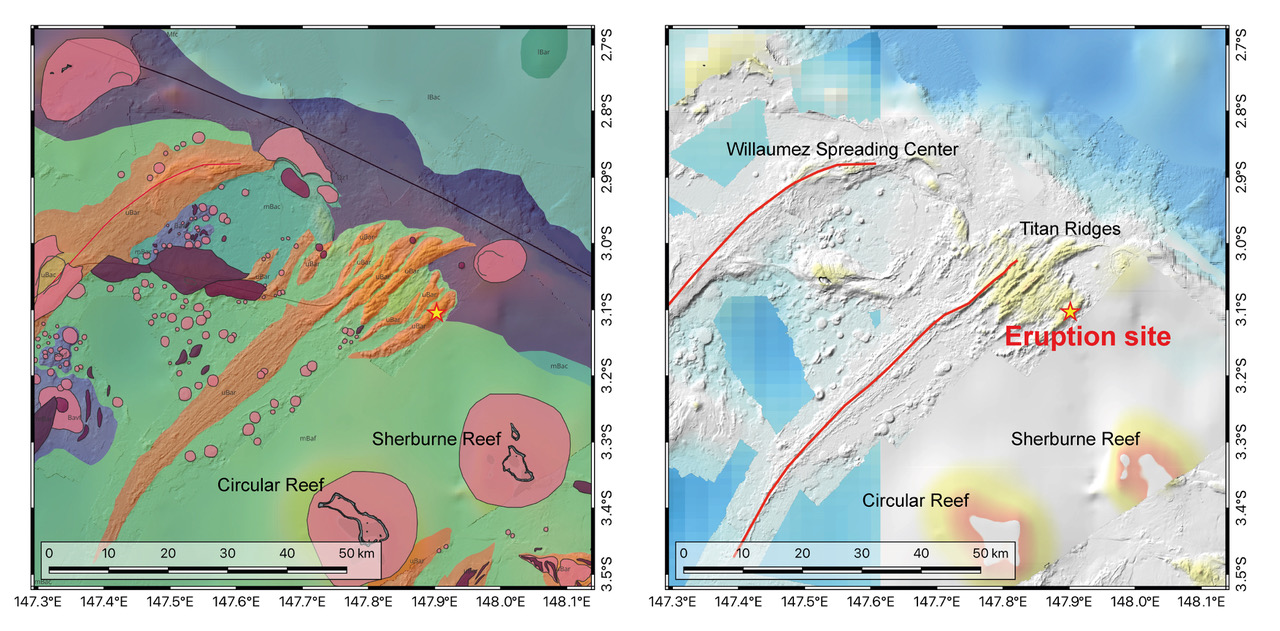
The location of the current eruption: on the left, the geological map of the Titan Ridges (Brandl et al., 2024); next to it, a bathymetric map.
Illustration: Philipp Brandl, GEOMAR
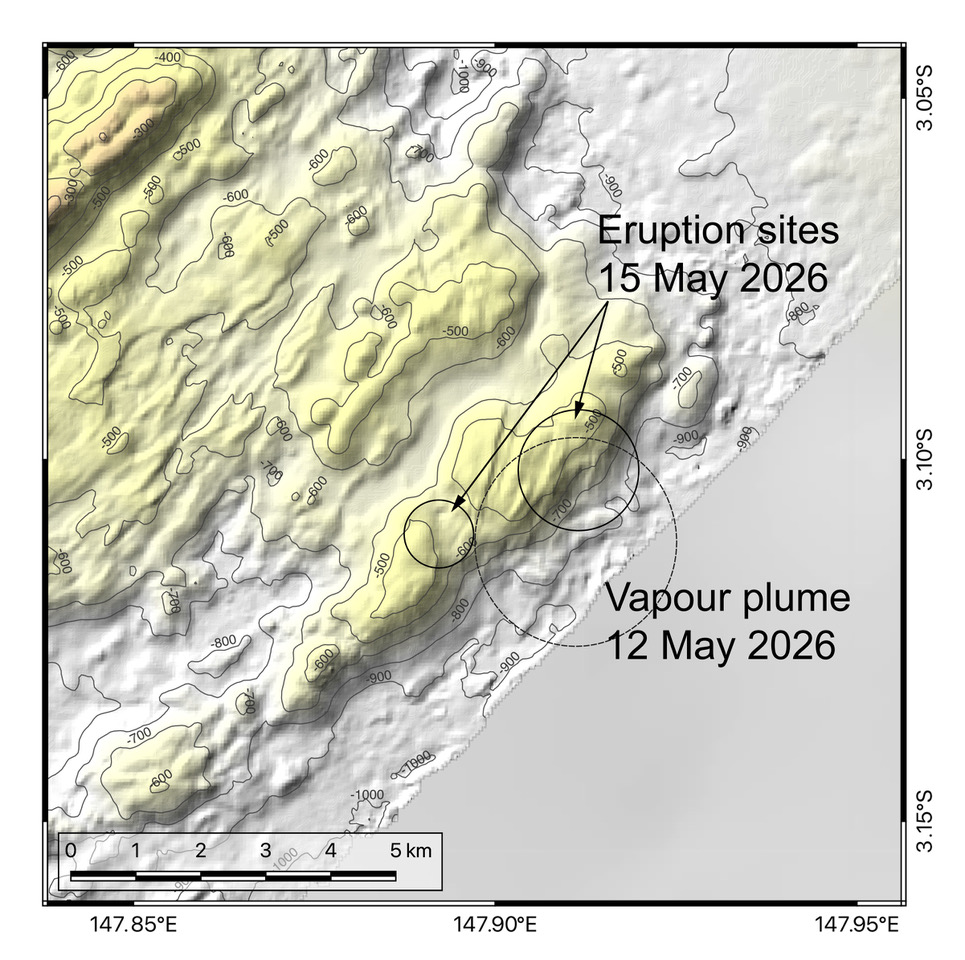
This is a bathymetric map showing the morphology of the seabed near the current eruption site. The bathymetry was recorded in the 2010s. At that time, the summit of the Titan Ridge volcano was located over 400 metres below the surface of the sea.
Illustration: Philipp Brandl, GEOMAR
Possible Eruption of an Underwater Volcano in the Bismarck Sea
GEOMAR Mapping Data Helps Interpret the Event
There are currently indications of a submarine volcanic eruption in the northern central Bismarck Sea off Papua New Guinea. Initial assessments suggest that the activity could be linked to the so-called “Titan Ridges” near the Willaumez Transform Fault. Thanks to a new regional geological map, the current eruption could be assigned to a previously rather inconspicuous system of volcanic ridges beneath the sea surface.
New Geological Map Helps Interpret the Event
The map was produced in collaboration with the University of Ottawa (Canada) under the lead of GEOMAR Helmholtz Centre for Ocean Research Kiel. It was developed as part of international research into the tectonically active island arc region off Papua New Guinea and the Solomon Islands (International Collaborative Research and Training Experience in Marine Geodynamics and Georesources, CREATE). The map documents seafloor structures such as fault systems, volcanoes and spreading centres — areas where new oceanic crust forms. The region is among the most geologically active areas on Earth. Several tectonic plates converge there. Earthquakes, volcanism and hydrothermal activity shape the seafloor.
“Underwater volcanoes are difficult to observe because they often lie hundreds or thousands of metres below the sea surface, and many remain undiscovered,” says Dr Philipp A. Brandl, marine geologist at GEOMAR. “In this case, our detailed mapping data can help those involved locally to interpret the current events.” The eruption may originate from the same underwater volcano that breached the sea surface during an eruption in 1972.
Ongoing Volcanic Activity Beneath the Water
Since 8 May, a plume of steam and gas has been rising above the affected area. On 12 May, the eruption plume reached an altitude of around 4,000 metres. The VAAC Darwin (Volcanic Ash Advisory Center) subsequently issued a warning for aviation. By 15 May, the sea had become discoloured across an area of more than 250 square kilometres — an indication of ongoing volcanic activity beneath the water. Images from the European Earth observation programme Copernicus also show smaller pumice rafts extending up to 200 kilometres west-southwest of the volcano.
No Threat to Local Populations
As the volcano is located in a very remote marine region far from inhabited coastlines, there is currently no known danger to the population. The local volcano observatory (Rabaul Volcanological Observatory, Mineral Resources Authority, Papua New Guinea) is publishing regular reports on the eruption. Ships are advised to avoid the area.
It has not yet been confirmed whether the current eruption originates from the same volcano as the 1972 event. However, the case highlights the importance of long-term fundamental research in the ocean: maps and datasets developed over many years can suddenly help scientists better understand and interpret ongoing natural events.
Original Publication:
Brandl, P. A., Hannington, M. D., Kraetschell, A., & Sander, S. G. (2024). A New Geological Map of the Marginal Basins of Eastern Papua New Guinea: Implications for Crustal Accretion and Mineral Endowment at Arc–Continent Collisions. Lithosphere, 2024(4).
DOI: 10.2113/2024/lithosphere_2024_145
This satellite image shows the affected area in the Bismarck Sea. Two eruption sites are visible on the surface of the water, with water vapour being carried away by the wind. Large areas of the sea have changed colour and there are extensive patches of light brown pumice floating on the surface.
Satellite image from 22 May 2026 (ESA, modified Copernicus Sentinel data, 2026)
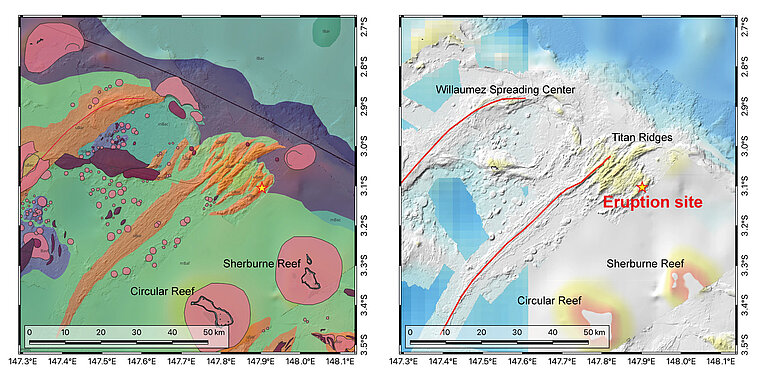
The location of the current eruption: on the left, the geological map of the Titan Ridges (Brandl et al., 2024); next to it, a bathymetric map.
Illustration: Philipp Brandl, GEOMAR
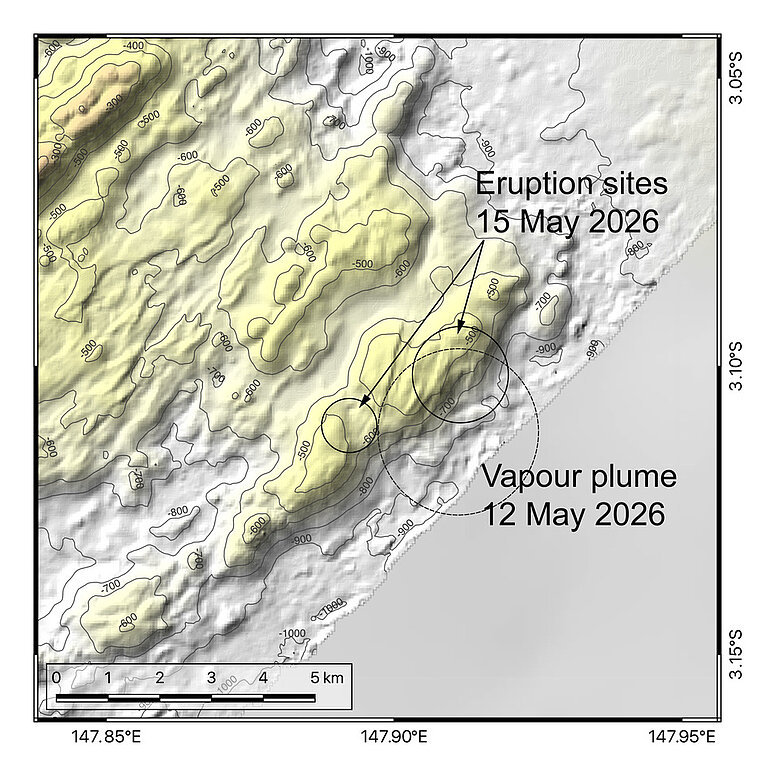
This is a bathymetric map showing the morphology of the seabed near the current eruption site. The bathymetry was recorded in the 2010s. At that time, the summit of the Titan Ridge volcano was located over 400 metres below the surface of the sea.
Illustration: Philipp Brandl, GEOMAR