Prof. Christian Berndt
Phone: +49 (0)431 600 2273
Marion Jegen-Kulcsar
Phone: +49 (0)431 600 2560


Cold seep systems on the Vøring Plateau
Marine geophysics (active source seismology, controlled source electromagnetic surveying) and marine geology to determine gas and gas hydrate concentration and distribution at major fluid escape structures in the northeast Atlantic
Duration: 01/04/12-31/12/12
Sponsered by: DFG
Proponents: Prof. Christian Berndt, Dr. Marion Jegen-Kulcsar
International Partner: National Oceanography Centre Southampton (NOCS)
Large vent sites are a significant source for carbon entering the ocean. The aim of the project is to test different hypotheses about the formation and functioning of two exemplary sites on the Vøring Plateau in order to provide better constraints on the temporal and spatial variations of carbon release. This will aid biogeochemical modelling, assessment of the impact on benthic ecosystems and provide further information on the geological processes in the deep parts of sedimentary basins. The two structures have very different origins. The first site is a gas blow-out pipe in the Nyegga gas hydrate province. For this site seismic data already exist and the scientists onboard RV METEOR will acquire additional controlled source electromagnetic data to quantify the amount of hydrocarbons in the shallow subsurface and to infer the distribution of hydrates. This will improve the knowledge about how gas is migrating through the gas hydrate stability zone. The second site is a large vent on the Gjallar Ridge, which initiated as a break-up related hydrothermal system. Although it is the biggest known seep in the North Atlantic it has not been studied so far. The aims of the cruise are to determine if this site can serve as a window to the geological processes active in the deep part of the basin and to understand why this system is still active whereas most other break-up related hydrothermal systems have shut down in the Early Eocene 55 million years ago.
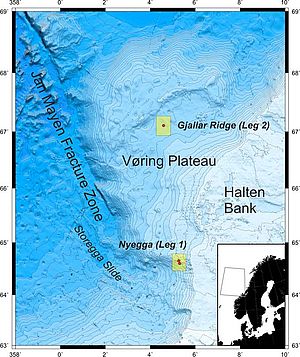
Leg 1 collected CSEM data on the northern slope of the Storegga Slide called Nyegga, which is the most prolific European gas hydrate province. Leg 2 first shot seismic data above two combined CSEM/OBS receivers left behind at Nyegga during the first leg, and then continued to the Gjallar Ridge in the northwest of the Vøring Plateau. In that study area high-resolution 3D seismic data and rock samples from a large hydrothermal system were collected.