Contribution of high-intensity gas seeps in the Black Sea to methane emission to the atmosphere
Fifth Framework Programme ENERGY, ENVIRONMENT and SUSTAINABLE DEVELOPMENT
Project Period: February 2003 - January 2006
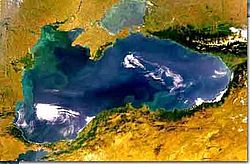
The project CRIMEA focuses on the transfer of methane from the seafloor through the water column and into the atmosphere from submarine high-intensity methane seeps and outbursts in the Black Sea. The aim is to evaluate their possible contribution to changes in atmospheric composition and their possible impact on climate processes. The project is innovative as it focuses on high-intensity seeps that vigorously eject methane into the water column or immediately into the atmosphere. Such seeps are more likely to have a pronounced effect on atmosphere and climate than the "normal" steady seeps where the larger part of the methane is dissolved and oxidized, consumed by bacteria or fixed in seafloor carbonate crusts.
GEOMAR is a leading specialist in the scientific study of hydrates, seeps and seep-associated processes. It is involved in several WPs. It participates in the seimic surveys, in close co-operation with RCMG, and is responsible for the multi-beam survey. GEOMAR is a convener of WP3. It executes the flare-imaging survey for mapping gas jets and plumes. It deploys a newly developed Fluid-Flow-Observatory for measuring the flux of escaping gases and performs in-situ analyses of escaping gases. It also plays an important role in WP5, where it deploys a novel methane equilibrator to analyze methane content and flux in the surface waters and the air, and it is involved in the isotopic analyses.