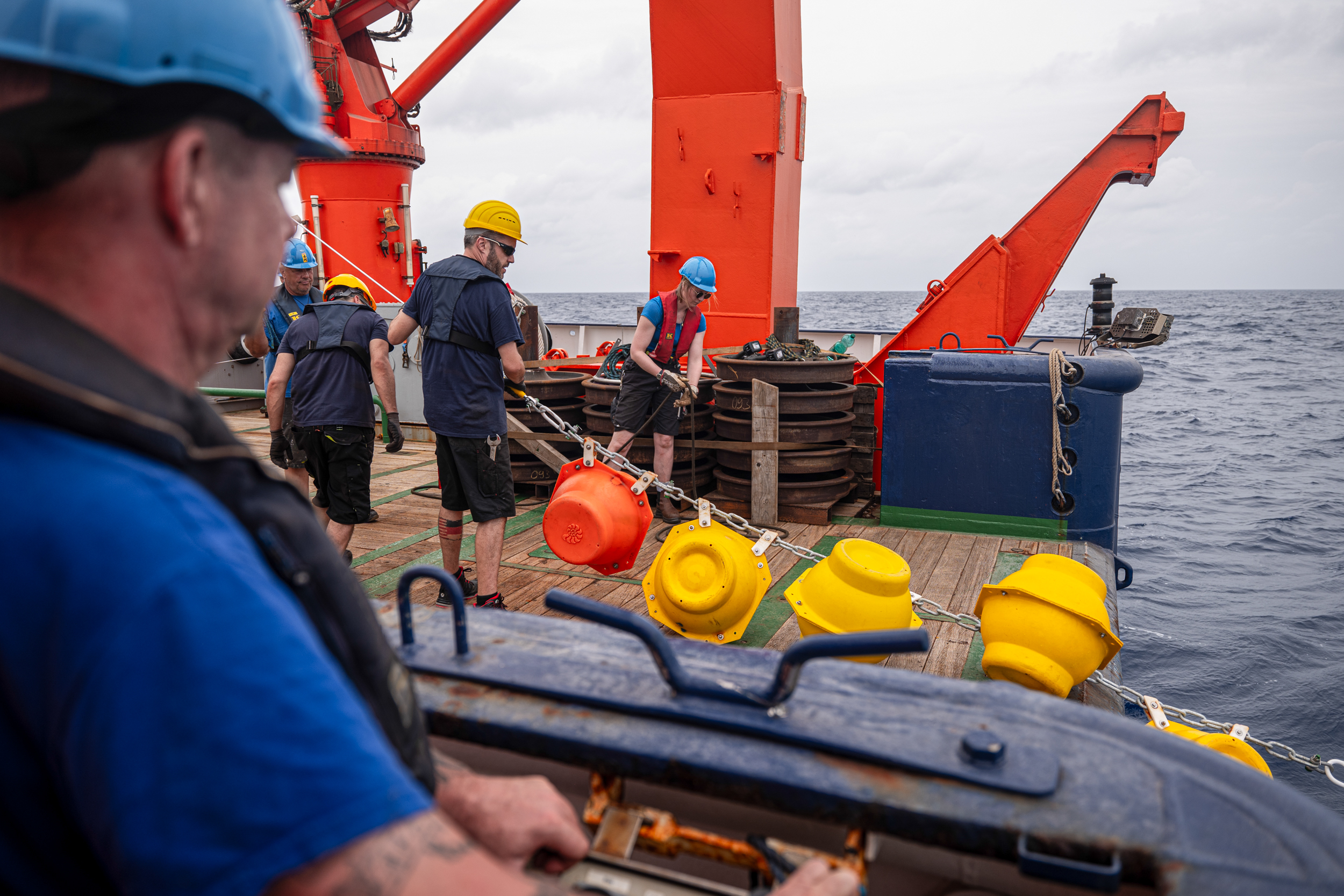
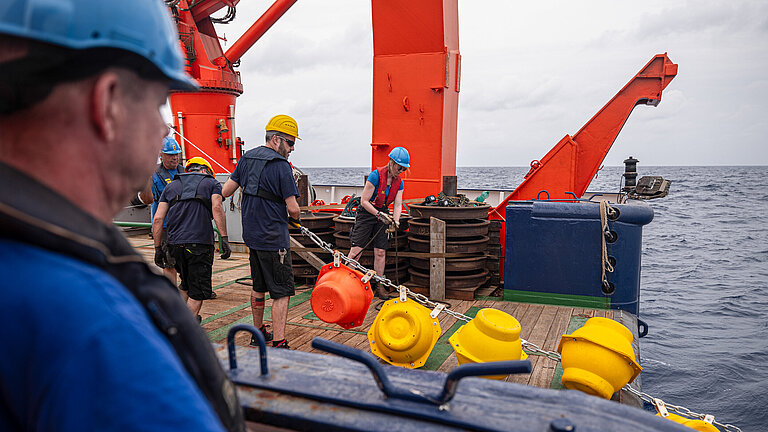
Over the weekend, the METEOR embarked on its final voyage from Brazil across the Atlantic. During the M219 expedition, several deep-sea moorings will be retrieved, serviced, and redeployed. These monitoring systems provide continuous data series over many years.
Photo: David Menzel
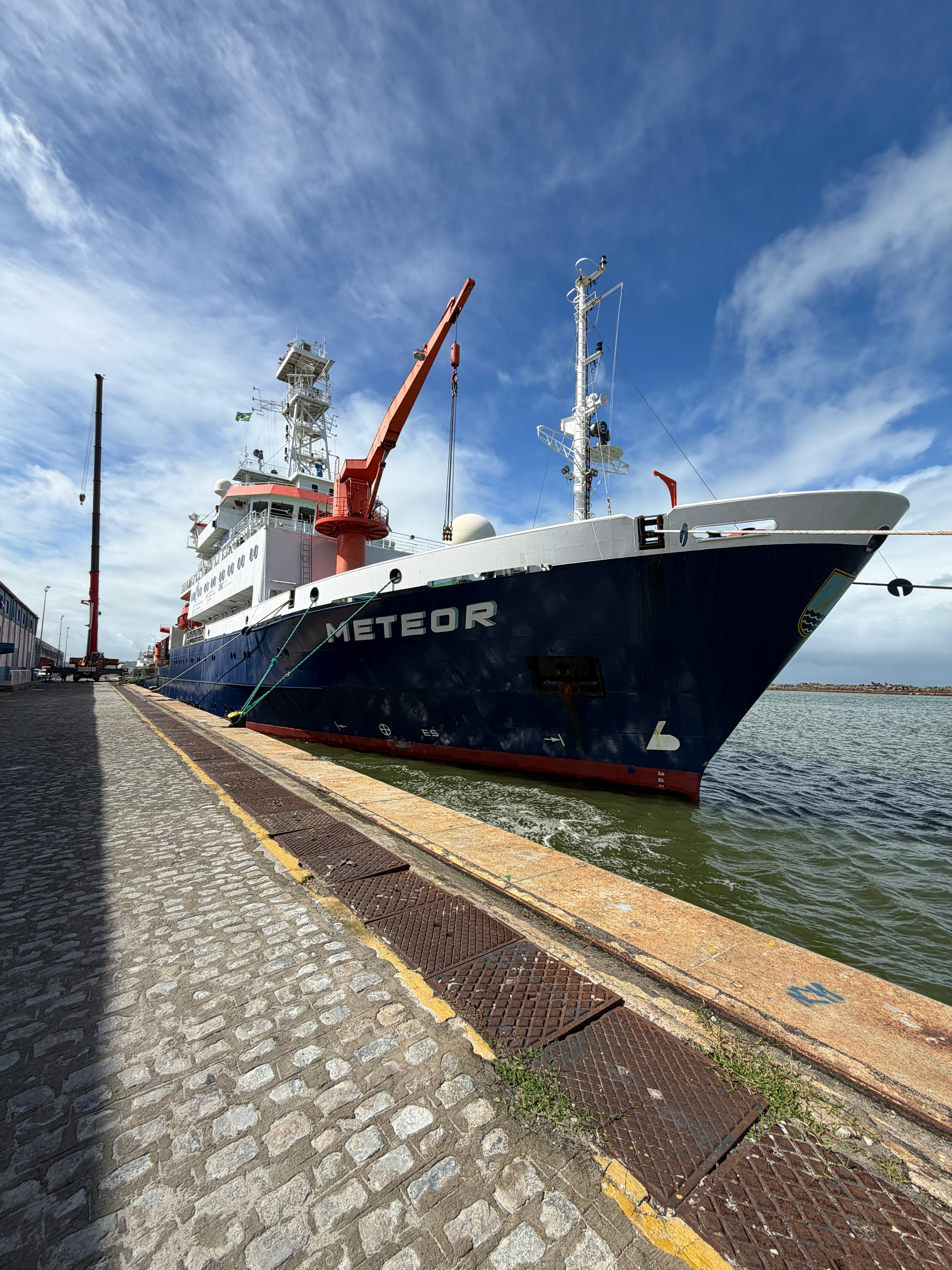
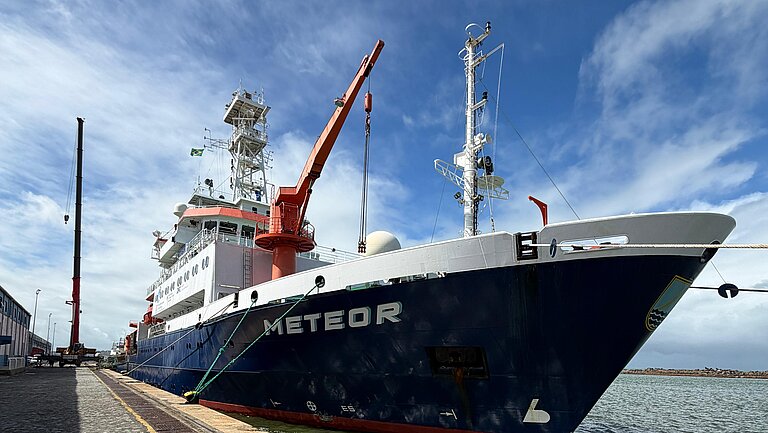
The crew consists mainly of physical oceanographers who study the major current systems in the Atlantic. During the expedition, they will focus on key aspects of the Atlantic Meridional Overturning Circulation (AMOC).
Photo: Franz Philip Tuchen, University of Miami
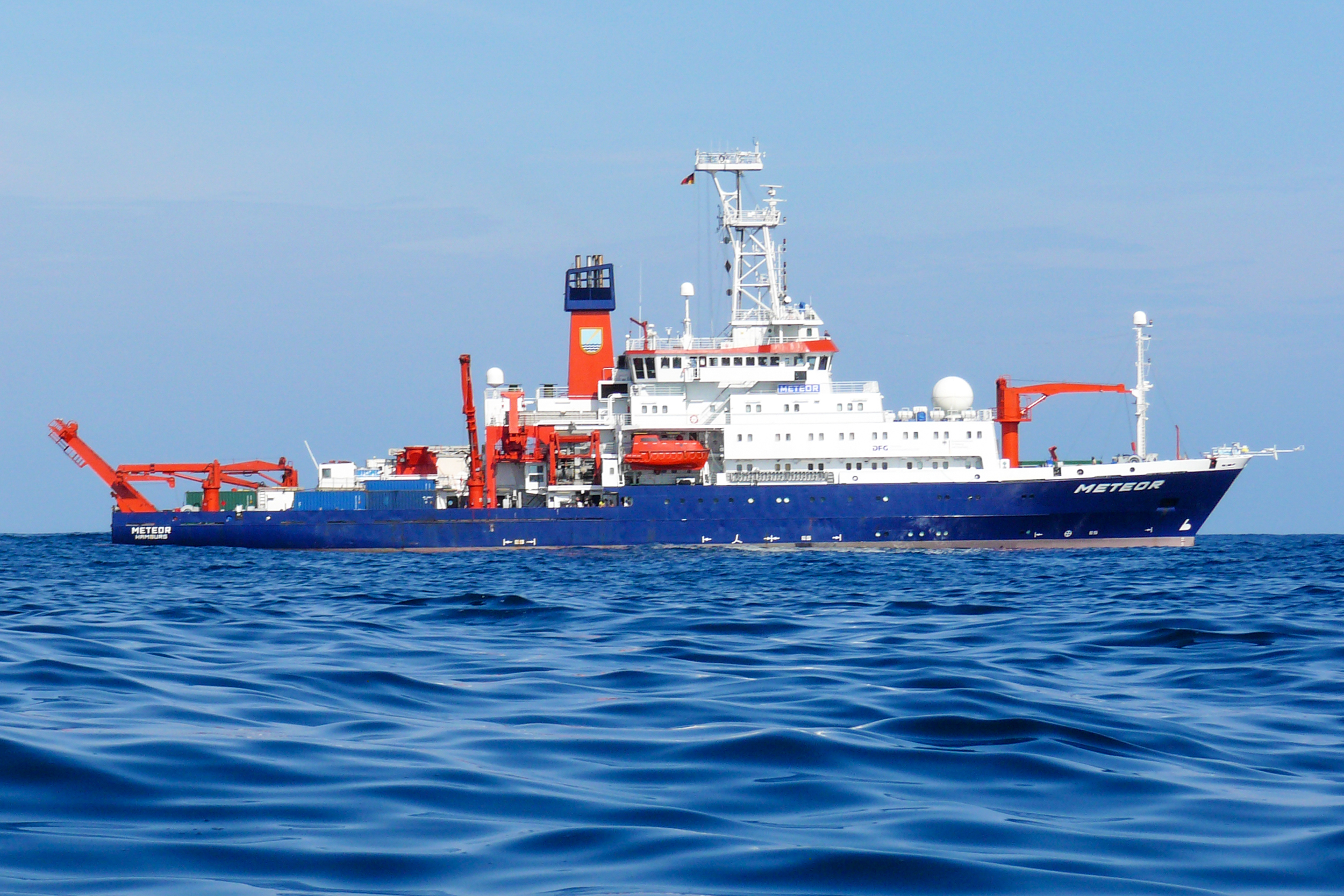
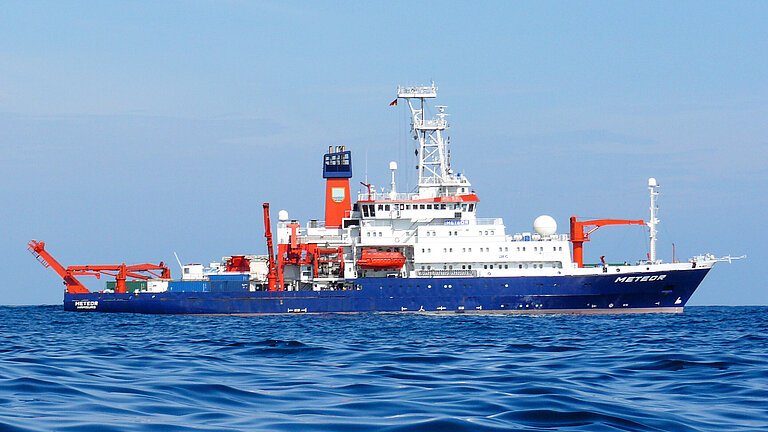
The METEOR is a vessel with a name steeped in the tradition of marine research. After 40 years of service, it will be decommissioned at the end of June.
Photo: Hermann Bange, GEOMAR
40 Years of Expedition History in its Wake
METEOR’s final research voyage investigates currents in the tropical Atlantic
Prof. Dr Peter Brandt, Head of the Physical Oceanography Research Division at GEOMAR, still remembers his first voyage on this ship vividly: “It was my first major expedition; I was still a student. The voyage took us into the Arabian Sea in the Indian Ocean during the south-west monsoon. The return journey after the research work was completed took us against the monsoon, but the wind was so strong that the METEOR couldn’t move forward at all.” That was in 1995, and the METEOR was on its 32nd voyage. Today, voyage number 219 begins, and it will be the last expedition for this METEOR. At the end of June, it will be decommissioned after 40 years of service.
The series of research vessels bearing this name dates back more than 100 years. The first METEOR was launched in Danzig (today Gdánsk, Poland) in 1915 and became the German Navy’s first research vessel in 1924. It became famous for the ‘German Atlantic Expedition’ from 1925 to 1927, during which an entire ocean basin was systematically surveyed for the first time and, among other things, evidence was provided of water exchange between the current systems of the northern and southern hemispheres. The second METEOR was in service from 1964 to 1985. The third METEOR has now been on research voyages since 1986, and the fourth METEOR is currently under construction. The new ship will be operated by the GEOMAR Helmholtz Centre for Ocean Research Kiel.
Expedition M219 – Tracing the Atlantic Climate System
The METEOR’s final voyage will once again take it across the Atlantic, from Recife in Brazil to Emden, following in the footsteps of the first METEOR. On board are mainly physical oceanographers who study the major circulation systems in the Atlantic – the Atlantic Meridional Overturning Circulation (AMOC). This circulation system transports warm surface waters northwards and cold deep waters southwards. It acts like a gigantic heating and cooling system for the climate: it distributes heat from the south towards the north, thereby influencing weather and climate far beyond the Atlantic region. It is considered certain that the AMOC will weaken as a result of global warming. But is this already happening? And to what extent? Peter Brandt: “Whether the Atlantic Meridional Overturning Circulation is already weakening can only be answered through continuous observations. Every single set of measurements is a piece of the puzzle in this global picture.”
Long-term Observation in the Tropical Atlantic
The M219 expedition is investigating key parts of the ocean circulation system. Off the coast of Brazil, the focus is on fluctuations in the North Brazilian Undercurrent and the Deep Western Boundary Current (DWBC); in addition, measurements taken at the equator provide insights into the movement of water masses and signals from the margins into the interior of the ocean. Another key focus is the multifunctional mooring north of the island of São Vicente, Cabo Verde, the Cape Verde Ocean Observatory (CVOO), which, among other things, records how the ocean absorbs and stores carbon dioxide.
During the voyage, several deep-sea moorings will be retrieved, maintained and redeployed. These measurement systems, equipped with current, temperature, oxygen and particle sensors, provide continuous data series over many years. In addition, the researchers will install bottom echo sounders with pressure sensors on the seabed, which will be used to characterise the AMOC in the tropical Atlantic. Extensive station work will also be carried out to collect data on temperature, salinity, oxygen, nutrients, currents and particle distribution in the water.
New Measuring Buoy: High-Tech in the Middle of the Ocean
The METEOR will make a port call in Mindelo, Cabo Verde (West Africa). There, a new measuring buoy will be taken on board, which is then to be anchored near the Cape Verdean long-term measuring station CVOO. The buoy was developed and built in Kiel at GEOMAR. It is designed to continuously collect data from the ocean and the air above it and transmit this to GEOMAR and Cape Verdean institutions. From this, researchers can determine how the exchange of heat and gases between the atmosphere and the ocean works. “Increased uptake of CO2 from the air and the resulting ocean acidification can have a negative impact on marine organisms,” explains Dr Björn Fiedler, a chemical oceanographer and scientific coordinator of the Cape Verde cooperation at GEOMAR. “With the newly developed buoy, we can therefore not only investigate the process of gas exchange in greater detail, but also provide valuable data on the marine ecosystem in West Africa, which supports the livelihoods of many people in the region.”
The METEOR will then set course for Emden. For expedition leader Peter Brandt, this marks the end of his 17th voyage on the METEOR: “To accompany the final voyage of a ship so significant for marine research as expedition leader – that is certainly something special.”
Expedition at a glance
Name: M219
Chief Scientist: Prof. Dr Peter Brandt
Dates: 30 May 2026 – 28 June 2026
Start: Recife (Brazil)
End: Emden (Germany)
Cruise area: Tropical Atlantic
Researchers and technical experts from several German and international institutions are participating in Expedition M219. In addition to the GEOMAR Helmholtz Centre for Ocean Research Kiel, participants include the Rosenstiel School of Marine, Atmospheric, and Earth Science, University of Miami (USA), the Federal University of Pernambuco (Brazil), the Lamont-Doherty Earth Observatory (USA), the Institute of Marine Chemistry and Biology (ICBM, University of Oldenburg) and the Centre National de la Recherche Scientifique (France). The voyage is also supported by the German Weather Service, whose on-board weather station provides meteorological measurements and weather forecasts for the expedition.
Over the weekend, the METEOR embarked on its final voyage from Brazil across the Atlantic. During the M219 expedition, several deep-sea moorings will be retrieved, serviced, and redeployed. These monitoring systems provide continuous data series over many years.
Photo: David Menzel
The crew consists mainly of physical oceanographers who study the major current systems in the Atlantic. During the expedition, they will focus on key aspects of the Atlantic Meridional Overturning Circulation (AMOC).
Photo: Franz Philip Tuchen, University of Miami
The METEOR is a vessel with a name steeped in the tradition of marine research. After 40 years of service, it will be decommissioned at the end of June.
Photo: Hermann Bange, GEOMAR