
From November 24 to 26, the GEOMAR Helmholtz Centre for Ocean Research Kiel, together with project partners from West Africa and Europe, hosted a co-design workshop for the FUTURO (Future West African Marine Ecosystem) research project in the Senegalese coastal town of Saly. Almost 70 participants were on site.
Photo: Saly Living Lab

A three-day workshop in the Senegalese coastal town of Saly brought together representatives from numerous FUTURO partner organisations this week.
Photo: Saly Living Lab

Off the coast of West Africa lies an exceptionally productive and biodiverse ecosystem that provides food and income for 200 million people. The FUTURO study area therefore encompasses the waters from Mauritania in the north to Sierra Leone in the south, extending as far as Cape Verde.
Photo: Arne Körtzinger, GEOMAR

The nearly 70 participants from various sectors, including 50 from seven West African countries and regional organizations, jointly developed concrete research topics and programme elements for the research programme FUTURO.
Photo: Saly Living Lab
Launch of the FUTURO research programme
West African and European partners are developing a long-term research programme with a one-year observation campaign off the coast of West Africa
The ongoing changes in the marine ecosystem off West Africa are complex and challenging: rising temperatures, declining oxygen levels, acidification, and increasing overfishing are shaping a region that provides a livelihood for hundreds of millions of people. The international research programme FUTURO (Future West African Marine Ecosystems) is coordinated by GEOMAR and addresses these challenges. As one of its first major activities, it will conduct a large-scale, year-long ship-based campaign off the West African coast, beginning in 2029. The aim is to establish a scientific basis for the protection and sustainable use of the West African ecosystem – particularly in light of accelerating climate change and fishing pressure.
FUTURO focuses on co-design
Off the coast of West Africa lies an exceptionally productive and biodiverse ecosystem that provides food and income for 200 million people. The FUTURO study area therefore encompasses the waters from Mauritania in the north to Sierra Leone in the south, extending as far as Cape Verde. The planned one-year research expedition aims to improve our understanding and sustainable management of the tropical upwelling zone in the Atlantic Ocean off West Africa, involving stakeholders from decision-makers, society, and science at an early stage.
Therefore, the FUTURO research programme has adopted a co-design approach: research is developed jointly with the people who live, work, or hold political responsibility in the local communities. A three-day workshop in the Senegalese coastal town of Saly this week brought together representatives from numerous partner organizations. These included researchers, political decision-makers, members of civil society organizations, and representatives from the private sector. Nearly 70 participants from the seven West African countries of Cabo Verde, Gambia, Guinea, Guinea-Bissau, Mauritania, Senegal, and Sierra Leone, as well as from Europe, met to jointly develop and refine the FUTURO research programme.
Bringing together actors from politics, society and science
FUTURO is an officially endorsed project of the United Nations Decade of Ocean Science for Sustainable Development (2021-2030) under the umbrella of the “SEAWARD Africa” Decade Programme. The FUTURO Decade Project is jointly led by GEOMAR Helmholtz Centre for Ocean Research Kiel and the Intergovernmental Oceanographic Commission Sub-Commission for Africa and Adjacent Island States (IOC-AFRICA). It includes the marine research institutes Instituto de Mar (IMar), Cabo Verde; Centre de Recherches Océanographiques de Dakar-Thiaroye (CRODT), Senegal; Institut Mauritanien de Recherches Océanographiques et des Pêches (IMROP), Mauritania; and the Leibniz Centre for Tropical Marine Research (ZMT) in Bremen.
The workshop was funded by GEOMAR, the German Federal Ministry for Economic Cooperation and Development and Kiel Marine Science (KMS) at Kiel University. "For the FUTURO project, co-design means developing research questions and approaches together with the impacted local people as equal partners in an interactive process, in order to create solutions that meet their actual needs and local circumstances. Only in this way can knowledge be generated that enjoys broad acceptance and has a long-term impact," says Prof. Dr. Arne Körtzinger, chemical oceanographer at GEOMAR and scientific coordinator of FUTURO.
The “Saly Declaration” as a joint signal
At the conclusion of the workshop, participants adopted the “Saly Declaration” – a strong call to participate in FUTURO, to strengthen cooperation between science and society in West Africa, and to support it with the necessary political and financial framework. “With the Saly Declaration, we are jointly assuming responsibility for the important marine ecosystem off the coast of West Africa, one of the most productive regions in the ocean,” said Edwin Mwashinga, Program Officer at IOC AFRICA.
What happens next?
The preparatory phase for the year-long field study is currently underway. In the coming months, the workshop results will be incorporated into the work programme and the development of further scientific modules for FUTURO. Simultaneously, the partner institutions are working on, among other things, funding plans and the establishment of transdisciplinary working groups. The actual year-long research expedition is scheduled to begin in 2029, followed by a synthesis phase in which new findings will be jointly evaluated and translated into policy recommendations. The long-term goal is to establish FUTURO as an international programme with strong African leadership.
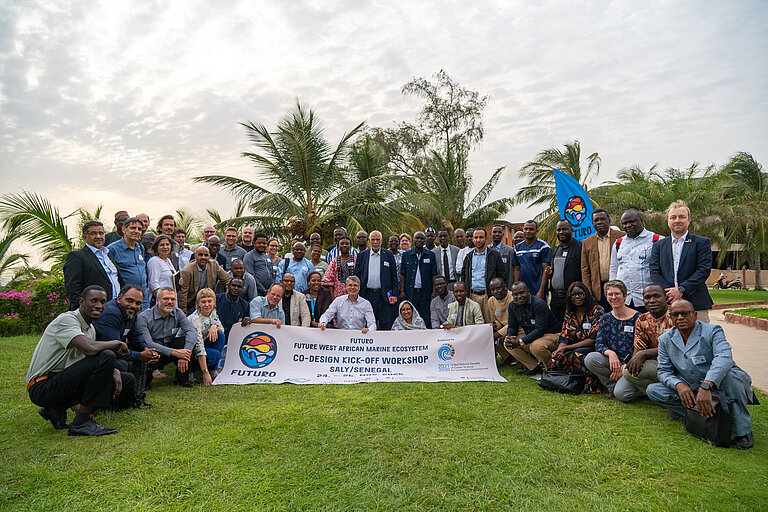
From November 24 to 26, the GEOMAR Helmholtz Centre for Ocean Research Kiel, together with project partners from West Africa and Europe, hosted a co-design workshop for the FUTURO (Future West African Marine Ecosystem) research project in the Senegalese coastal town of Saly. Almost 70 participants were on site.
Photo: Saly Living Lab
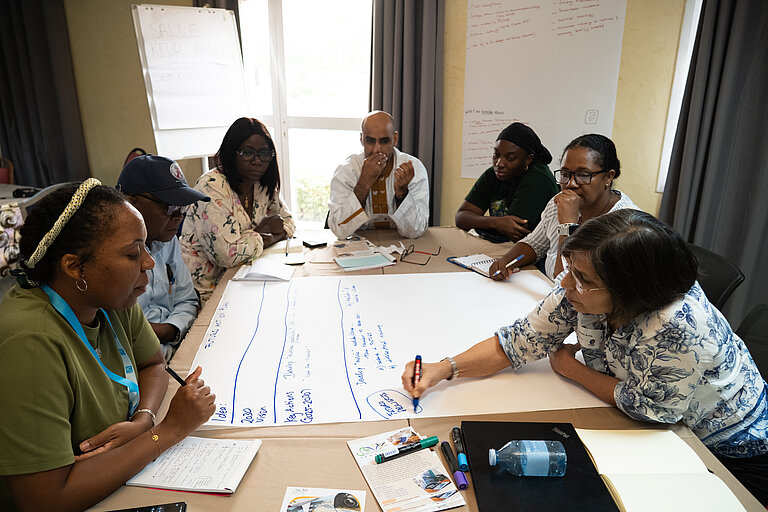
A three-day workshop in the Senegalese coastal town of Saly brought together representatives from numerous FUTURO partner organisations this week.
Photo: Saly Living Lab
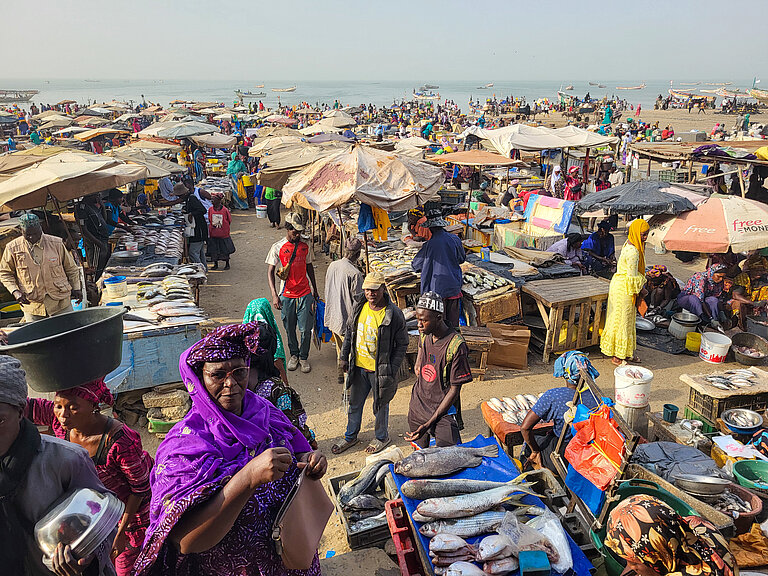
Off the coast of West Africa lies an exceptionally productive and biodiverse ecosystem that provides food and income for 200 million people. The FUTURO study area therefore encompasses the waters from Mauritania in the north to Sierra Leone in the south, extending as far as Cape Verde.
Photo: Arne Körtzinger, GEOMAR
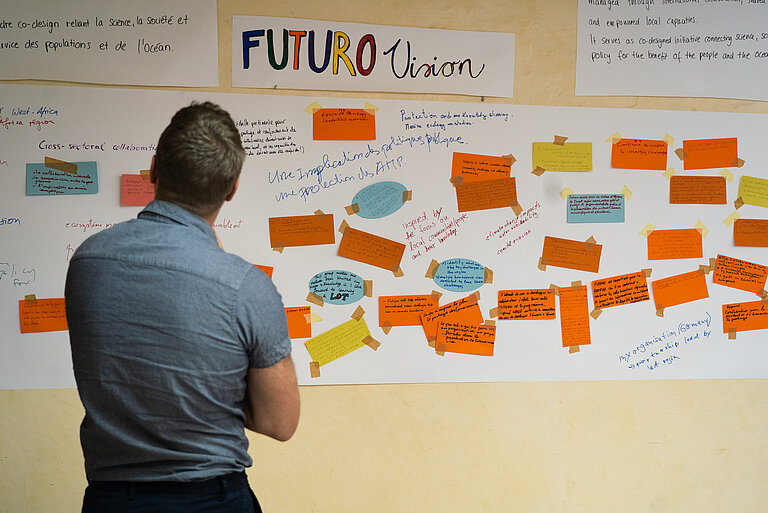
The nearly 70 participants from various sectors, including 50 from seven West African countries and regional organizations, jointly developed concrete research topics and programme elements for the research programme FUTURO.
Photo: Saly Living Lab