
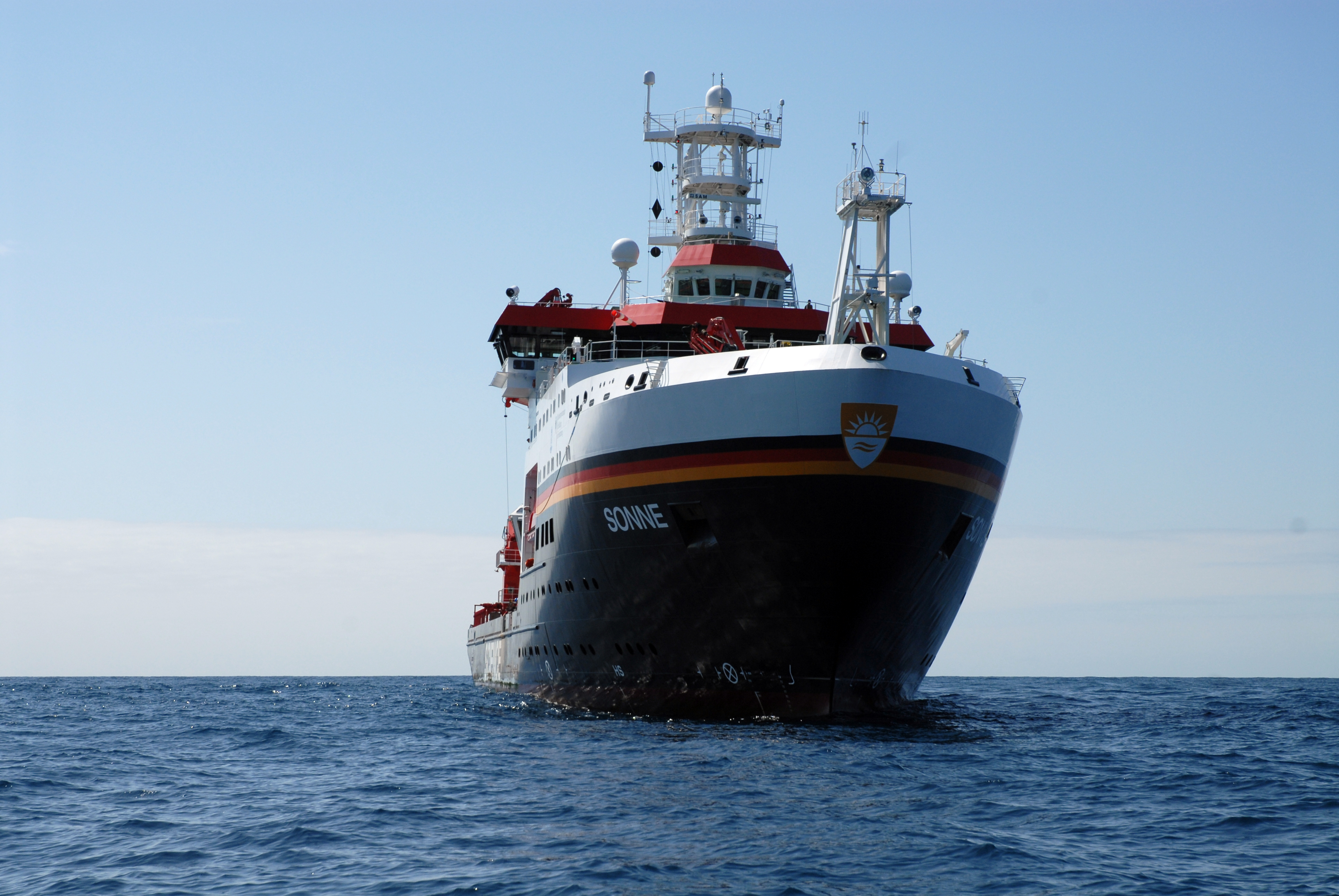
After a stopover in Honolulu, the SONNE now heads back to the Hess Rise, one of the largest and, at the same time, least explored volcanic plateaus on Earth. An international research team led by Dr Jörg Geldmacher aims to test various hypotheses regarding the formation of the plateau.
Photo: Peter Linke, GEOMAR
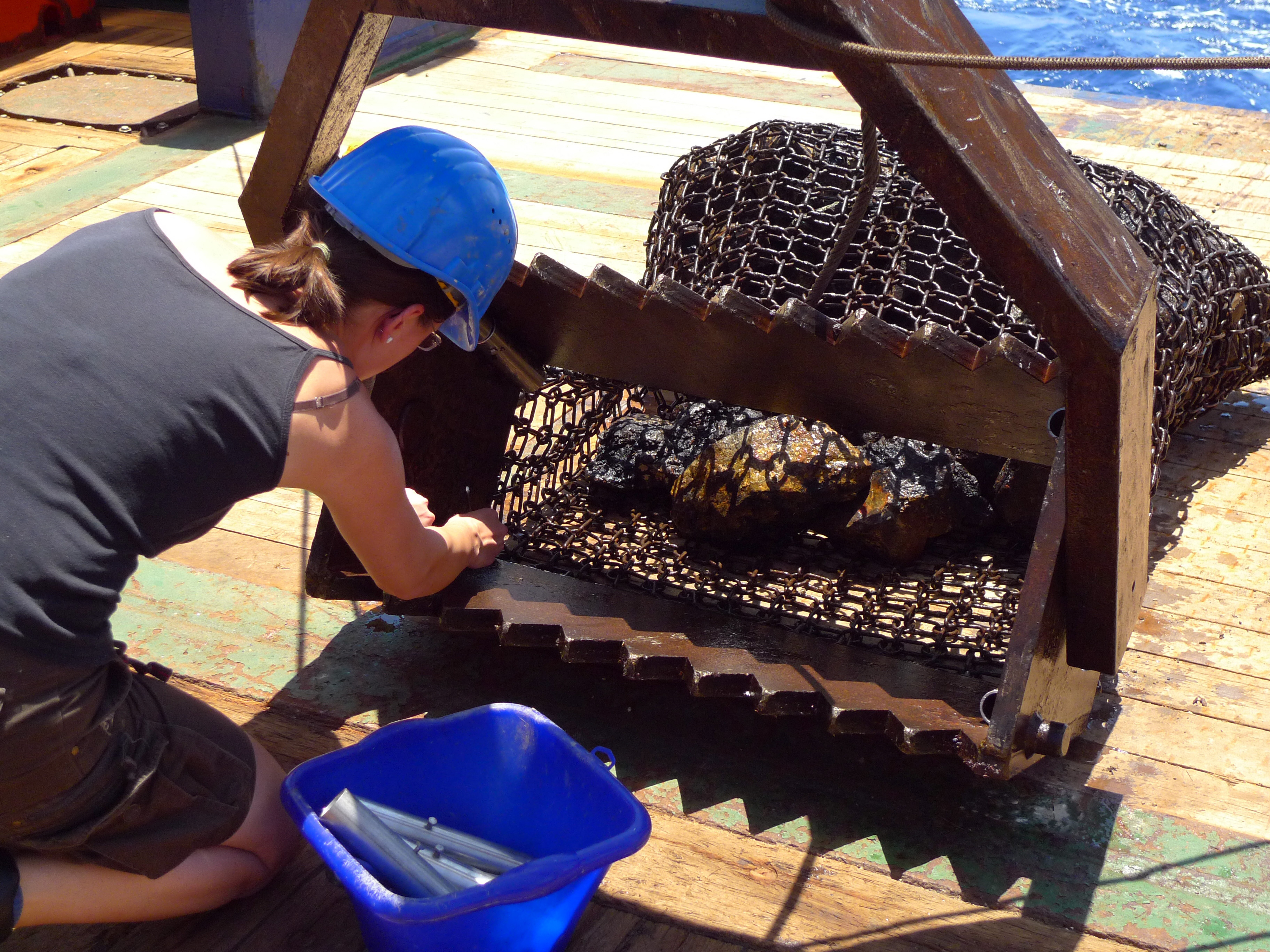
Now that the geophysical surveys have been completed, the geologists are taking over for the second part of the 'Hess Evolution' expedition. One of their most important pieces of equipment is the chain-bag dredge, which they use to collect rock samples from the seabed.
Photo: Reinhard Werner, GEOMAR
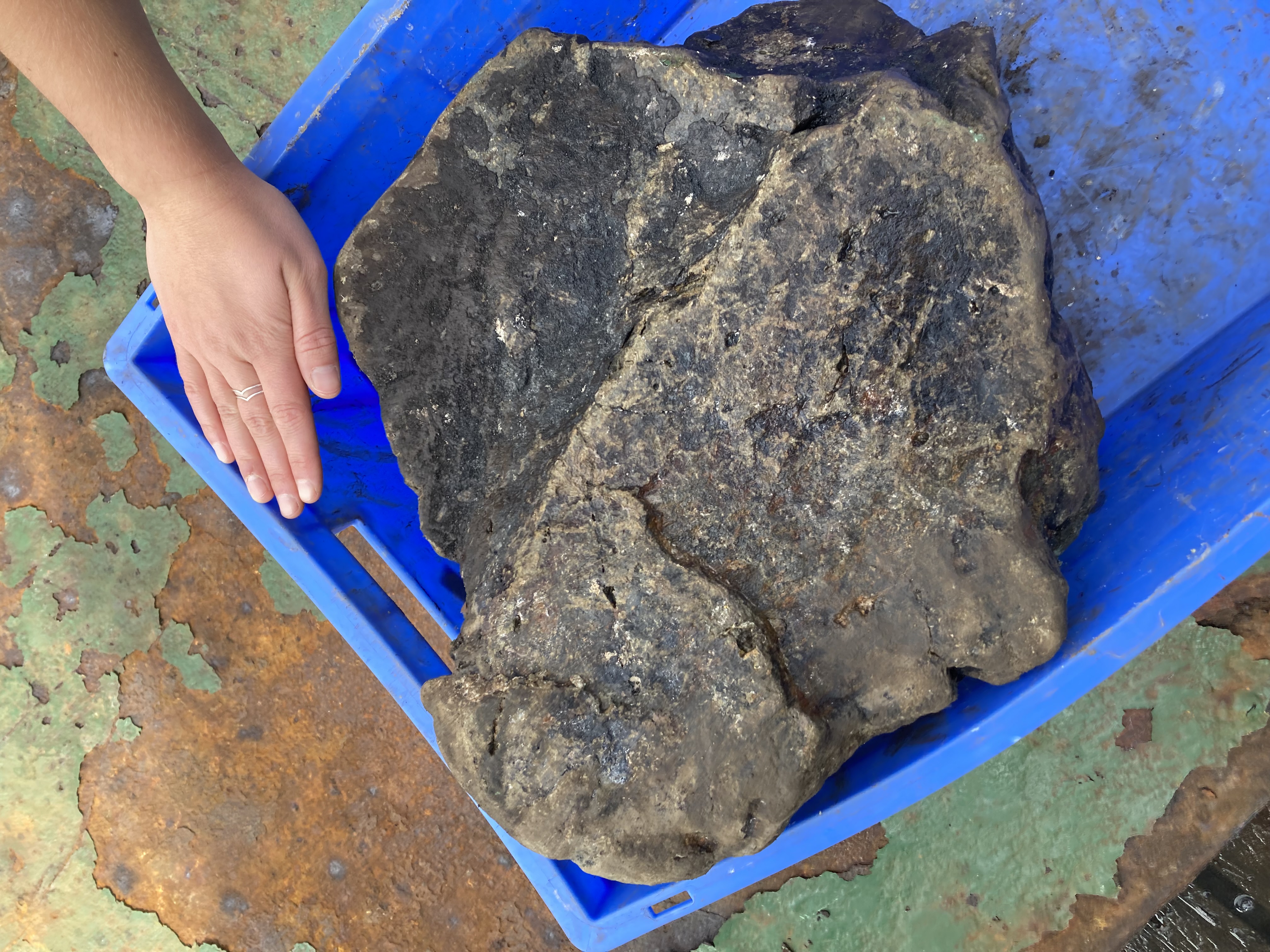
Each sample taken from the seabed is like a piece of a jigsaw puzzle. By analysing their age and chemical composition, researchers can determine the conditions and processes involved in their formation.
Photo: Jörg Geldmacher, GEOMAR
Expedition to the Origins of a Giant Beneath the Sea
SONNE Cruise SO320/2 Investigates the Age and Formation of Hess Rise
The study area lies far from any coastline. Deep beneath the waters of the North Pacific, between Japan and North America, rises a vast volcanic plateau known as Hess Rise. Extending for more than 1,000 kilometres, it is among the largest oceanic plateaus on Earth. Yet despite its immense size, remarkably little is known about it. Even its origin, around 100 million years ago, remains unresolved.
Named after Harry Hammond Hess of Princeton University, a pioneer of marine geophysics and geomorphology who first identified the feature while serving aboard the USS Cape Johnson during surveys in 1942–1943, Hess Rise continues to pose fundamental geological questions. Did it form along the path of a migrating triple junction, where three tectonic plates met? Did it develop directly at an ancient spreading centre where new oceanic crust was created? Or was it produced independently of plate boundaries by a mantle plume – an upwelling of hot material from deep within the Earth's mantle?
The expedition “Hess Evolution” aims to provide answers. The project aboard the research vessel SONNE is divided into two legs. During the first leg, led by Dr Anke Dannowski, scientists spent four and a half weeks investigating geophysical questions such as the deep structure of the plateau. Last weekend, the scientific party changed over in Honolulu and the geologists took over.
Chief Scientist Dr Jörg Geldmacher, a geochemist at GEOMAR, is bringing along his preferred scientific tool: the chain bag dredge. This device enables the efficient recovery of rock samples from great depths. “Every sample recovered from the seafloor is a piece of the puzzle. Its age and chemical composition allow us to reconstruct how and under what conditions the rock formed,” says Geldmacher.
Rock Samples from Water Depths of up to 6,000 Metres
During the expedition, rocks will be collected from the slopes and ridges of the plateau at around 55 stations, in some cases from water depths of up to 6,000 metres. Once back on shore, the samples will be analysed using geochemical and isotopic methods. Radiometric dating techniques will allow the scientists to determine when individual parts of the plateau formed. A key question is whether the rocks reveal systematic age patterns across the plateau or whether they were formed at roughly the same time.
“The age distribution across the plateau is a critical test of the competing formation models,” says Geldmacher. “It will tell us whether volcanism migrated along a tectonic structure or whether large parts of the plateau formed within a relatively short period of geological time.”
Searching for a Late Volcanic Phase
Another focus of the expedition is a series of smaller volcanic cones that sit on top of the plateau. These may provide evidence of a later phase of volcanism that occurred long after the main plateau had formed.
Such late-stage volcanic activity has also been documented on other oceanic plateaus, but its cause remains poorly understood. The new samples will reveal whether these volcanic cones are younger than the main plateau and whether they were fed by different magma sources.
“Hess Rise is one of the last major oceanic plateaus whose formation history remains largely unknown,” says Geldmacher. “With the samples collected during this expedition, we hope to identify the processes that created one of the largest volcanic complexes on our planet more than 100 million years ago.”
“In Earth’s history, volcanic events of this magnitude were often accompanied by the release of enormous quantities of volcanic gases, particularly carbon dioxide, over geologically short timescales. These episodes frequently triggered major global climate changes and mass extinctions. Understanding these processes therefore also provides an important perspective on the modern climate crisis.”
The answer is of fundamental importance for understanding our planet. Oceanic plateaus are among the largest volcanic structures on Earth, and Hess Rise may hold the key to understanding how vast volumes of magma can reach the surface in a relatively short geological period and how the tectonic evolution of the Pacific Basin unfolded.
Expedition at a Glance
Name: SONNE Expedition SO320/2 “Hess Evolution”
Chief Scientist: Jörg Geldmacher
Dates: 19 June – 3 August 2026
Start: Honolulu
End: Vancouver
Study Area: Northwestern Pacific, Hess Rise
After a stopover in Honolulu, the SONNE now heads back to the Hess Rise, one of the largest and, at the same time, least explored volcanic plateaus on Earth. An international research team led by Dr Jörg Geldmacher aims to test various hypotheses regarding the formation of the plateau.
Photo: Peter Linke, GEOMAR
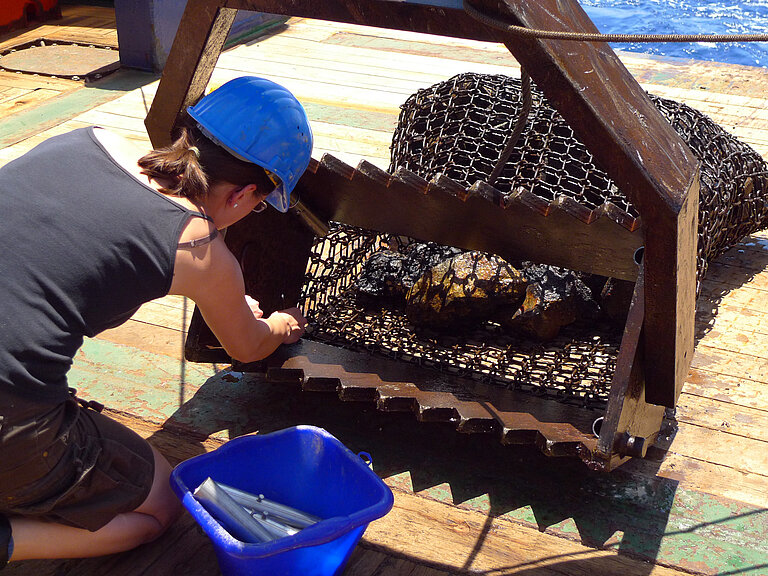
Now that the geophysical surveys have been completed, the geologists are taking over for the second part of the 'Hess Evolution' expedition. One of their most important pieces of equipment is the chain-bag dredge, which they use to collect rock samples from the seabed.
Photo: Reinhard Werner, GEOMAR
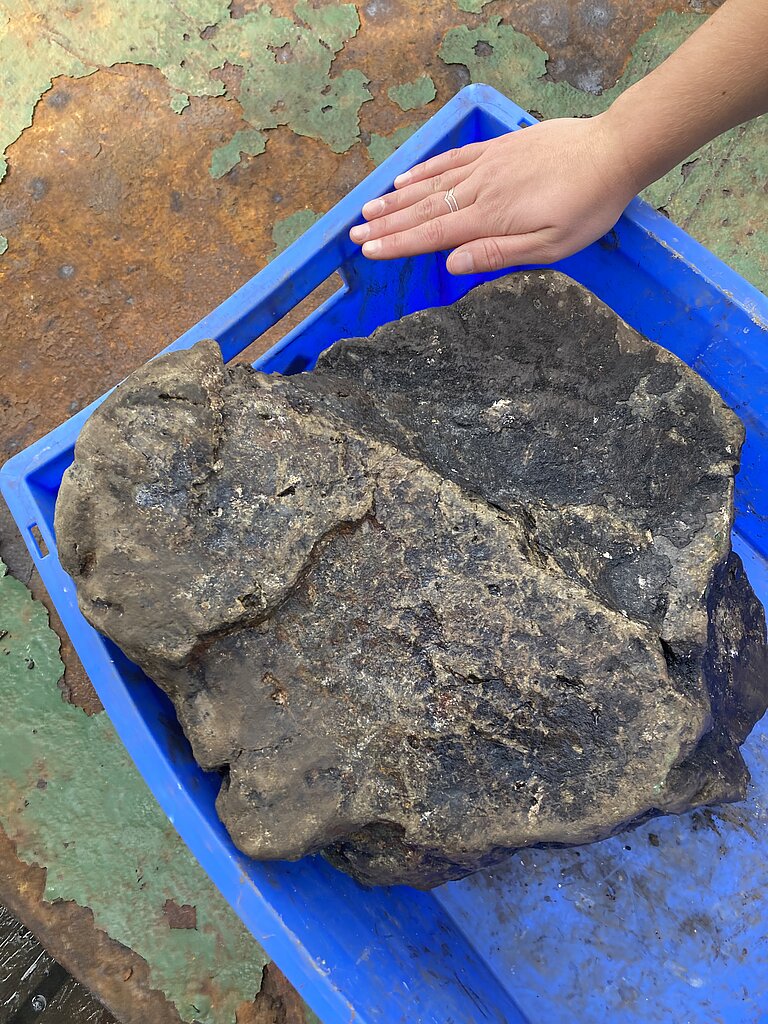
Each sample taken from the seabed is like a piece of a jigsaw puzzle. By analysing their age and chemical composition, researchers can determine the conditions and processes involved in their formation.
Photo: Jörg Geldmacher, GEOMAR