


This year's CTPR report examines the role of the ocean in the Earth's climate, as well as the changes brought about by climate change. A particular focus is given to the impact on coastal and small developing island states. Traditionally published in the run-up to the United Nations Conference of the Parties (COP), the report focuses on a different theme each year.
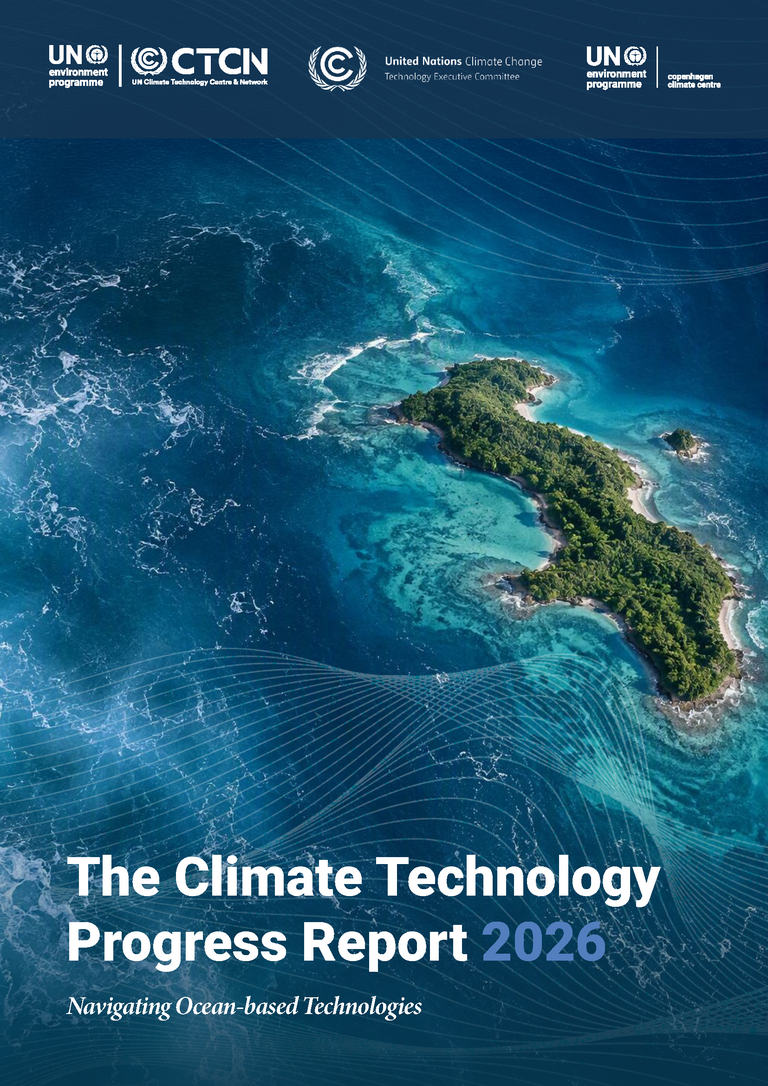
Figure: Cover of the CTPR (2026).

The ocean currently absorbs around a third of man-made CO₂ emissions, as well as around 90 per cent of the additional heat retained in the Earth’s system. As climate change accelerates, the ocean's ability to regulate our climate is under increasing pressure.
Photo: Michael Sswat, GEOMAR
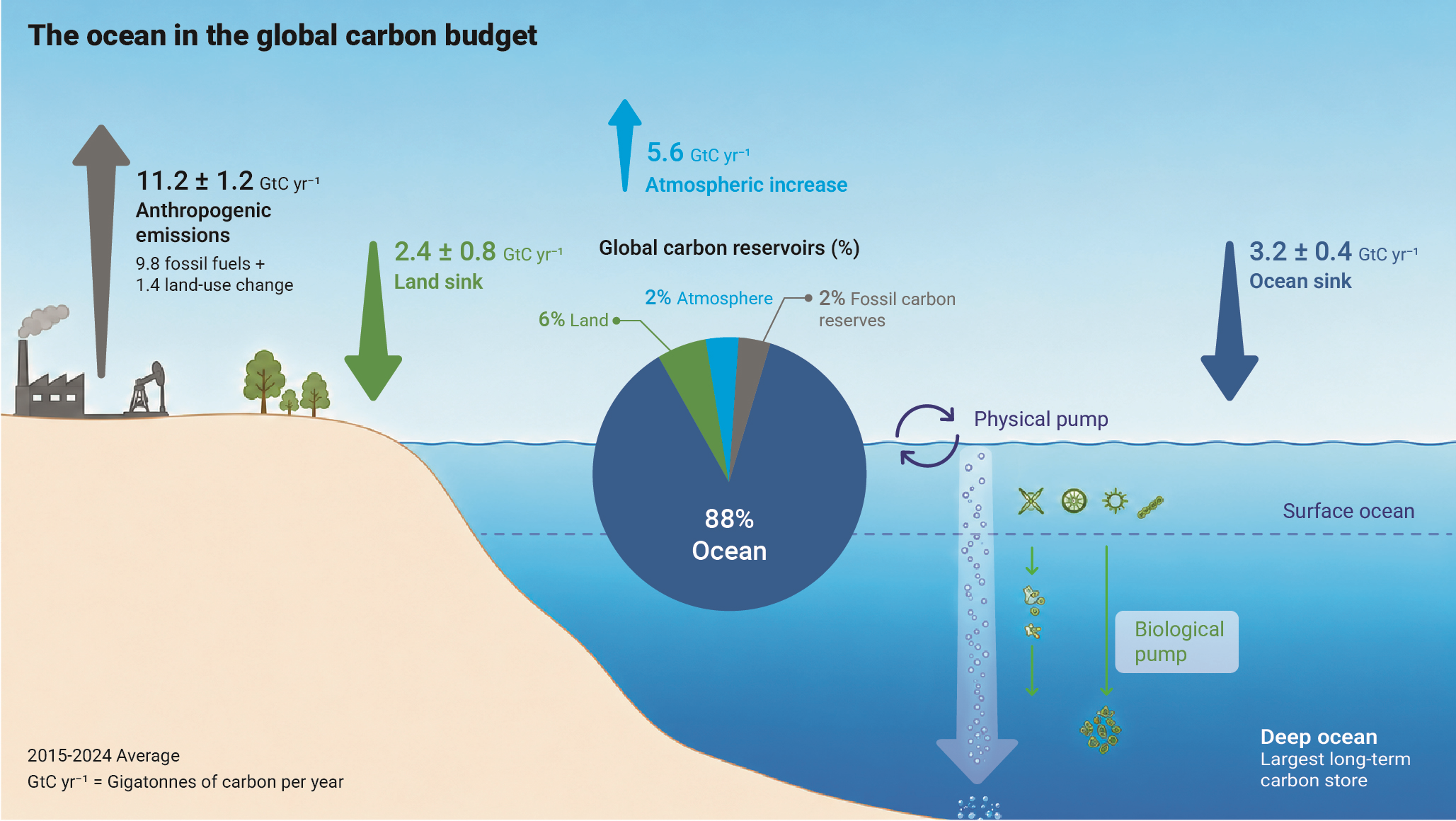
The ocean in the global carbon budget: The pie chart in the centre shows the relative sizes of the marine, terrestrial, atmospheric and fossil carbon reservoirs, illustrating that the ocean holds by far the most carbon in the system. The arrows indicate the role of the ocean and land in mitigating anthropogenic CO₂ emissions.
Illustration: CTPR (2026); Data source: Global Carbon Project (GCP) (2026).
The ocean's role in regulating the climate is under pressure
Three Helmholtz Centres contribute to new UN report on the role of the ocean in the climate system
The ocean currently absorbs around one-third of human-caused CO2 emissions and approximately 90 per cent of the additional heat retained in the Earth’s system as a result of climate change. However, the processes that enable this climate function are being compromised by global warming itself.
This is highlighted in the ‘Climate Technology Progress Report 2026‘, published today by the United Nations Environment Programme (UNEP). The report is traditionally published in the run-up to the Conference of the Parties (COP) and focuses on a different topic each year. This year, it examines the role of the ocean in the Earth’s climate and the changes brought about by climate change.
“A weaker carbon sink in the ocean means that more carbon dioxide remains in the atmosphere, making climate targets harder and costlier to achieve. The ocean has bought humanity time in the fight against climate change. We cannot afford to take this role for granted,” said Martin Krause, Head of the Climate Change Division at UNEP.
State of the Ocean Carbon Sink
The chapter on the fundamentals of carbon uptake in the ocean was written by seven authors, led by two GEOMAR researchers: Dr Nadine Mengis and Dr Judith Ziegler. It is entitled ‘State of the Ocean Carbon Sink – Trends, Variability, Mechanisms and FutureChange’ and describes the ocean as a central but vulnerable regulator of the climate system.
“Without the ocean, global warming would be significantly more advanced today, as it has absorbed almost 30 per cent of the CO2 that we humans have emitted so far,” says Judith Ziegler. “However, due to climate change, the ocean is already absorbing around six per cent less carbon than it otherwise could. If we want to preserve this vital climate service, it is crucial that we reduce emissions rapidly and significantly.”
Alongside the GEOMAR researchers, Dr Judith Hauck from the Alfred Wegener Institute, Helmholtz Centre for Polar and Marine Research (AWI), also contributed to the chapter. In particular, she drew on her expertise from the Global Carbon Budget and from regional carbon budgets within the framework of RECCAP (Regional Carbon Cycle Assessment and Processes). For the Global Carbon Budget, Hauck coordinates the annual estimate of the ocean’s CO2 uptake. Judith Hauck presented the state of the ocean as a carbon sink during today’s online launch of the report.
Climate protection technologies are no substitute for emissions reductions
Dr Bryce van Dam from Hereon, yet another researcher from the Helmholtz Association, was also involved in the report. Together with Prof. Dr Christopher Pearce from the UK’s National Oceanography Centre (NOC), he was responsible for the chapter on technologies for monitoring, managing and enhancing the oceanic carbon sink. The chapter highlights the growing interest in ocean-based climate protection approaches – such as the restoration of blue carbon ecosystems or marine approaches to carbon dioxide removal. At the same time, it emphasises that such technologies can only play a supplementary role and are no substitute for rapid and sustained emissions reductions. Prerequisites include a strong scientific basis, transparency, environmental standards and effective governance.
A key focus of the report is therefore the expansion of ‘Ocean Carbon Intelligence’. This refers to the interplay between ocean observation, data analysis and modelling, as well as strong international cooperation. Until now, significant gaps in monitoring networks, data systems and scientific understanding have prevented governments and investors from realistically assessing climate risks and making informed decisions.
Fair access to finance and technology
The report also emphasises that equitable access to finance, technology, data and capacity-building – particularly for coastal states and Small Island Developing States – is crucial to ensuring that ocean-based climate measures can be implemented effectively and fairly.
“How much CO2 the ocean absorbs depends on complex physical, chemical and biological processes – and these vary greatly depending on the region and the time of year,” says Nadine Mengis. “Additional observations across the entire carbon cycle would help to better understand the ocean’s carbon sink and improve regional and global models. This requires long-term international cooperation and reliable resources for ocean observation networks.”
The report was published by the UNEP Copenhagen Climate Centre (UNEP-CCC) in collaboration with the Climate Technology Centre and Network (CTCN) and the Technology Executive Committee (TEC) of the United Nations Framework Convention on Climate Change.
Judith Ziegler will present the report at a UNEP event during the COP31 in Antalya.
About: The Climate Technology Progress Report
The Climate Technology Progress Report (CTPR) is published annually ahead of the UN Climate Change Conference (COP). It is produced by the Copenhagen Climate Centre of the United Nations Environment Programme (UNEP-CCC) in collaboration with the Climate Technology Centre and Network (CTCN) and the Technology Executive Committee (TEC) of the United Nations Framework Convention on Climate Change (UNFCCC). The report is aimed at national planners and decision-makers, as well as funding and development organisations. It analyses the conditions that drive the development and transfer of climate technologies and identifies where gaps exist. The 2026 edition focuses on technologies that protect or enhance the uptake and long-term storage of carbon in the ocean. Its production is supported by the Danish Ministry of Foreign Affairs.
This year's CTPR report examines the role of the ocean in the Earth's climate, as well as the changes brought about by climate change. A particular focus is given to the impact on coastal and small developing island states. Traditionally published in the run-up to the United Nations Conference of the Parties (COP), the report focuses on a different theme each year.
Figure: Cover of the CTPR (2026).

The ocean currently absorbs around a third of man-made CO₂ emissions, as well as around 90 per cent of the additional heat retained in the Earth’s system. As climate change accelerates, the ocean's ability to regulate our climate is under increasing pressure.
Photo: Michael Sswat, GEOMAR
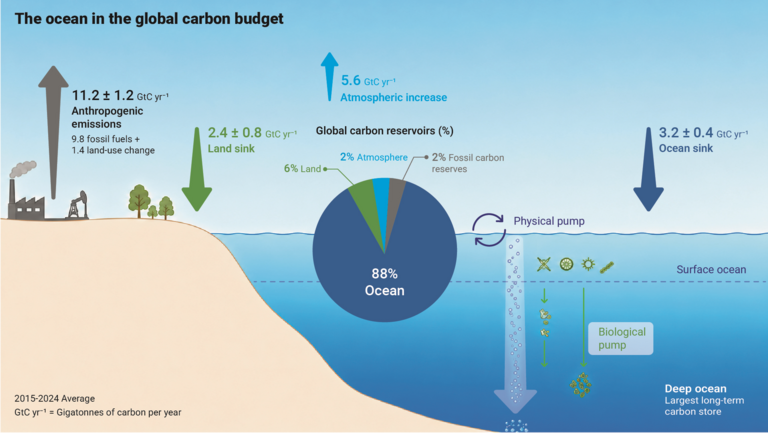
The ocean in the global carbon budget: The pie chart in the centre shows the relative sizes of the marine, terrestrial, atmospheric and fossil carbon reservoirs, illustrating that the ocean holds by far the most carbon in the system. The arrows indicate the role of the ocean and land in mitigating anthropogenic CO₂ emissions.
Illustration: CTPR (2026); Data source: Global Carbon Project (GCP) (2026).
