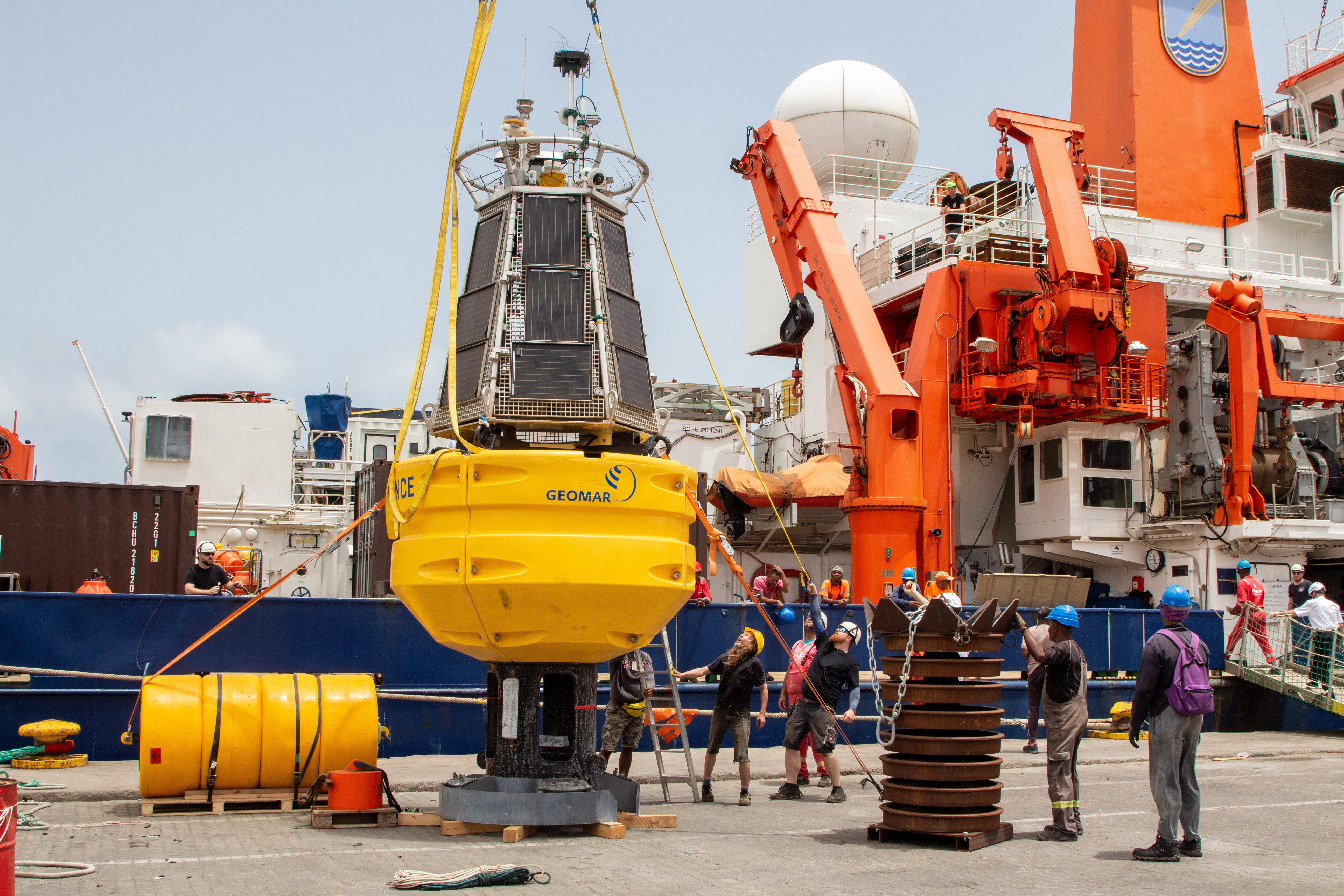
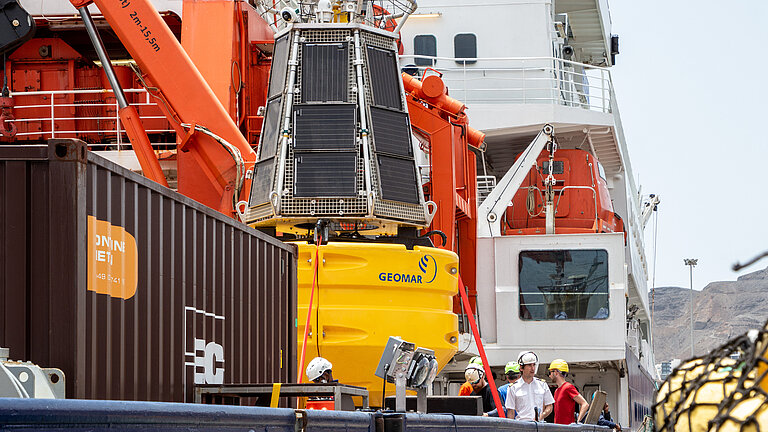
The new measuring buoy is being loaded at the port of Mindelo in Cape Verde. It is set to provide data on gas exchange between the ocean and the atmosphere in future.
Photo: Edson Silva Delgado, Etfilmes/OSCM
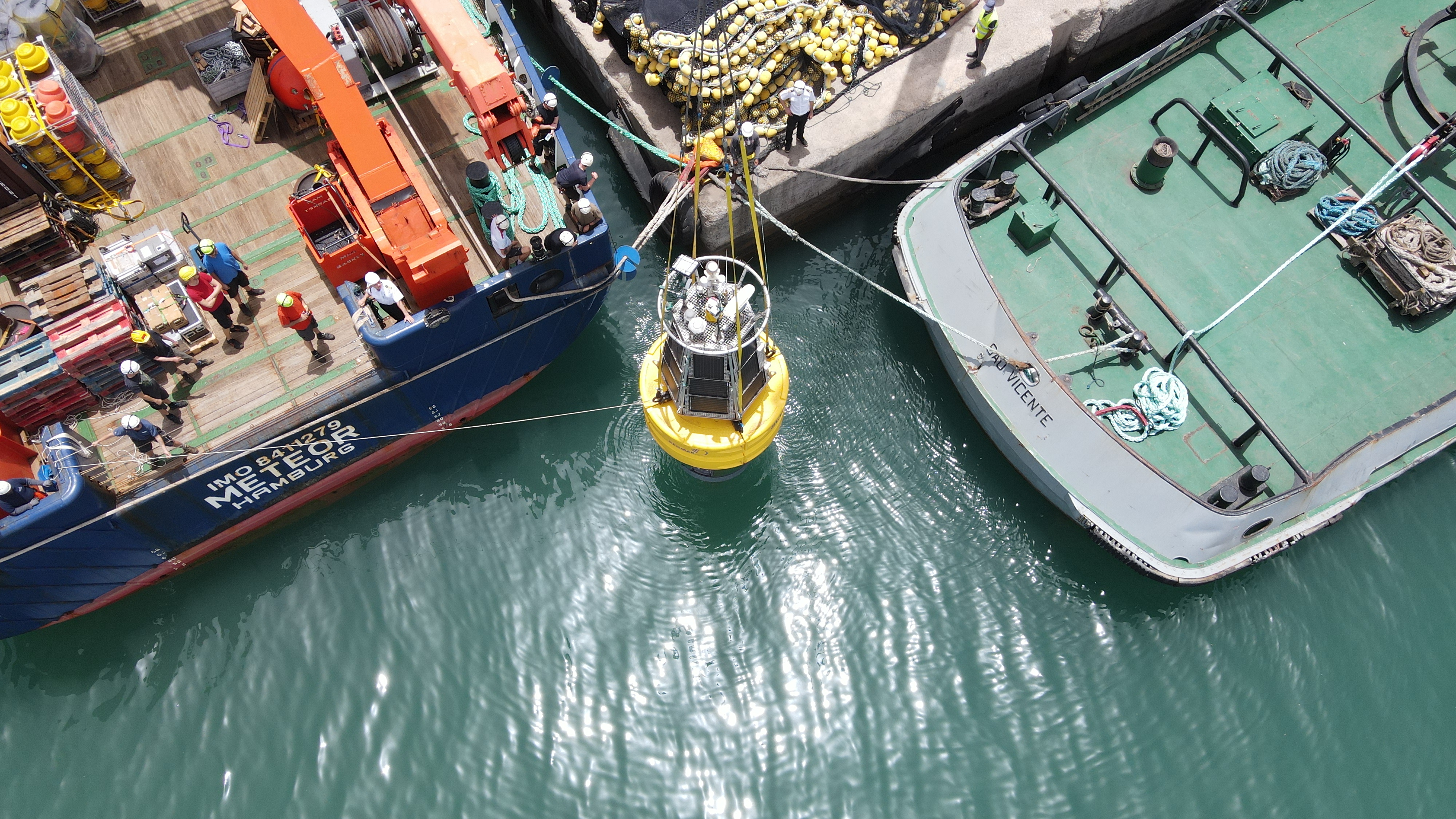
The buoy, which is around 7.5 metres high and weighs 3.5 tonnes, was developed and built at GEOMAR in Kiel. Eighteen solar panels provide the buoy with an autonomous power supply, enabling the transmission of real-time data via satellite.
Photo: Edson Silva Delgado, Etfilmes / OSCM
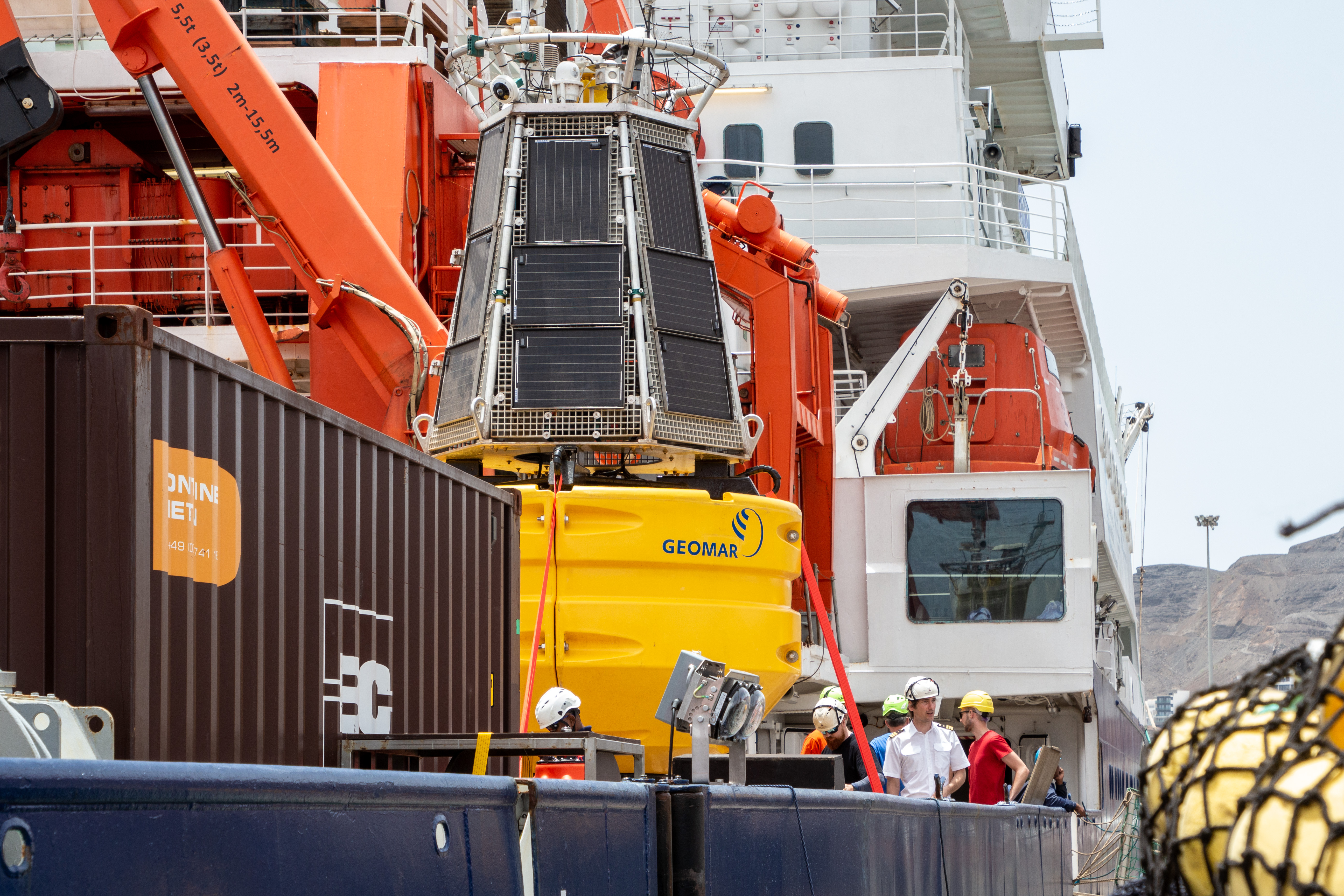
The buoy on the aft deck of the research vessel METEOR: Deploying and mooring the new buoy at the Cape Verde Ocean Observatory (CVOO) was the ship’s final scientific task before it will be decommissioned at the end of the month.
Photo: Edson Silva Delgado Etfilmes / OSCM
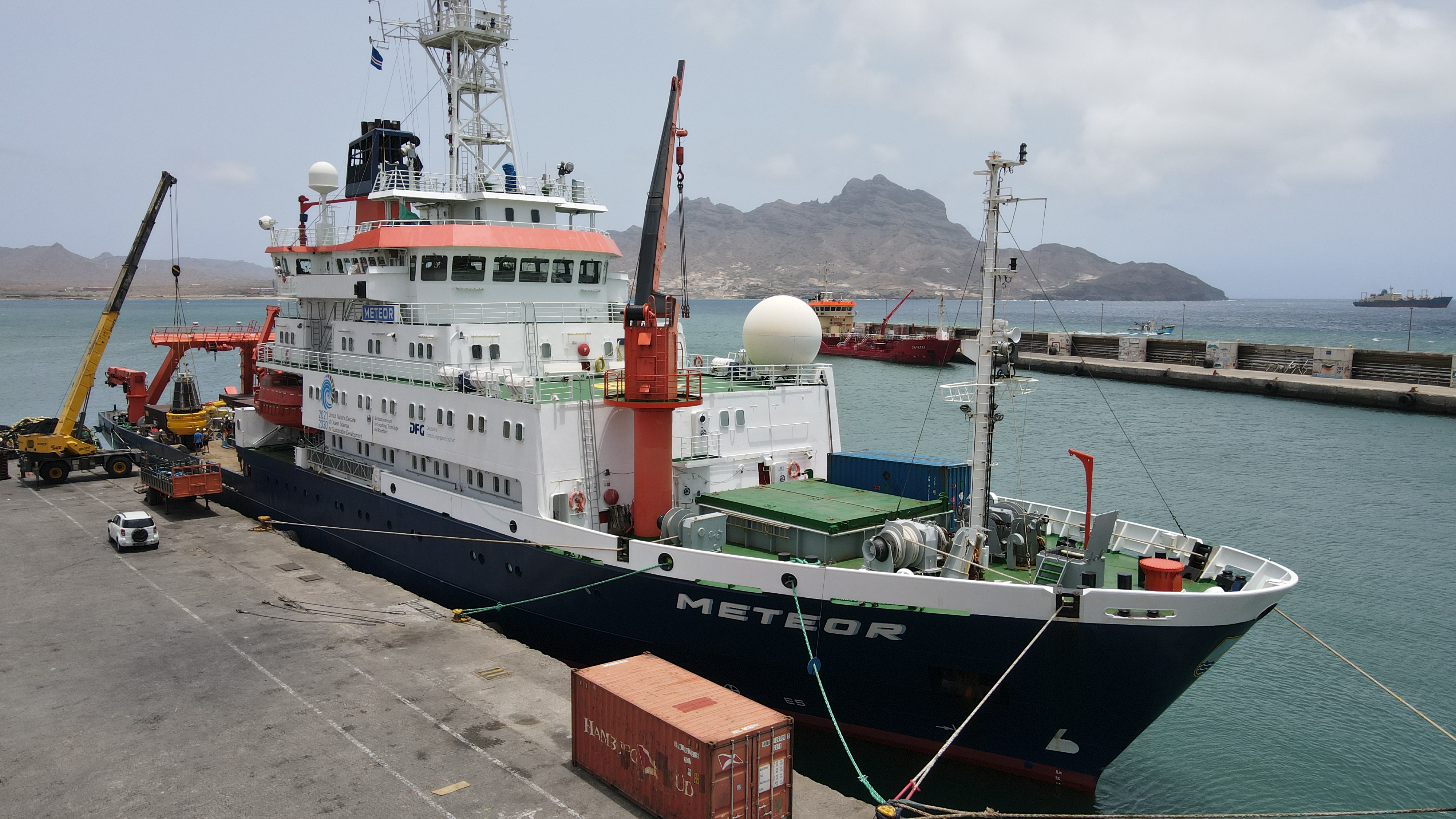
The METEOR delivered the buoy to its destination in the tropical Atlantic. There, it is now continuously gathering valuable data on the state of the ocean off the coast of West Africa, an area that has hitherto had little observational infrastructure.
Photo: Edson Silva Delgado Etfilmes / OSCM
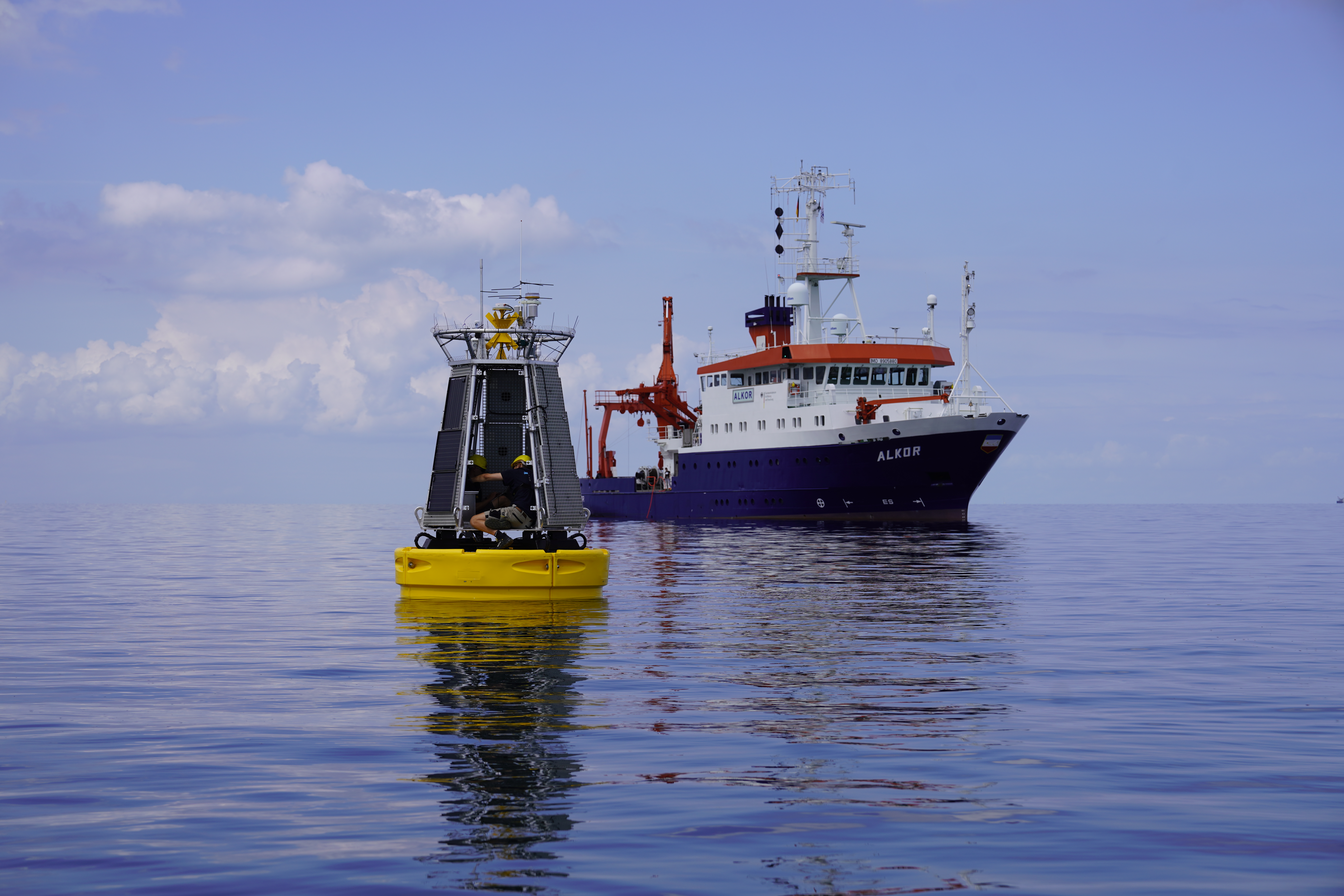
The buoy during a test run in the Baltic Sea: It has since reached its destination and is now part of the ocean observatory near the Cape Verde Islands, the CVOO. This observatory has been collecting long-term data since 2006. It is affiliated with the Ocean Science Centre Mindelo (OSCM) in Mindelo on São Vicente.
Photo: Louisa Trippe, GEOMAR
New buoy for the Cape Verde Ocean Observatory
While the U.S. is threatening to dismantle its deep-sea monitoring network, GEOMAR is expanding its long-term monitoring in the Northeast Atlantic
Anyone wishing to understand the ocean and its interaction with the climate needs data. Ideally, data collected over long periods at the same location and under consistently the same conditions. This is where long-term observations, or time series, come in. The older they are, the more valuable their data treasure trove becomes, as it reveals changes over extended periods. Much of what science knows today about ocean warming and acidification, or changes in major ocean circulation systems, is based on such long-term data.
A significant portion of this infrastructure is at risk: In early June, the U.S. National Science Foundation (NSF) announced that it would be scaling back large parts of its Ocean Observatories Initiative (OOI), one of the world’s largest ocean observation networks. The move has since been blocked by the U.S. Senate.
Meanwhile, efforts are underway in Europe to expand ocean observation. Earlier this month, the European Union sent a clear signal with the Ocean Eye initiative: by 2035, Europe aims to provide thirty-five per cent of a global ocean observation system – a task to which the GEOMAR Helmholtz Centre for Ocean Research Kiel will also contribute with its scientific and technical expertise.
GEOMAR has recently expanded a long-term observatory in the tropical Atlantic: at the Cape Verde Ocean Observatory, north of the Cape Verdean island of São Vicente, a new measuring buoy has been successfully deployed; in future, it will continuously measure gas exchange between the ocean and the atmosphere and make the data available in real time. The buoy was loaded onto the research vessel METEOR at the port of Mindelo, which then transported it to its destination far off the coast.
A US buoy, which was part of the international PIRATA buoy network (Prediction and Research Moored Array in the Tropical Atlantic), is currently being decommissioned near the new buoy. The US National Oceanic and Atmospheric Administration (NOAA) is decommissioning it as part of budget cuts implemented by the US government under President Donald Trump. The GEOMAR buoy will therefore at least partially fill the data gap that is emerging at this location in the Atlantic.
What the buoy measures
There is a constant exchange between the ocean and the atmosphere – of heat, but also of gases such as carbon dioxide (CO2). To better monitor this exchange in an area that has hitherto had little observational infrastructure, the buoy continuously measures data from the ocean and the air above it. It was developed and built at GEOMAR in Kiel. With a diameter of around three metres, a height of approximately 7.5 metres and a weight of 3.5 tonnes, it is a technically sophisticated structure: 18 solar panels provide it with autonomous power, whilst a radar reflector and a signal lantern make it visible to shipping.
In the air, the buoy measures temperature, relative humidity, air pressure and CO2 levels. In the water, it measures, amongst other things, temperature, oxygen and CO2 levels. Only by comparing the values in the air and in the water can it be determined whether the ocean is currently absorbing or releasing carbon dioxide at this location. The data is supplemented by measurements of wave conditions and meteorological data collected in collaboration with the German Weather Service (DWD).
Why gas exchange is important for ecosystems
“Increased uptake of carbon dioxide from the air and the resulting acidification of the ocean can have a negative impact on marine organisms,” explains Dr Björn Fiedler, a chemical oceanographer and scientific coordinator of the Cape Verde cooperation at GEOMAR. “With the newly developed buoy, we can therefore not only investigate the process of gas exchange in greater detail, but also provide valuable data on the marine ecosystem off West Africa, which forms the basis of livelihoods for many people in the region.”
The new data supplement the long-term measurements that the Cape Verde Ocean Observatory has been providing for years, adding a previously missing component: the exchange between water and air – measured over a long period at the same location and under consistent conditions. Particularly in view of the serious cuts currently threatening other major ocean observation systems, such continuous, freely accessible measurement series are becoming increasingly important.
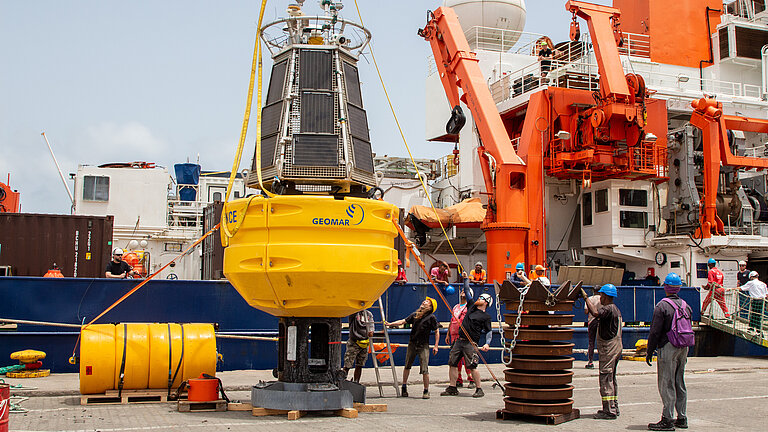
The new measuring buoy is being loaded at the port of Mindelo in Cape Verde. It is set to provide data on gas exchange between the ocean and the atmosphere in future.
Photo: Edson Silva Delgado, Etfilmes/OSCM
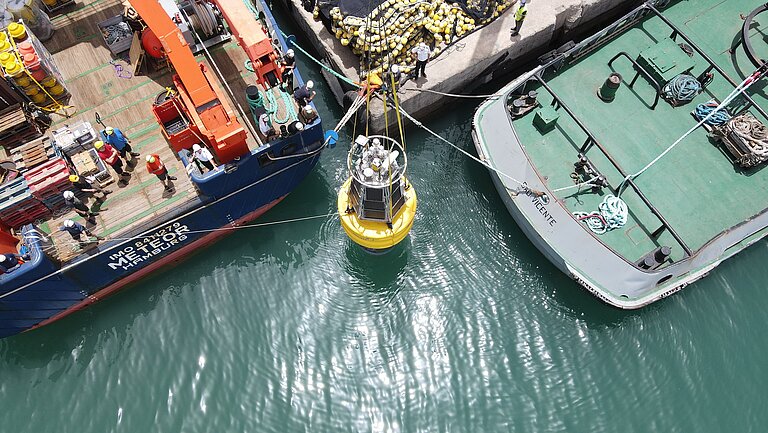
The buoy, which is around 7.5 metres high and weighs 3.5 tonnes, was developed and built at GEOMAR in Kiel. Eighteen solar panels provide the buoy with an autonomous power supply, enabling the transmission of real-time data via satellite.
Photo: Edson Silva Delgado, Etfilmes / OSCM
The buoy on the aft deck of the research vessel METEOR: Deploying and mooring the new buoy at the Cape Verde Ocean Observatory (CVOO) was the ship’s final scientific task before it will be decommissioned at the end of the month.
Photo: Edson Silva Delgado Etfilmes / OSCM
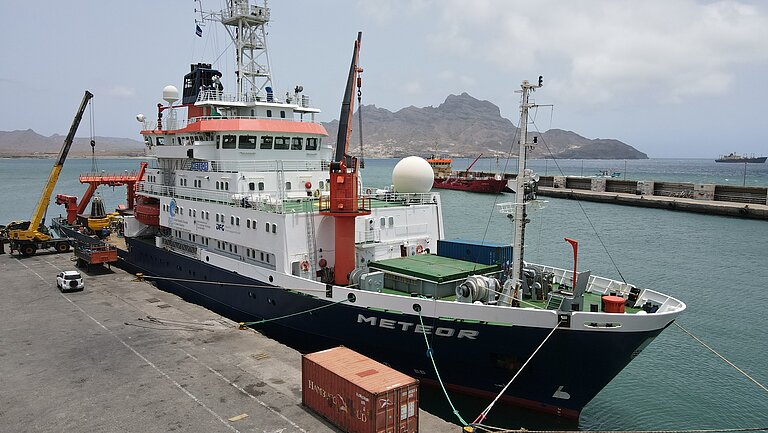
The METEOR delivered the buoy to its destination in the tropical Atlantic. There, it is now continuously gathering valuable data on the state of the ocean off the coast of West Africa, an area that has hitherto had little observational infrastructure.
Photo: Edson Silva Delgado Etfilmes / OSCM
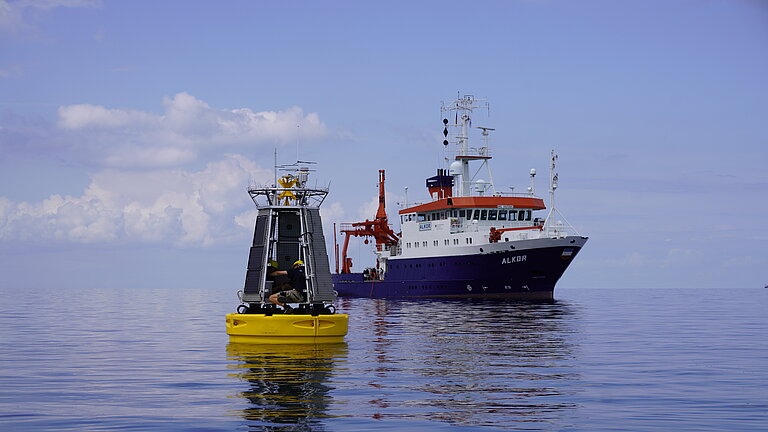
The buoy during a test run in the Baltic Sea: It has since reached its destination and is now part of the ocean observatory near the Cape Verde Islands, the CVOO. This observatory has been collecting long-term data since 2006. It is affiliated with the Ocean Science Centre Mindelo (OSCM) in Mindelo on São Vicente.
Photo: Louisa Trippe, GEOMAR