

In the new video podcast, Prof. Dr Klaus Wallmann discusses the current state of play regarding carbon dioxide storage under the sea with Kristin Hamann, and offers recommendations for action.
Photo: Starboard Visuals

Germany’s storage capacity beneath the North Sea is limited. In the podcast, Prof. Dr Klaus Wallmann says that careful consideration must be given to which industrial sectors should be permitted to use geological CO₂ storage beneath the sea.
Photo: Starboard Visuals
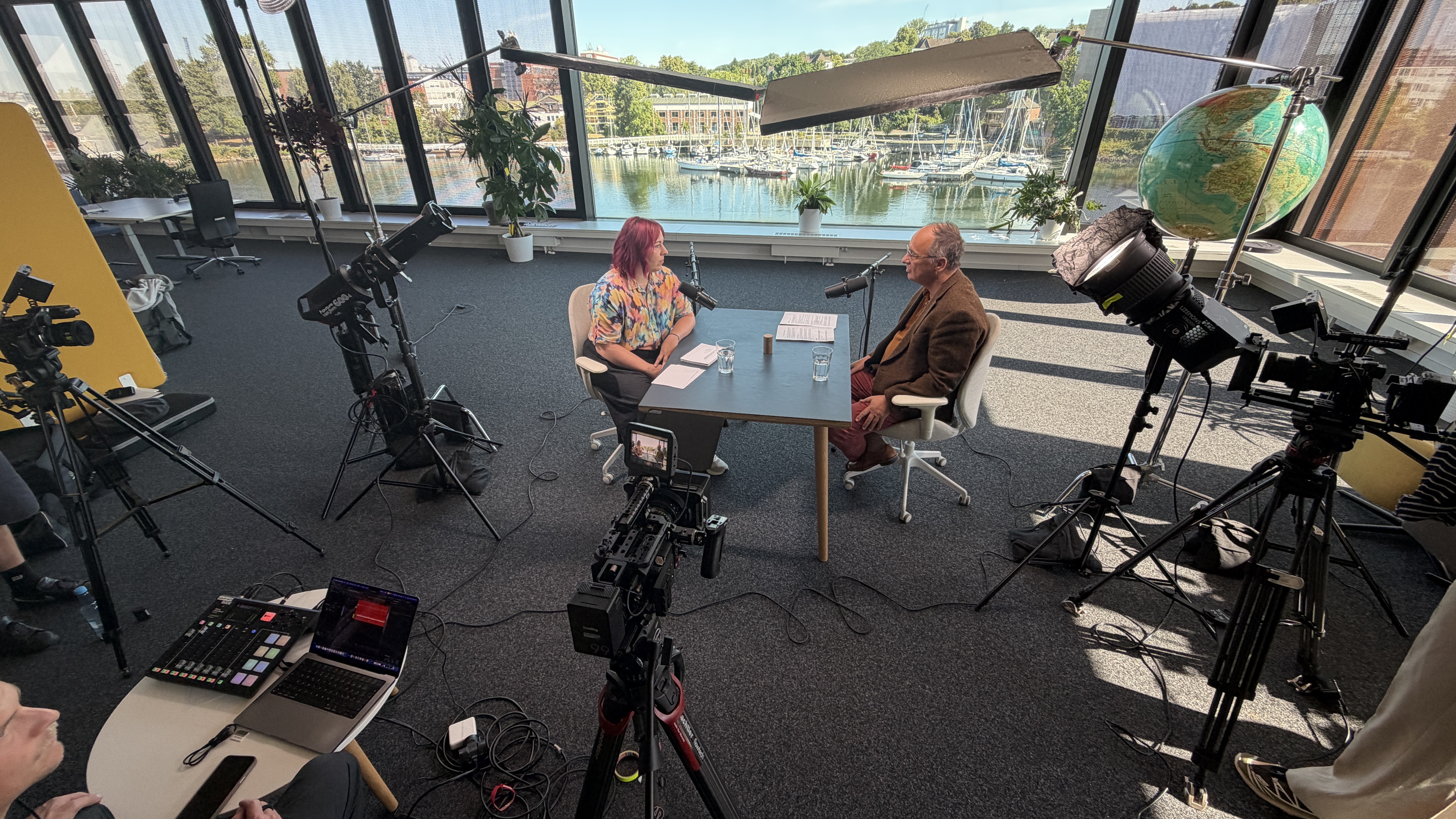
The podcast 'CCS: What is it?' has now run for 13 episodes. The two most recent episodes were produced as video podcasts for the first time.
Photo: Starboard Visuals
What Germany’s limited CO2 storage capacity beneath the North Sea means
GEOMAR expert Klaus Wallmann explains the current state of play regarding carbon dioxide storage beneath the sea in a video podcast and offers recommendations for action
The CDRmare research consortium on CO2 storage deep beneath the German North Sea (GEOSTOR) has today published two new special episodes of its (video) podcast ‘CCS: What is it?’ as well as a new factsheet to provide information on Germany’s limited CO2 storage capacities beneath the German North Sea.
“The German government intends to present its strategy for decarbonising German industry by the end of the year. The capture and storage of heavy and unavoidable CO2 emissions – such as those produced during cement production and waste incineration – play a key role in this. The volume of these emissions exceeds our storage capacities beneath the German North Sea. For this reason, careful consideration must be given to determining for which industrial sectors geological CO2 storage beneath the sea should be permitted and for which it should not,” says Prof. Dr Klaus Wallmann, coordinator of the GEOSTOR research consortium and head of the Marine Geosystems research unit at GEOMAR Helmholtz Centre for Ocean Research Kiel.
Key findings at a glance:
Germany’s CO2 storage capacities beneath the North Sea are limited: GEOSTOR preliminary surveys show that the static CO2 storage capacity in Buntsandstein reservoirs seaward of the coastal zone amounts to approximately 0.9 to 5.5 billion tonnes of CO2, however, a large proportion of the potential storage sites is currently inaccessible, as the North Sea in these areas is already being used for other purposes (e.g. wind energy, shipping, military activities) or is a protected area. To nevertheless enable CO2 storage on an industrial scale, concepts for the multiple use of the sea must be developed in the relevant North Sea areas and taken into account in maritime spatial planning.
Despite the GEOSTOR calculations, the actual usable storage capacities are not yet known. They may amount to approximately 0.5 to 1.5 billion tonnes of CO2. If this assumed capacity were utilised between 2035 and 2100, this would result in an annual storage rate of 8 to 23 million tonnes of CO2. By contrast, the estimated annual storage requirement in Germany in 2045 is around 8.5 to 70 million tonnes of CO2. Furthermore, capacity must be reserved to store CO2 in the future that has been removed from the atmosphere through the use of BECCS (Bioenergy with Carbon Capture and Storage) and DACCS (Direct Air Capture and Storage) technologies (negative emissions). By way of comparison: if Germany were to inject 8 to 23 million tonnes of CO2 per year beneath the German North Sea, the amount of CO2 stored would correspond to 1 to 4 per cent of the country’s current CO2 emissions.
CCS should only be used for CO2 quantities whose generation cannot be avoided. Germany’s limited CO2 storage capacity underscores the fact that avoiding greenhouse gas emissions is the most effective climate protection measure and must be the top priority in all political decisions. The storage of CO2 in the seabed of the German North Sea should, due to the limited storage capacity, be restricted to those quantities of CO2 that cannot in principle be avoided (primarily cement production and waste incineration) or that have been removed from the atmosphere (e.g. BECCS and DACCS, the removal of CO2 from the air followed by storage in the ground). Until CO2 storage in the deep subsurface of the German North Sea becomes possible (from 2035 at the earliest), Germany could export captured CO2 to countries bordering the North Sea.
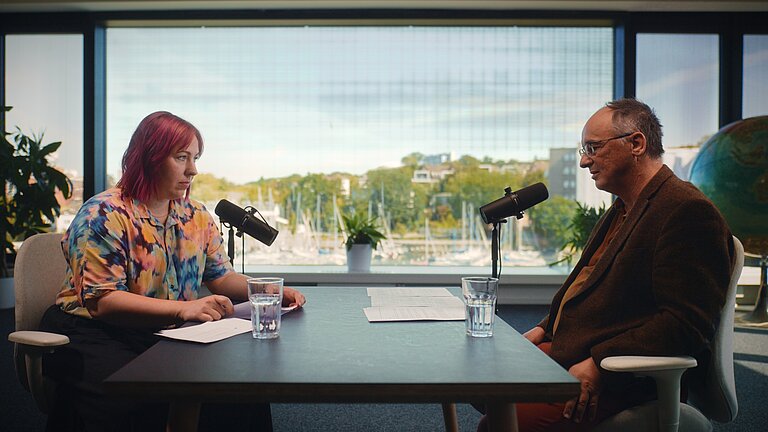
In the new video podcast, Prof. Dr Klaus Wallmann discusses the current state of play regarding carbon dioxide storage under the sea with Kristin Hamann, and offers recommendations for action.
Photo: Starboard Visuals

Germany’s storage capacity beneath the North Sea is limited. In the podcast, Prof. Dr Klaus Wallmann says that careful consideration must be given to which industrial sectors should be permitted to use geological CO₂ storage beneath the sea.
Photo: Starboard Visuals
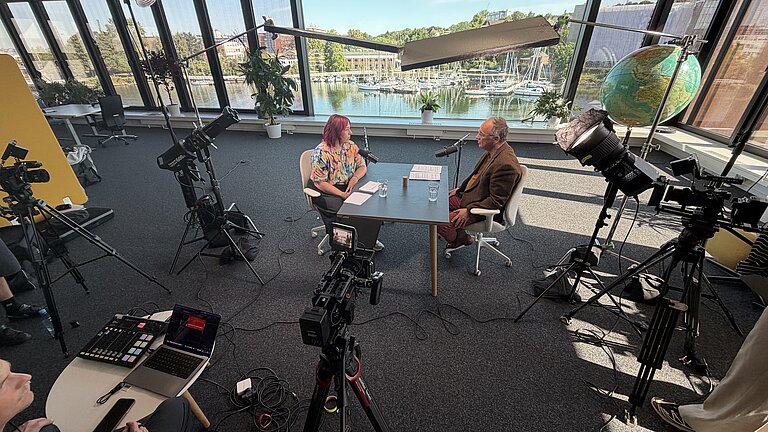
The podcast 'CCS: What is it?' has now run for 13 episodes. The two most recent episodes were produced as video podcasts for the first time.
Photo: Starboard Visuals