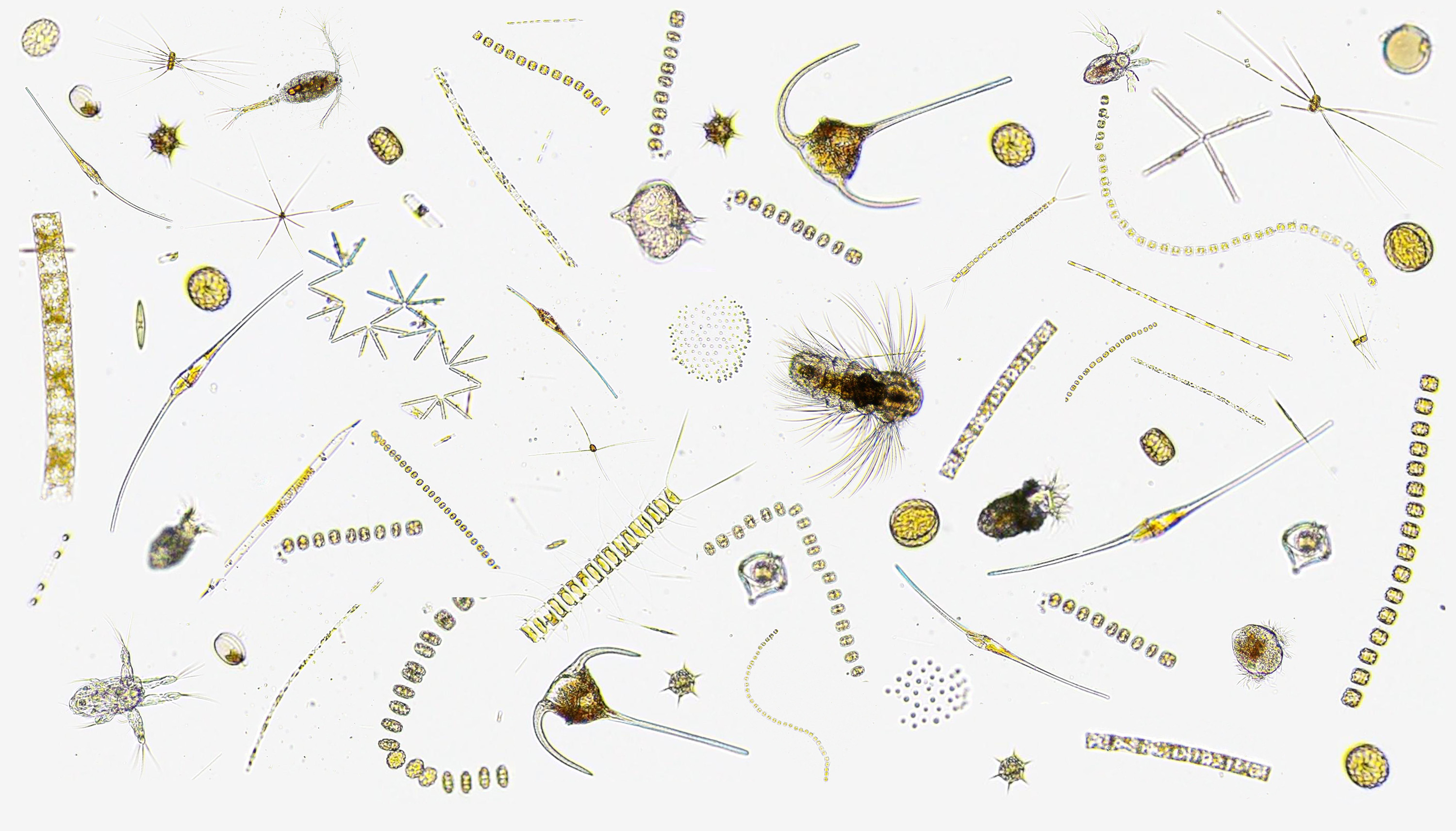
Microalgae: The image shows a collage of phytoplankton, single-celled microalgae, found during fieldwork for RECOVER in February 2026. Collage: Isabell Schlangen, SDU
What is RECOVER all about?
The abbreviation RECOVER stands for REsilience of COastal Vital Ecosystems through innovative management solutions in the Danish-German border region.
Healthy ecosystems are crucial for protecting the climate and adapting to climate change. Marine habitats are very important because they take up atmospheric CO2, provide food and oxygen, and are good for human health. The ecosystems of the western Baltic Sea are not doing well. Some of the issues include a more frequent occurrence of algal blooms, less oxygen in the water and more frequent fish dying. Among others, the causes include too much fertiliser in the water and warmer water due to climate change. The EU Nature Restoration Regulation says that at least 20% of damaged sea habitats must be fixed by 2030. Throughout the Baltic Sea, it is challenging to restore the ecosystem. As the sea connects habitats across country borders, we need to find solutions that think beyond national borders if we are to tackle environmental problems.
The RECOVER project is looking into how Germany and Denmark can better manage the western Baltic Sea, including the Bay of Kiel and the Belts. It is looking into whether microalgae can be used as a way to check the health of the sea and is developing new technologies and AI-supported applications for real-time analysis.
We plan is to make a digital copy of the south-western Baltic Sea that can be used to test different ideas on how to protect the environment. Policymakers, the farming and fishing industries, local authorities and citizens are joined in the project and encouraged to collaborate on measures to protect and restore the Baltic Sea ecosystems. Research institutions, universities and a wide range of network partners are working together to strengthen German-Danish cooperation on protecting the Baltic Sea. The project aims at strengthening the cross-border ability in the region to deal with the environmental consequences of climate change, and it supports the EU Strategy for the Baltic Sea Region. The project is thereby good for the environment, the economy and the people in the region.
Who is involved in RECOVER?
A total of six partners are involved in RECOVER.
1. GEOMAR Helmholtz Centre for Ocean Research Kiel
GEOMAR is located on the eastern shore of Kiel and is leading the project. Researchers at the centre study microalgae in the sea and collect and analyse ecological data for RECOVER. The model-based foundation for a digital twin of the south-western Baltic Sea is also being developed here in cooperation with the SDU, to better assess the health of the Baltic Sea. GEOMAR is contributing with its long-standing expertise in ocean research, biogeochemistry, and ecological modelling.
2. Nordcee (Nordic Centre for Earth Evolution), University of Southern Denmark
Nordcee is a department within the Department of Biology at the University of Southern Denmark (SDU) in Odense. In RECOVER, Nordcee researchers are studying microalgae in Danish coastal waters as indicators of environmental status. A distinctive feature is the strong public involvement in sampling, which aims to expand the dataset and thus apply a citizen science approach. The Nordcee team is therefore incorporating public participation into the project.
3. Mads Clausen Institute, University of Southern Denmark
The Mads Clausen Institute at the University of Southern Denmark in Sønderborg develops low-cost sensors for measuring microalgae as indicators of water quality. With expertise in product innovation, sensor technology and measurement technology, the institute contributes to the development of monitoring technologies that may in the future be used at monitoring stations and on ships.
4. Mærsk Mc-Kinney Møller Institute, University of Southern Denmark
The Mærsk Mc-Kinney Møller Institute (MMMI) is part of the University of Southern Denmark and has departments in Odense and Sønderborg. The institute specializes in software, artificial intelligence, data analysis and modelling. Within the RECOVER project, MMMI researchers will develop the initial elements of a digital twin of the south-western Baltic Sea, making the health of the Baltic Sea visible in real time.
5. Center for Ocean and Society (CeOS), University of Kiel
The Centre for Ocean and Society at the University of Kiel is conducting RECOVER research into effective and socially acceptable protection and management measures for the Baltic Sea, in the southern Danish Baltic Sea and along the Schleswig-Holstein coast. The researchers employ interdisciplinary approaches to bring social expertise to the project.
6. Danish Centre for Rural Research, University of Southern Denmark
The Danish Centre for Rural Research at the University of Southern Denmark in Esbjerg supports research into social and societal acceptance conducted by CeOS. This research examines how Baltic Sea restoration measures are accepted and implemented at local and regional levels.
In addition to the six main partners in RECOVER, there are over 20 network partners
-
Project lead: Prof. Dr. Anja Engel
GEOMAR Helmholtz Centre
for Ocean Research Kiel
Wischhofstraße 1 - 3, D-24148 Kiel
Phone: +49 431 600-1510
Mail: aengel(at)geomar.deProject coordination: Gesine Ramm
GEOMAR Helmholtz Centre
for Ocean Research Kiel
Wischhofstraße 1 - 3, D-24148 Kiel
Phone: +49 431 600-1245
E-Mail: gramm(at)geomar.de
-
-
► Aquaspect-Project: Automated identification of zooplankton using AI
► Recover-Projekt: Interreg Project for finding and evaluating restoration measures for the Baltic Sea in the German-Danish area
► Time Series Station Boknis Eck: Storymap