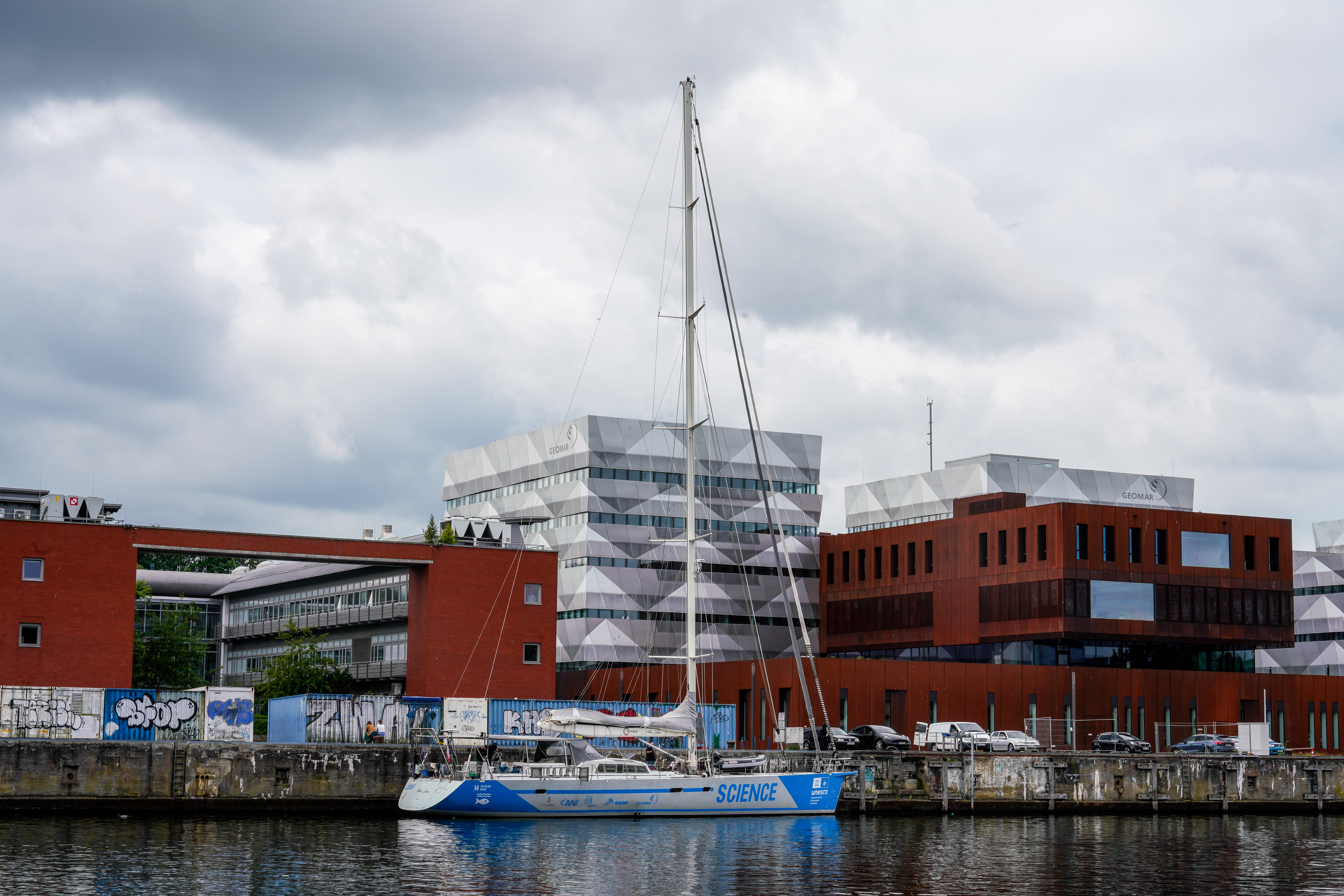
GEOMAR researchers are setting off on an expedition in July aboard a special vessel: together with the Malizia team, they will be sailing on the research sailing vessel Malizia Explorer.
Photo: Janne Lene Polei, GEOMAR
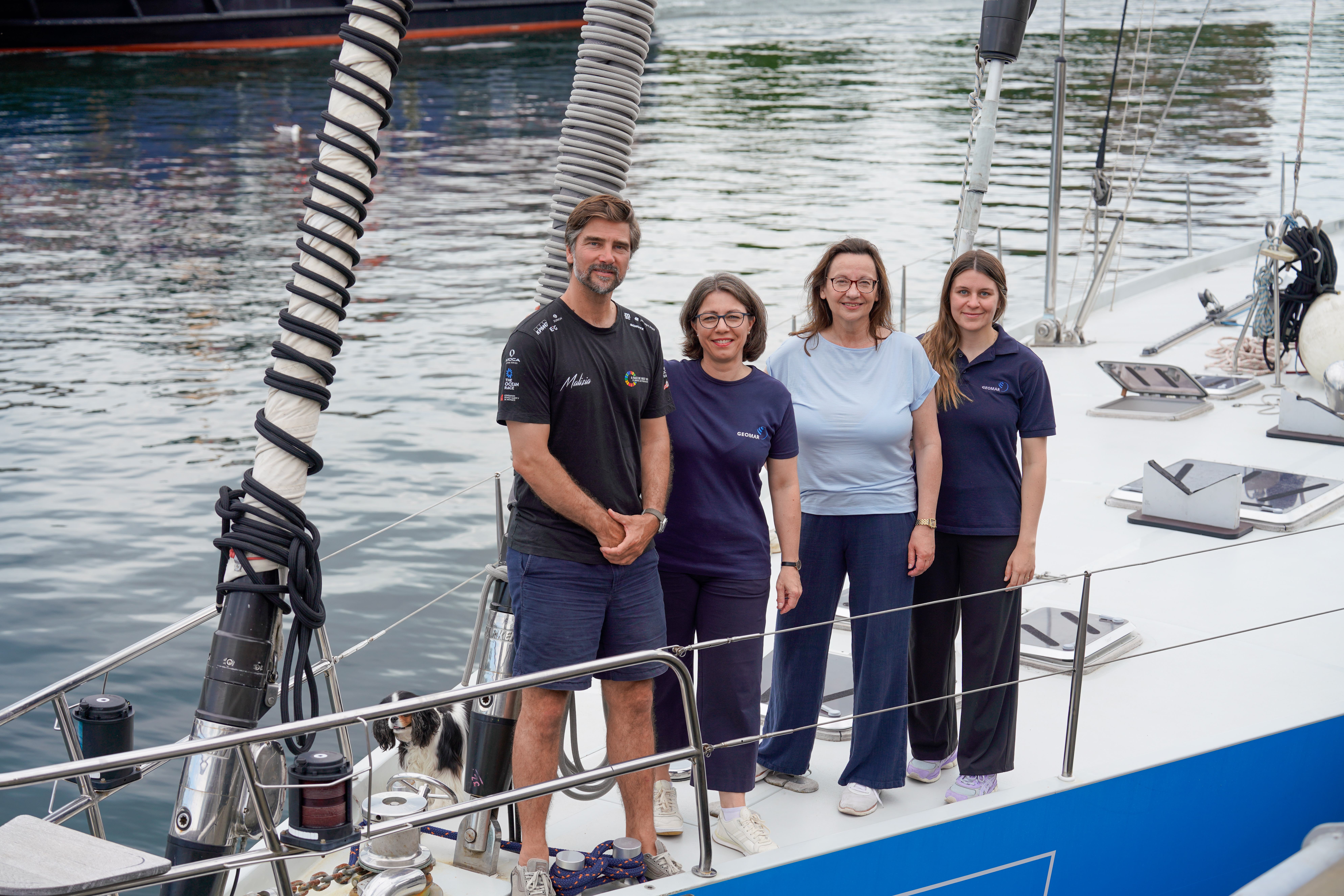
Boris Herrmann (professional sailor and skipper of Team Malizia), Prof. Dr Katja Matthes (Director of GEOMAR), Prof. Dr Anja Engel (Head of the ‘Marine Biogeochemistry’ research division at GEOMAR, responsible for leg 2) and Jana Silva Willim (doctoral researcher in the ‘Marine Evolutionary Ecology’ research group, responsible for legs 1 and 3) (f. l. t. r.) are looking forward to the upcoming expeditions.
Baltic Sea research under sail
GEOMAR launches expeditions aboard the Malizia Explorer
How can scientific research be combined with sustainable shipping? The answer lies at GEOMAR’s jetty in Kiel: the Malizia Explorer, a 26-metre-long sailing vessel specially converted for scientific expeditions, moored there on Thursday. Together with professional sailor and Team Malizia skipper Boris Herrmann, GEOMAR scientists today presented the vessel’s first planned research voyages in the Baltic Sea.
“The collaboration with Team Malizia combines excellent research with a powerful message for the protection of the ocean,” said Prof. Dr Katja Matthes, Director of GEOMAR. “With the Malizia Explorer, we can reach marine areas in a particularly climate-friendly way whilst at the same time inspiring people to care about the protection and importance of the ocean.”
“I have been sailing the world’s oceans for many years and have observed the changes – most obviously the changes in the ice, but also the carpets of Sargassum that are now forming in the Atlantic. We have grown into this collaboration with the scientific community. A researcher from GEOMAR collected data during a sailing race, and we wanted to do the same. Over the years, we’ve come to understand why data collection is relevant and interesting. That’s also how the idea for the Malizia Explorer came about,” says Boris Herrmann, explaining the origins of the collaboration between Team Malizia and GEOMAR.
A long-standing partnership for science and ocean conservation
GEOMAR and Team Malizia have been working together for many years. Sensors on board the team’s racing yacht have been collecting important data on the state of the ocean during international regattas. Since the Malizia Explorer was launched in 2025, GEOMAR has also been the research vessel’s scientific partner.
After several months in the Southern Ocean, a new chapter is now beginning: for the first time, the Malizia Explorer is undertaking scientific expeditions in the Baltic Sea. The vessel can accommodate a three-person sailing crew and up to eight scientists. On board are laboratory and storage facilities for samples, a dinghy for work near the coast, and a crane for deploying scientific equipment.
Three legs of the voyage in the western Baltic Sea
From 9 to 24 July 2026, GEOMAR will lead three research cruises in the western Baltic Sea. During the first and third legs of the voyage, the researchers will investigate seagrass beds in the Bay of Kiel and the Bay of Mecklenburg, as well as off the coast of southern Denmark. They will assess the condition and extent of the underwater plants and take sediment cores to determine their potential as natural carbon sinks.
The second leg of the expedition will focus on microalgae, known as phytoplankton. These tiny organisms form the basis of marine food webs and play a key role in the carbon cycle. The researchers aim to investigate how the species composition and activity of microalgae can be used as indicators of the Baltic Sea’s health, and what contribution they make to carbon dioxide uptake. The work provides data for the RECOVER (Resilience of coastal vital ecosystems through innovative management solutions in the Danish-German border region) and KIMMCO (flagship project for AI-driven monitoring of marine microalgae as CO₂ sinks within the framework of the Natural Climate Protection Action Programme) projects. The aim of KIMMCO is to develop new AI-supported methods that can automatically detect phytoplankton and determine their role as natural carbon sinks more accurately.
New technologies for ocean observation
Modern measurement techniques are being used on board. Specialised camera systems and automated analysers detect microalgae directly in the water, enabling high-resolution observations of their diversity and activity. In addition, the researchers take water samples, measure organic carbon compounds and collect environmental DNA (eDNA) to draw conclusions about biodiversity.
These expeditions help to provide a better assessment of the ecological status of the Baltic Sea. The sea is suffering greatly from rising temperatures, excessive nutrient inputs and habitat loss. The data collected is vital for understanding these changes and developing effective conservation and restoration measures.
GEOMAR researchers are setting off on an expedition in July aboard a special vessel: together with the Malizia team, they will be sailing on the research sailing vessel Malizia Explorer.
Photo: Janne Lene Polei, GEOMAR
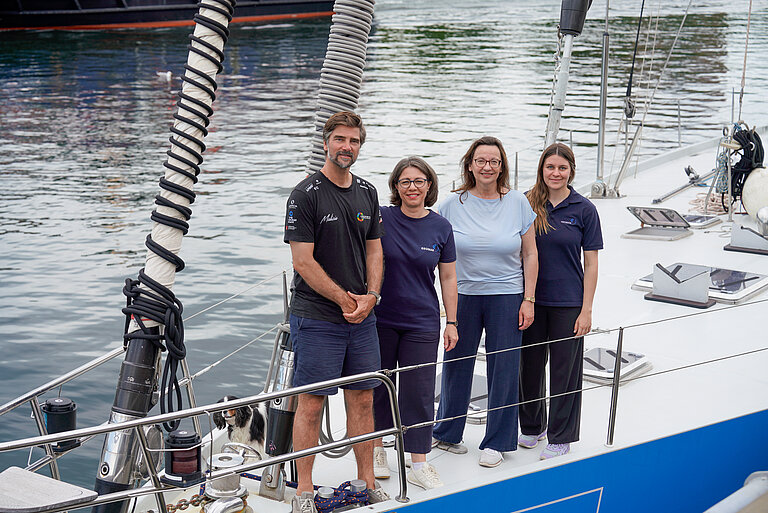
Boris Herrmann (professional sailor and skipper of Team Malizia), Prof. Dr Katja Matthes (Director of GEOMAR), Prof. Dr Anja Engel (Head of the ‘Marine Biogeochemistry’ research division at GEOMAR, responsible for leg 2) and Jana Silva Willim (doctoral researcher in the ‘Marine Evolutionary Ecology’ research group, responsible for legs 1 and 3) (f. l. t. r.) are looking forward to the upcoming expeditions.