
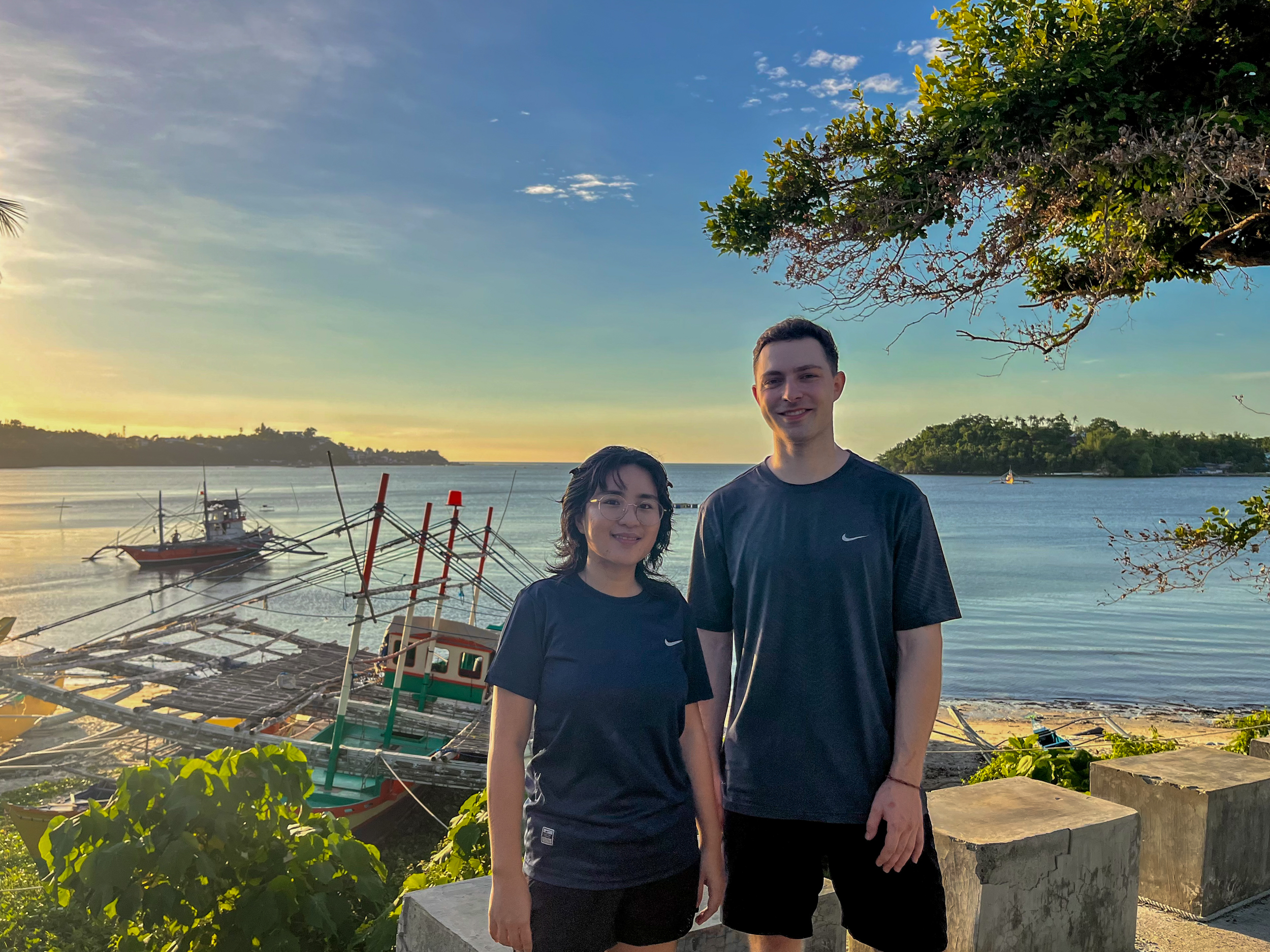
As part of the GAME project, Konstantin Buchholz from the University of Freiburg and Jonalyn Jame Catedrilla from the University of the Philippines carried out joint research off the coast of Bolinao in the Philippines.
Photo: private
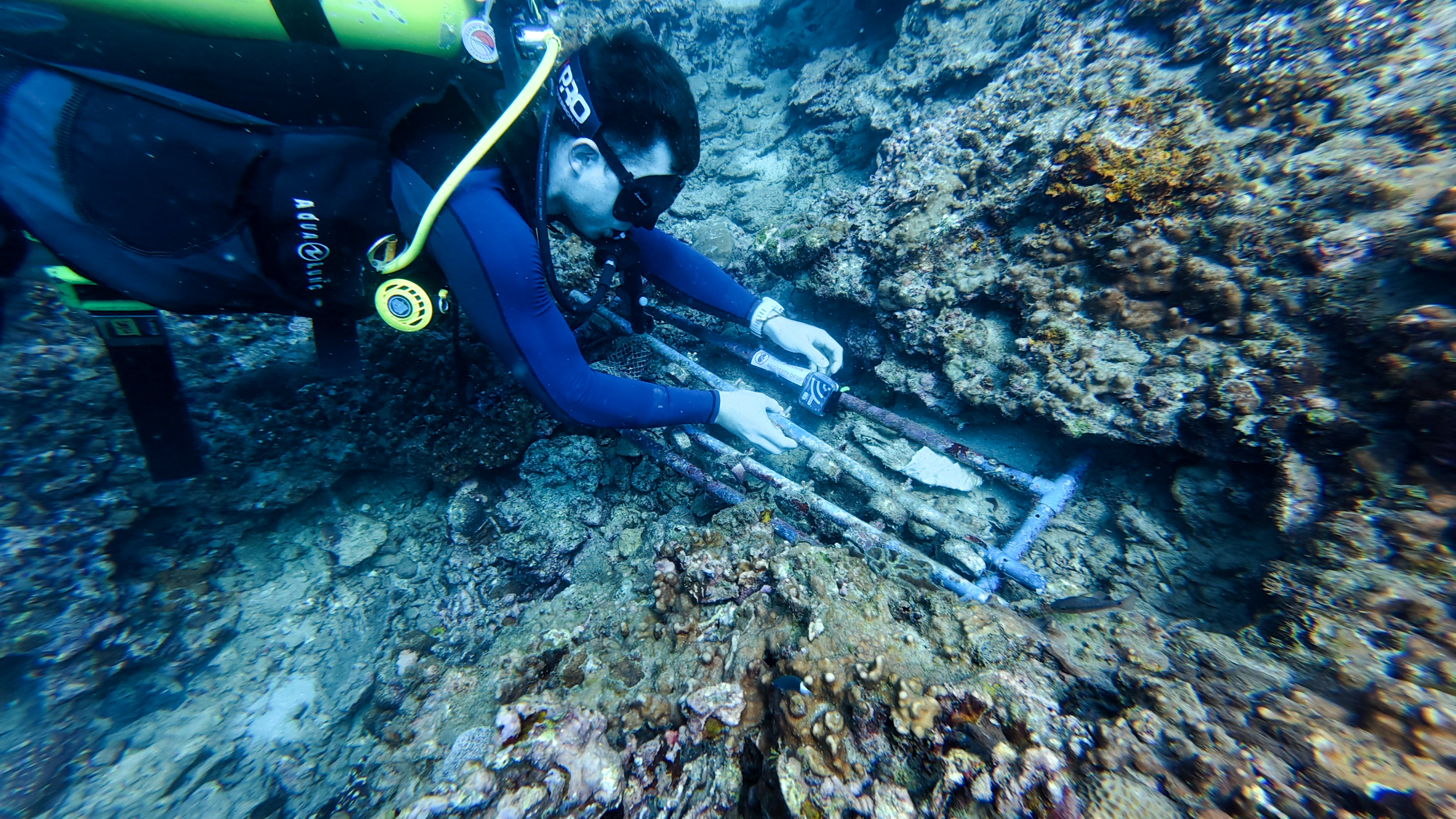
For the experiment, they first recorded underwater sounds in a coral reef, which were later played back at the test site.
Photo: private
Underwater Soundscapes Influence Where Marine Organisms Settle
GAME 2026: Students have been studying the impact of underwater sound on marine habitats around the world
Eight locations worldwide and one central research question: That is the idea behind GAME. For the 24th time, master’s students in the GEOMAR program are collaborating to investigate an ecological issue. “A win-win situation for everyone,” says project leader Dr Mark Lenz. “We combine research and teaching. The results provide new scientific insights. At the same time, the students experience the entire research process.”
In Search of the Right Habitat
Sessile marine animals such as corals, sponges, and barnacles remain in one place as adults. Before that, they drift with the current as larvae for days or weeks—until they settle. “And where they settle is the one crucial decision of their lives,” emphasizes Dr. Lenz. When choosing a location, the larvae are guided by various factors, such as light conditions or the nature of the substrate. “Whether the acoustic environment also plays a role has hardly been studied so far,” explains the ecologist.
To investigate this question, the students conducted experiments in Chile, Wales, Finland, Spain, Madeira, Malaysia, Japan, and the Philippines. First, they used underwater microphones—known as hydrophones—to record natural background sounds—for example, in a bladderwrack bed in Finland and in a coral reef in the Philippines. They then played back the recordings or boat noise through underwater speakers. Around the speakers, they attached PVC colonization plates. Similar constructions with silent dummy speakers were used as a control group. After two to three months, they examined which organisms had colonized the plates.
Underwater Sound as a Factor in Marine Conservation
Initial results show that underwater noise can have a significant impact on the colonization of marine organisms. “Interestingly, the effects went in both directions,” explains project leader Dr Mark Lenz. The organisms studied reacted differently to boat noise: Barnacle settlement often decreased, while blue mussel settlement at another site appeared to increase. This is precisely why GAME’s international research approach is important: Comparing different marine regions shows how varied the responses to the same influences can be.
These findings could be relevant for marine conservation. This is because natural soundscape serves ecological functions and can be masked by human-made noise. Its protection could therefore be given greater consideration in the future.
Learn to Conduct Research and Discover New Opportunities
For six months, Konstantin Buchholz from the University of Freiburg and Jonalyn Jame Catedrilla from the University of the Philippines conducted joint research off the coast of Bolinao in the Philippines. They had met at the GAME kick-off workshop in Kiel in March. In Bolinao, they largely organized their daily research activities on their own: In the mornings, they checked their experimental setups while snorkeling; in the afternoons, they worked in the lab. “Above all, we learned to conduct research independently,” says Buchholz.
Back in Kiel, the two are analyzing their results, which they can then use for their master’s theses. In addition to scientific training, GAME also supports students in their career planning. Workshops on science communication and career planning round out the program. For Buchholz, his outlook on his professional future has already changed: “In the past, I was pretty sure I didn’t want to pursue a Ph.D. But I’m enjoying analyzing the results so much that I’m already looking for Ph.D. positions in Germany.” Catedrilla can also imagine a career in research, but doesn’t want to commit to anything just yet: “I love doing research and discovering new things. At the same time, I’m also open to other career paths.”
About: GAME
GAME (Global Approach in Marine Ecology) is an international research and training program at the GEOMAR Helmholtz Center for Ocean Research in Kiel. Since 2002, students from various countries have been working together each year on a common marine ecology research question. The experiments take place at sites around the world and are conducted using comparable methods. The program combines scientific research with practical training and international collaboration. This year, the project was supported by the Marianne and Dr. Fritz Walter Fischer Foundation, the Rotary Club Kieler Förde, and the companies J. Bornhöft, HYDRO-BIOS, Hydrotechnik Lübeck, LimnoMar and SubCtech.
Presentations of the GAME Results
To conclude the project, the students will present their results in an online talk and at several in-person events:
4 December 2026, 12:00 p.m.: Online talk
https://uni-kiel.zoom-x.de/j/69259304826?pwd=c1Ues2gSa7liLJe9XgkNtbKgiR5Ri1.1
7 December 2026, 10:15 a.m.: Kiel University, Environmental Sciences, laboratory building, Olshausenstraße 85, 24118 Kiel
7 December 2026, 3:00 p.m.: GEOMAR, conference room 5-1.213 “Pazifik”, Wischhofstraße 1–3, 24148 Kiel
9 December 2026, 1:00 p.m.: University of Rostock, Institute of Biological Sciences, Albert-Einstein-Straße 3a, 18059 Rostock
15 December 2026, 1:00 p.m.: University of Bochum, lecture hall HGB 10, Universitätsstraße 150, 44801 Bochum
As part of the GAME project, Konstantin Buchholz from the University of Freiburg and Jonalyn Jame Catedrilla from the University of the Philippines carried out joint research off the coast of Bolinao in the Philippines.
Photo: private
For the experiment, they first recorded underwater sounds in a coral reef, which were later played back at the test site.
Photo: private