

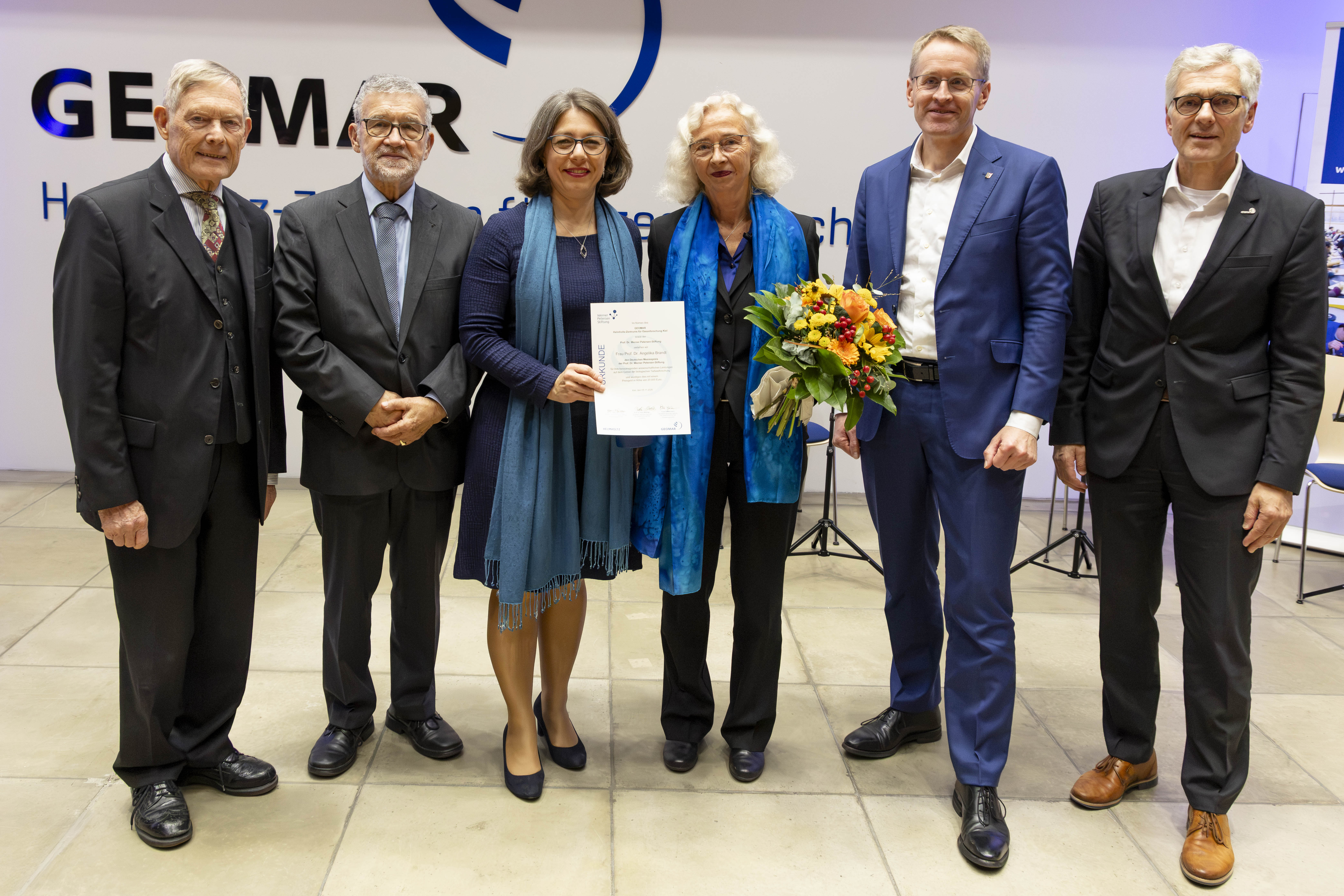
German Ocean Award winner Angelika Brandt (3rd from right) with the congratulators Christian Zöllner, Klaus Wichmann, Katja Matthes, Daniel Günther and Frank Spiekermann (from left to right).
Photo: Frank Molter
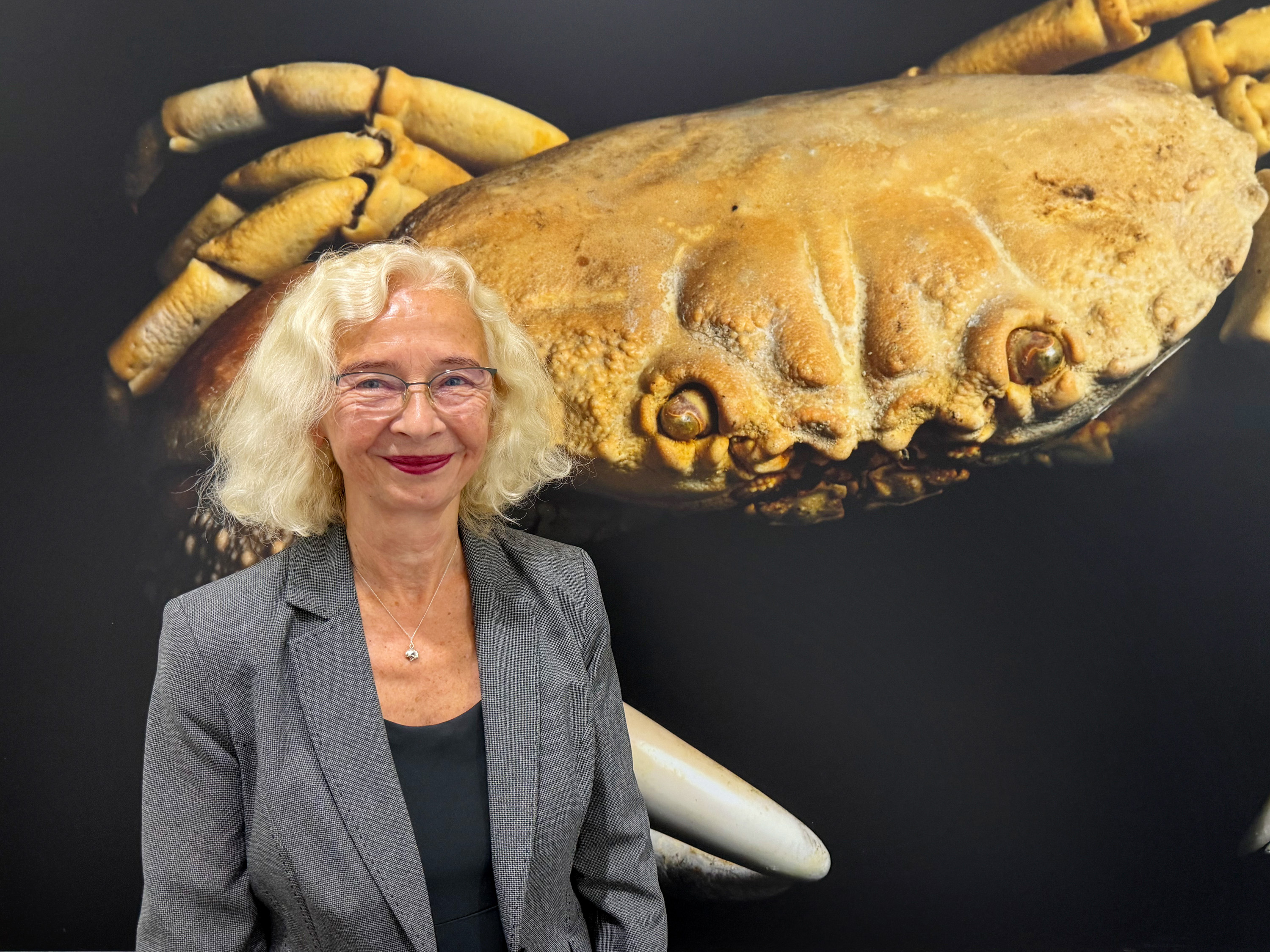
Angelika Brandt was a professor of marine zoology at Goethe University Frankfurt am Main and the Senckenberg Research Institute and Natural History Museum in Frankfurt from 2017 to 2026. She is being awarded the 2026 German Marine Award today in recognition of her outstanding scientific achievements.
Photo: Thorsten Wenzel, Senckenberg

The German Ocean Award is presented every two years by the Professor Werner Petersen Foundation, under the patronage of Minister-President Daniel Günther.
Image: Christoph Kersten, GEOMAR
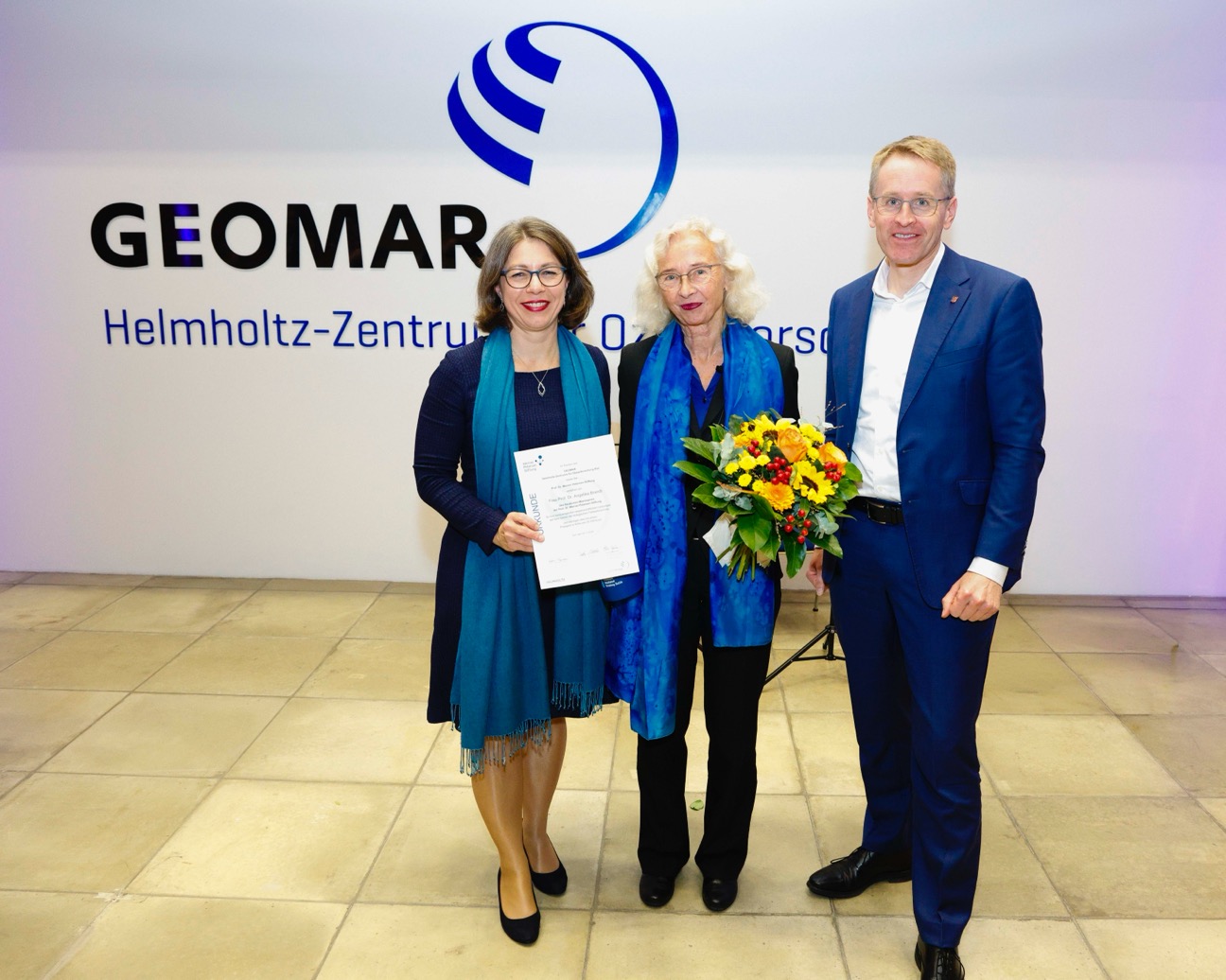
Awards ceremony at GEOMAR: Director Katja Matthes and Minister-President Daniel Günther congratulate Angelika Brandt on winning the German Ocean Award.
Photo: Frank Molter
Prof. Dr Angelika Brandt to receive the German Ocean Award
The award recognises her outstanding work on the hidden biodiversity of the deep sea
Deep down on the seabed lies one of the largest and, at the same time, least explored habitats on our planet. Darkness, cold and high pressure characterise the deep sea. And yet it is teeming with life: every sample taken from the deep-sea floor can contain numerous organisms, including many species hitherto unknown to science. Prof. Dr Angelika Brandt has made a significant contribution to revealing this hidden diversity.
For decades, she has been researching the biodiversity of deep-sea and polar organisms. Her work focuses, amongst other things, on crustaceans such as marine isopods, but also on fundamental questions of evolutionary biology and biogeography: Which organisms live in the deep sea? How are they related to one another? How do species spread over long distances? And which geological structures, currents or environmental conditions act as barriers or links between habitats?
In recognition of her outstanding scientific achievements, Angelika Brandt is today receiving the 2026 German Ocean Award. The award, worth 20,000 euros, is presented by the Prof. Dr Werner Petersen Foundation in cooperation with GEOMAR Helmholtz Centre for Ocean Research Kiel. Patron Daniel Günther, Minister-President of the State of Schleswig-Holstein, will deliver a welcome address. The laudatory speech in honour of the laureate will be given by Prof. Dr Antje Boetius, President of the Monterey Bay Aquarium Research Institute, via live video link.
GEOMAR Director Prof. Dr Katja Matthes said: “In honouring Angelika Brandt today, we are recognising a researcher who has, in the truest sense of the word, brought light into the darkness. Her discoveries of hidden deep-sea biodiversity powerfully demonstrate to us that deep-sea research is not only fundamental research but also a safeguard for the future.”
And Dr h.c. Klaus Wichmann, Chairman of the Prof. Dr Werner Petersen Foundation, added: “You can only protect what you know. Angelika Brandt has shown us just how much life is hidden in the deep sea, thereby laying the foundations for the responsible use and conservation of the ocean. The Prof. Dr Werner Petersen Foundation is delighted to honour this work with the German Ocean Award.”
Daniel Günther, Minister-President of the State of Schleswig-Holstein and patron of the German Ocean Prize, said: “It is fascinating how much there is still to discover in our oceans. Angelika Brandt has co-discovered over 100 new deep-sea species and opened up a hidden world for us. Her work helps us to understand how the oceans are changing and what that means for our livelihoods. With the German Ocean Prize, we are honouring her pioneering commitment to marine research. GEOMAR, the institution behind this prize, sets global standards in marine research. Together with the Werner Petersen Foundation, it honours outstanding achievements in a field that is one of our major scientific strengths here in Schleswig-Holstein. We want to build on this strength further. After all, the depths of the oceans still hold many answers to questions that concern us all.”
An integrative approach to deep-sea research
Angelika Brandt was Professor of Marine Zoology at Goethe University Frankfurt am Main and at the Senckenberg Research Institute and Natural History Museum in Frankfurt from 2017 to 2026. There, she headed the Department of Marine Zoology from 2017 until the end of 2025. Prior to that, she spent 22 years as Professor of Zoology at the University of Hamburg, Curator of Crustacea and Polychaeta, and Director and Deputy Director, respectively, of the Zoological Museum in Hamburg. From 2022 to 2025, she served on the Executive Board of the Senckenberg Society for Nature Research.
Brandt combines classical zoological methods, based on careful observation and description, with modern molecular biological techniques. This integrative approach is particularly important for deep-sea research: animals that are barely distinguishable externally may belong to genetically different species, whilst organisms that look different are sometimes part of the same species. Reliable species identification is therefore the foundation for understanding biodiversity, distribution, isolation and evolutionary processes.
Surprising diversity in the Southern Ocean
Brandt’s work in the Southern Ocean was particularly influential. As part of international expeditions, including the pioneering ANDEEP expeditions aboard the research vessel POLARSTERN, she significantly expanded our understanding of the diversity of invertebrate organisms in the Antarctic deep sea. The findings challenged the assumption that deep-sea biodiversity decreases towards the South Pole. Her research showed that the deep sea is neither a uniform, universally connected habitat nor a mosaic of completely isolated areas. Rather, it forms a network of habitats connected to varying degrees, characterised by deep-sea trenches, ridges, basins, fault zones, currents and the lifestyles of the respective species.
The significance of this research extends far beyond the description of individual species. Anyone wishing to identify and assess changes in an ecosystem must first know which organisms live there, how they are distributed and what functions they fulfil within the ecosystem. This knowledge is becoming increasingly important in the face of climate change and growing human interference in the oceans. Changes in temperature, oxygen levels, food supply or carbon cycles can affect deep-sea communities just as much as commercial exploitation of the seabed.
Extreme habitats: Expedition to the Aleutian Trench
The ‘AleutBio’ expedition, led by Angelika Brandt, set sail in 2022 aboard the research vessel SONNE to previously little-studied regions of the north-east Pacific, such as the habitats of the Aleutian Trench. The expedition provided new insights into biodiversity and biogeographical connections in extreme deep-sea habitats. It exemplifies Brandt’s integrative research approach, which combines taxonomy, molecular biology, ecology and international collaboration.
Angelika Brandt has received numerous awards for her research, including the International Prize for Biology in the field of systematics and taxonomy, the Carlo Heip Excellence Award in Marine Biodiversity, the SCAR Medal for Excellence in Polar Research, and the National Geographic Society’s Adventurer of the Year Award. One of her publications on deep-sea biodiversity in the Southern Ocean was recognised by Time magazine as one of the most important scientific discoveries of the year. Furthermore, she has been and continues to be actively involved in numerous international programmes in marine, polar and biodiversity research.
“I am absolutely delighted to receive this award,” said Professor Angelika Brandt. “It recognises not only my own work, but also that of the many colleagues with whom I have had the privilege of exploring the deep sea’s fascinating diversity of life over the decades. The deep sea fascinates me with its unique biodiversity and the close interconnectedness of life on our planet. It is a great pleasure that research into the deep sea and its significance for our future is in the spotlight today. This knowledge is crucial for the effective protection of the deep sea in the face of climate change and increasing human interference. Therefore, for me, the German Ocean Award is both an honour and an incentive to continue exploring this hidden world and to raise public awareness of its importance and the need to protect it.”
About: German Ocean Award
Since 2009, the German Ocean Award has recognised individuals who have made an exceptional contribution to the protection and conservation of the ocean. Since 2024, it has been awarded every two years in cooperation with the Prof. Dr Werner Petersen Foundation, alternating between public figures and scientists.
German Ocean Award winner Angelika Brandt (3rd from right) with the congratulators Christian Zöllner, Klaus Wichmann, Katja Matthes, Daniel Günther and Frank Spiekermann (from left to right).
Photo: Frank Molter
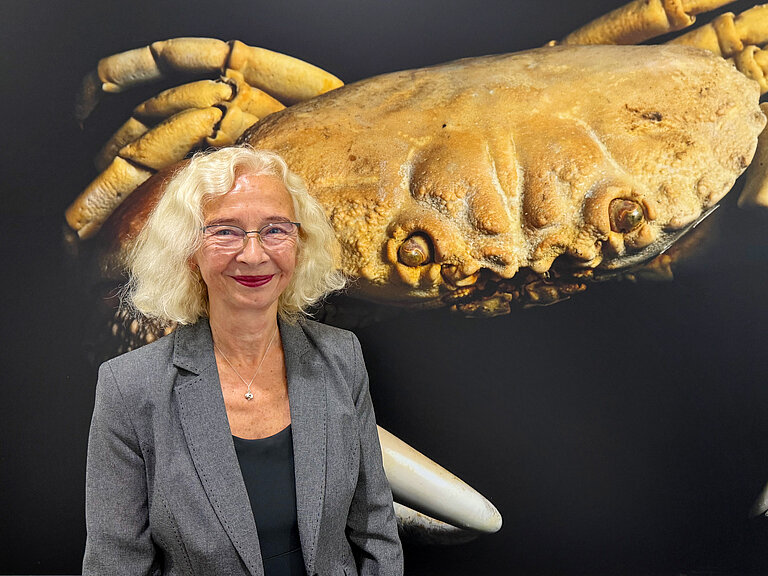
Angelika Brandt was a professor of marine zoology at Goethe University Frankfurt am Main and the Senckenberg Research Institute and Natural History Museum in Frankfurt from 2017 to 2026. She is being awarded the 2026 German Marine Award today in recognition of her outstanding scientific achievements.
Photo: Thorsten Wenzel, Senckenberg

The German Ocean Award is presented every two years by the Professor Werner Petersen Foundation, under the patronage of Minister-President Daniel Günther.
Image: Christoph Kersten, GEOMAR
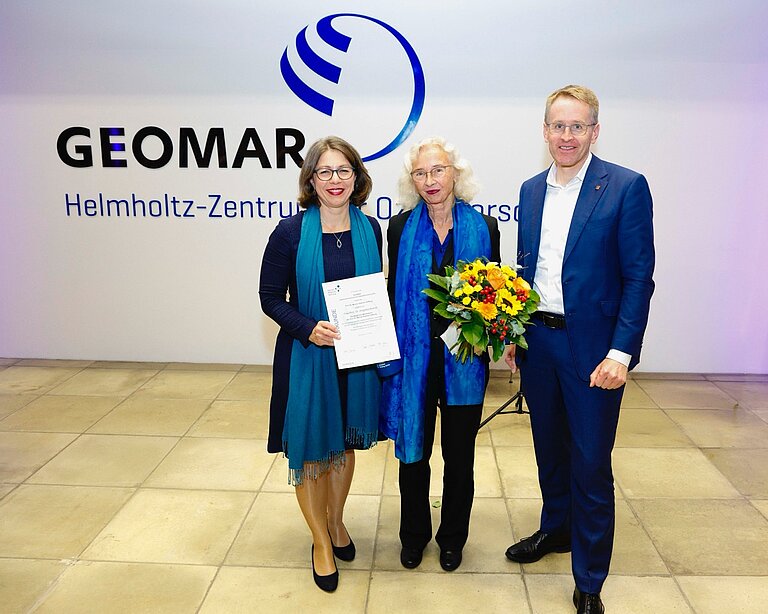
Awards ceremony at GEOMAR: Director Katja Matthes and Minister-President Daniel Günther congratulate Angelika Brandt on winning the German Ocean Award.
Photo: Frank Molter
