
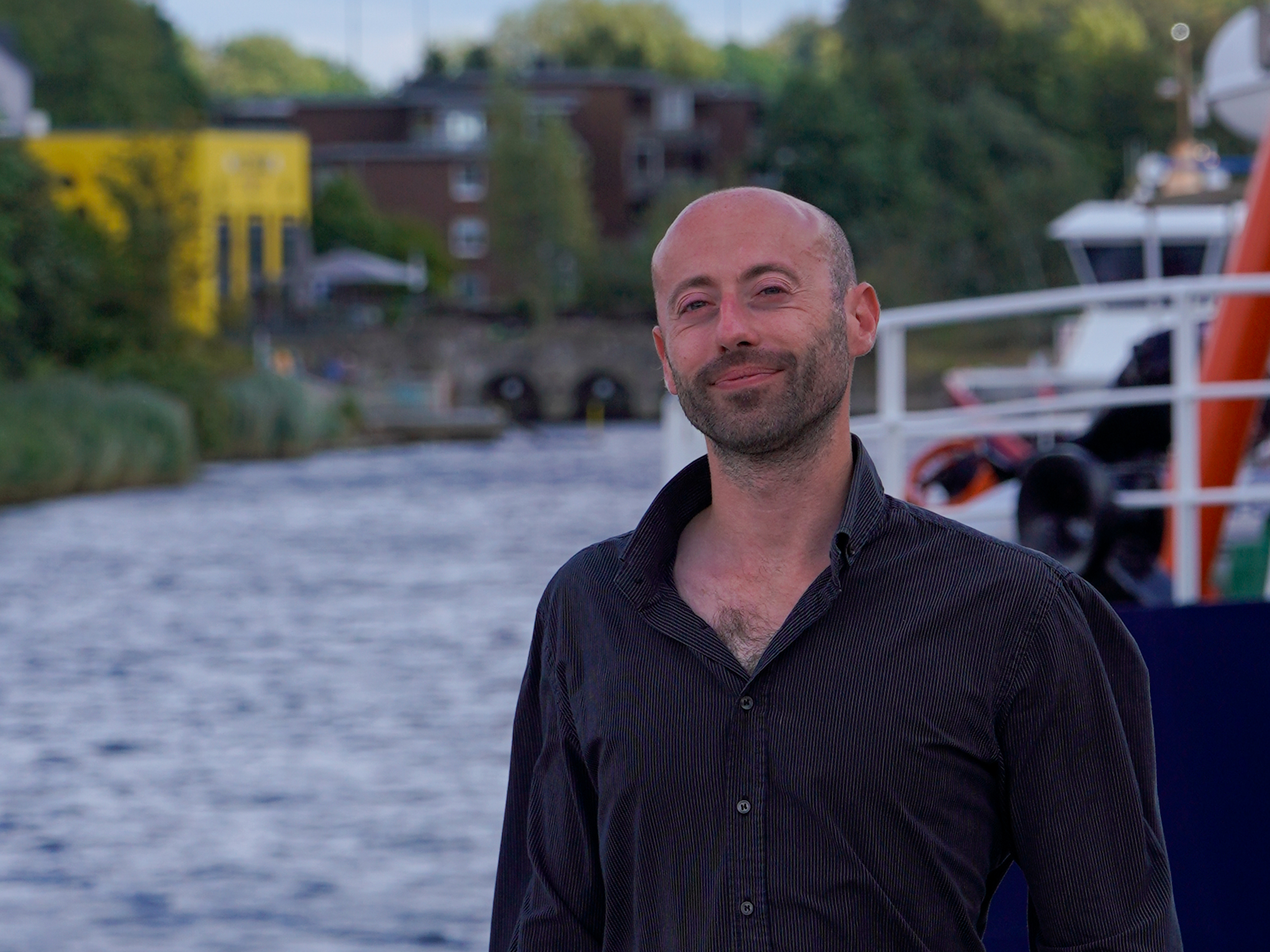
As a Humboldt Fellow, the ecologist Dr Paride Balzani is spending two years as a visiting researcher at GEOMAR. He will contribute his expertise in food web analysis to investigate the ecological role played by native and invasive copepods in the Baltic Sea.
Photo: Ilka Thomsen
What do the New Neighbours in the Baltic Sea Eat?
Dr Paride Balzani is researching the diet of invasive amphipods in the Baltic Sea as a Humboldt Fellow at GEOMAR
At GEOMAR, the research group led by PD Dr Elizabeta Briski focuses on biological invasions in marine and coastal ecosystems – a topic that is becoming increasingly important due to global shipping traffic and climate change. The ecologist Dr Paride Balzani is fitting in perfectly. He will be working with the group as a Humboldt Fellow for two years, contributing his expertise in food web analysis and investigating the ecological role of native and invasive amphipods in the Baltic Sea.
From Florence via Parma to Bohemia
Paride Balzani was born in Florence. After studying natural sciences, he completed his Ph.D. at the University of Parma in Italy. This was followed by four years as a postdoc at the University of South Bohemia in České Budějovice, Czech Republic.
Balzani describes himself as a classical ecologist: “I focus primarily on invasive species and food webs,” he says. His tool of choice is stable isotopes, which can be used to reconstruct trophic relationships and feeding competition between species.
The trophic niche of amphipods
His research in Kiel focuses on several species of the genus Gammarus, small amphipods usually measuring between half a centimetre and one centimetre in length. They have varying requirements regarding the salinity of their habitat and are besides marine species, there are also freshwater and terrestrial. Most invasive taxa originally came from the Black Sea and the Caspian Sea, while there is also one species from North America; they have now spread across large parts of inland Europe and in the coastal areas, they prefer to live in estuaries.
“What is the trophic niche of these invasive gammarids? There are several species that occur alongside one another – what do they actually eat? Does their diet change over time? Do they specialise, or do they become more generalist?" is how Balzani sums up his key research questions.
Space as a proxy for time
To answer these questions, Balzani is pursuing the so-called ‘space-for-time’ approach: he samples populations at different locations that have been colonised by the gammarids for different lengths of time, using space as a proxy for time. “Populations that have been there for longer probably behave differently from those that have recently arrived,” he explains. One challenge here is that, for many sites, there is hardly any record of when the amphipods actually first appeared. “It’s difficult to say when they first arrived; there’s very little data – that’s the hardest part” says Balzani.
Until now, the invasion ecologist has worked primarily in freshwater environments, such as rivers and lakes. By moving to GEOMAR, he wanted to specifically expand his expertise into marine ecosystems. “I’m interested in ecology regardless of the habitat; for me, the species are, first and foremost, models,” says Balzani.
Kiel for him was an attractive choice because of the reputation of the research centre. GEOMAR is highly regarded for this type of research and offers excellent facilities. He had already met his host, the biologist Dr Elizabeta Briski, when she was a visiting scholar at his university in South Bohemia. The two share not only similar scientific interests – their research also complements each other well: Balzani contributes his expertise in food webs, adding an important perspective to Briski's work on biological invasions in marine ecosystems.
What Balzani particularly enjoyed about Kiel this summer were the milder temperatures and its proximity to the Baltic Sea, whilst his home town was struggling with extreme heat – in Florence, there were 27 days in June and July alone with maximum temperatures exceeding 36 degrees Celsius.
As a Humboldt Fellow, the ecologist Dr Paride Balzani is spending two years as a visiting researcher at GEOMAR. He will contribute his expertise in food web analysis to investigate the ecological role played by native and invasive copepods in the Baltic Sea.
Photo: Ilka Thomsen