

Anna Niewerth
Phone: +49 (0) 431 600 2812
E-Mail: aniewerth(at)geomar.de

The research vessel SONNE has set sail from San Diego into the Pacific. Its destination is the Clarion-Clipperton Zone near the equator, where the largest known seabed deposits of polymetallic nodules are located.
Photo: Tim Kalvelage

The expedition is taking place as part of the MiningImpact project, which has been researching the environmental impacts of potential deep-sea mining since 2015.
Photo: ROV team, GEOMAR

In 2021, a company in the Clarion-Clipperton Zone) tested a remotely controlled pre-prototype of a nodule collector system on the seabed. The SONNE expedition will now investigate the effects of this disturbance five and a half years later.
Photo: ROV team, GEOMAR

Stalked fauna with deep-sea brittle stars on a manganese nodule: As well as investigating how seabed communities have changed five and a half years after the experiment, and how long sediment plumes continue to affect the area, the study will examine whether artificial hard substrates can promote recolonisation in place of manganese nodules.
Photo: ROV team, GEOMAR

To gather as much data as possible during the expedition, the SONNE is carrying a wide range of marine scientific research equipment. This includes the remotely operated underwater vehicle (ROV) KIEL 6000.
Photo: Tim Kalvelage

The ROV KIEL 6000 can dive to depths of up to 6,000 metres. It can collect samples from the seabed and take high-resolution photos and videos of the ocean depths.
Photo: Tim Kalvelage

Researchers can monitor what the underwater robot sees on the seabed while on board the vessel. The expedition includes researchers from 17 institutions across seven European countries. Their disciplines range from biology and microbiology to chemistry, oceanography and geology.
Photo: Tim Kalvelage
A Voyage into the Slow-Motion World of the Deep Sea
Expedition SO322 is investigating the environmental consequences of future mining of polymetallic nodules
Polymetallic nodules form at a snail’s pace. They grow about one to two millimetres over the course of a million years. If buried by sediment, they dissolve again. In their undisturbed state, they provide a habitat on the abyssal seafloor for animals that depend on a hard surface - which otherwise cannot be found there. “Typically, we find two to three small organisms on each nodule,” says Matthias Haeckel. He is a biogeochemist at the GEOMAR Helmholtz Centre for Ocean Research Kiel and chief scientist of the SO322 expedition, which started today. Sea anemones, soft corals, or giant stalked sponges — which in turn provide a habitat for other organisms — are absent where the nodules have been removed. And because everything proceeds extremely slowly in the deep sea, Haeckel is certain: “Likely, we will not see any recovery.”
Five and a half years after the collector trials: How has life at the seabed changed?
In spring 2021, the Belgian company Global Sea Mineral Resources (GSR) tested a remotely controlled pre-prototype of a nodule collector system for 74 hours on the seafloor in the Clarion-Clipperton Zone (CCZ) at a depth of more than 4,000 metres. During this time, the vehicle drove a distance of about 32 kilometres and harvested polymetallic nodules in an area of 54,000 square metres – an area roughly equivalent to seven soccer fields. The current expedition with RV SONNE will investigate effects at the seafloor five and a half years after this mining test. The expedition is part of the MiningImpact project, which has been studying the environmental impacts of potential future deep-sea mining since 2015.
In addition to the removal of the biota-rich layer of surface sediments, another effect is the sediment plume that is suspended in the bottom water and resettles again within a distance of several hundred metres around the mining site. Fauna that are attached to the nodules (sessile fauna) cannot escape it and gets buried. Haeckel: “Some organisms can clean themselves, others cannot. Those that filter their food from the water are also very likely to be affected.” Investigating these effects is challenging, just as research in the deep sea in general is by no means easy. “We are still far from having a complete knowledge of the abyssal ecosystem; for example, we do not know what role the individual species play,” says the scientist shortly before his sixth research expedition to polymetallic nodule fields. “We’re only just beginning to understand the deep sea.”
Marine technology from benthic landers to remotely operated vehicles
To gain as much insights as possible during the expedition, RV SONNE carries a multitude of marine research gear: the remotely operated vehicle (ROV) KIEL 6000, which alone is the size of a small van and requires five 20-foot containers for cables, winches, the control unit, and accessories. The autonomous underwater vehicle (AUV) ABYSS with its launch and recovery system; three benthic landers that can be deployed at the seafloor; and sediment sampling devices such as multiple and box corers - a total of 16 containers of scientific equipment are on board. And the expedition time will be utilised to the fullest: RV SONNE will not enter any port for 54 days - the maximum stay at sea for which the ship is designed.
In total, 39 researchers from 17 institutions and seven European countries are participating in the expedition - a multidisciplinary team drawing from the fields of biology, microbiology, chemistry, oceanography, and geology, each addressing a diverse range of research questions. In addition to investigating how faunal communities on the seafloor have changed five and a half years after the mining test and how long effects from the sediment plume persist, the scientists will also examine whether artificial hard substrates as a substitute for mined polymetallic nodules can promote recolonization of the seabed.
The Big Picture Is Still Unknown
Even if the above questions can be answered, the abyssal ecosystem remains largely understudied. Haeckel explains: “Many species in the CCZ are extremely rare; about ninety percent of the species that we have sampled so far are still unidentified and have no name. And no one knows how many species are still to be discovered.” Another important topic about which little is known is species connectivity: “Many species are distributed across the entire CCZ between Mexico and Hawaii, in some cases even across the Pacific Ocean - which means gene exchange must be taking place. But we do not know what intermediate spatial steps and temporal scales are involved.” If this connectivity is to be disrupted by mining operations, the consequences for the deep-sea ecosystem will be immense.
“This kind of large-scale damage must be prohibited, because we would only notice it, if it is already too late,” says Haeckel, adding, “The benthic ecosystem will not recover on human time scales. While the specific nodule habitat is removed permanently, sedimentary processes will be altered for thousands of years.”
Expedition at a Glance
Name: SO322 (MiningImpact project; NoduleMonitor3)
Chief Scientist / Project coordinator: Dr Matthias Haeckel
Schedule: 17 October 2026 – 9 December 2026
Start: San Diego
End: San Diego
Working Area: Pacific, Clarion-Clipperton Zone
About: MiningImpact
Since 2015, European scientists in the MiningImpact consortium have been assessing the environmental impacts of potential future deep-sea mining activities. The scientific findings are translated into recommendations for the International Seabed Authority (ISA) and national authorities. MiningImpact is funded under the Joint Programming Initiative Healthy and Productive Seas and Oceans (JPI Oceans) by the Belgian Federal Science Policy Office (Belgium), the Department of Work, Economy, Science, Innovation and Social Economy (Government of Flanders, Belgium), the Federal Ministry of Education and Research (Germany), the Ministry of Universities and Research (Italy), the Dutch Research Council (the Netherlands), the Research Council of Norway (Norway), Narodowe Centrum Badań i Rozwoju (Poland), and the Department for Environment, Food and Rural Affairs (United Kingdom).
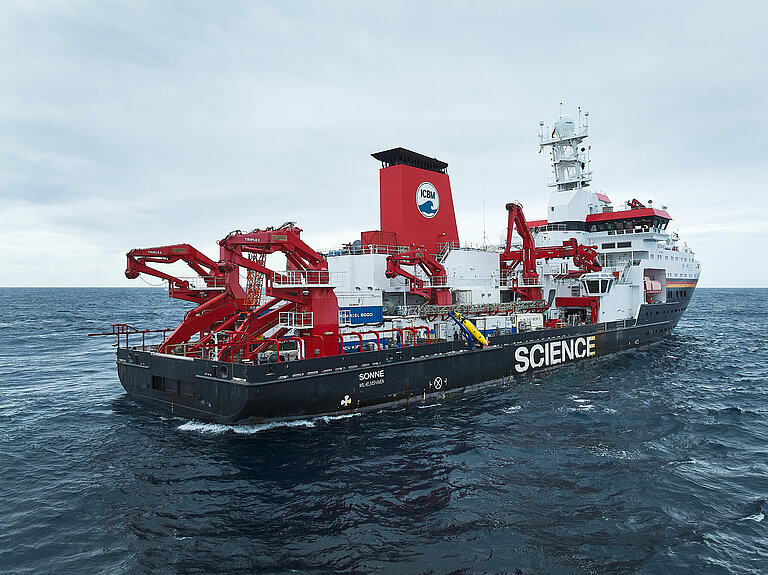
The research vessel SONNE has set sail from San Diego into the Pacific. Its destination is the Clarion-Clipperton Zone near the equator, where the largest known seabed deposits of polymetallic nodules are located.
Photo: Tim Kalvelage
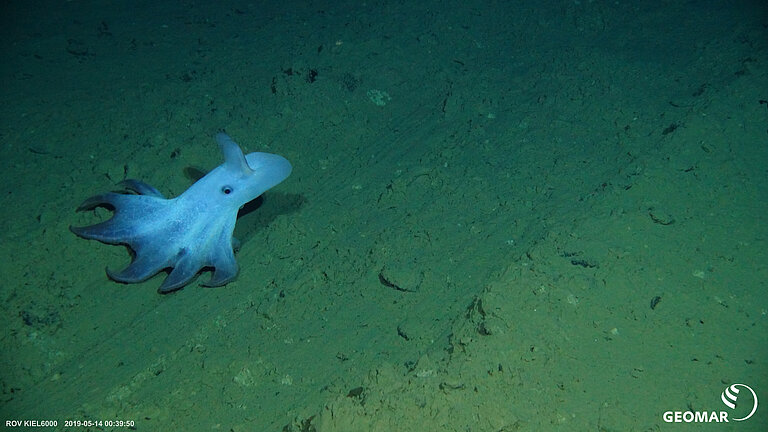
The expedition is taking place as part of the MiningImpact project, which has been researching the environmental impacts of potential deep-sea mining since 2015.
Photo: ROV team, GEOMAR
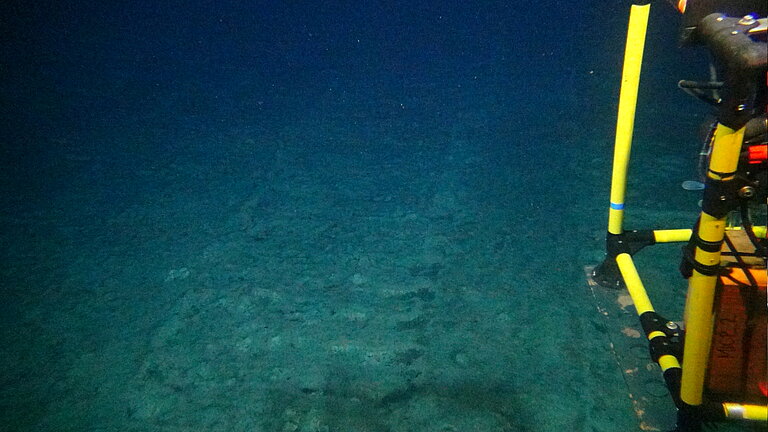
In 2021, a company in the Clarion-Clipperton Zone) tested a remotely controlled pre-prototype of a nodule collector system on the seabed. The SONNE expedition will now investigate the effects of this disturbance five and a half years later.
Photo: ROV team, GEOMAR
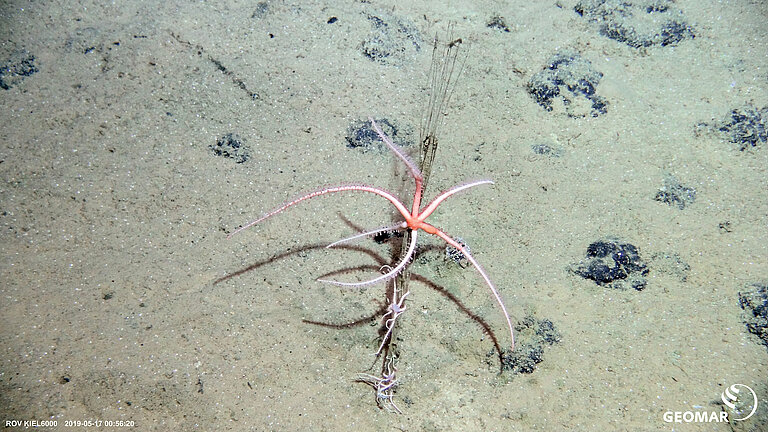
Stalked fauna with deep-sea brittle stars on a manganese nodule: As well as investigating how seabed communities have changed five and a half years after the experiment, and how long sediment plumes continue to affect the area, the study will examine whether artificial hard substrates can promote recolonisation in place of manganese nodules.
Photo: ROV team, GEOMAR
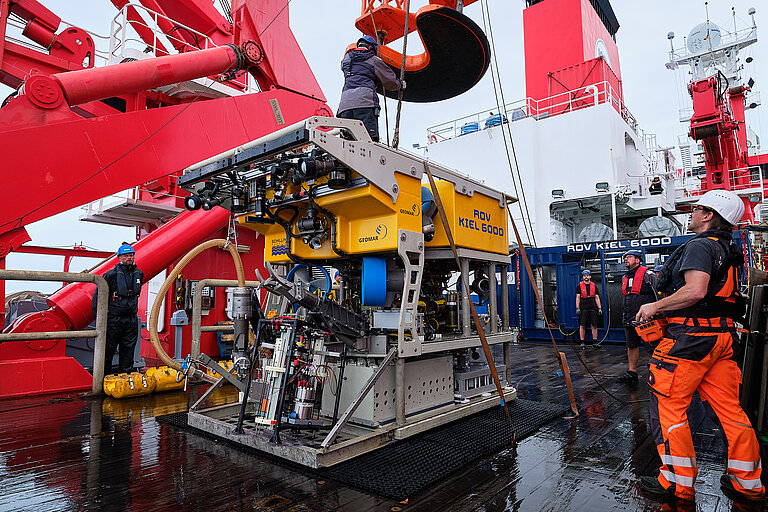
To gather as much data as possible during the expedition, the SONNE is carrying a wide range of marine scientific research equipment. This includes the remotely operated underwater vehicle (ROV) KIEL 6000.
Photo: Tim Kalvelage
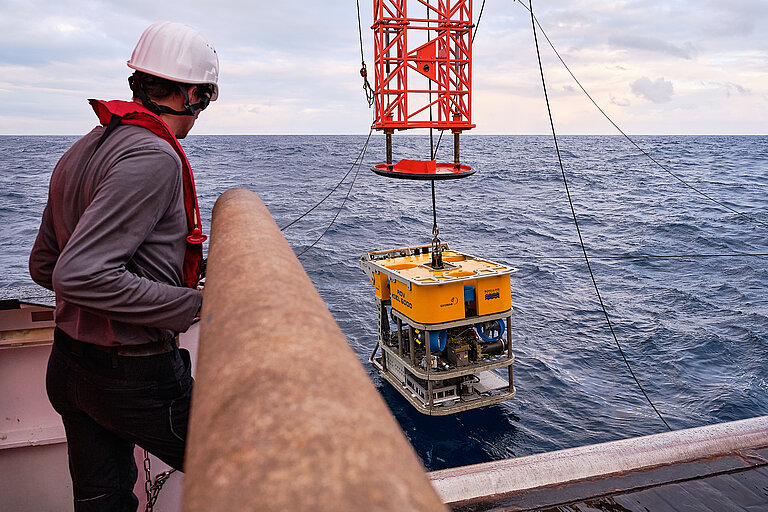
The ROV KIEL 6000 can dive to depths of up to 6,000 metres. It can collect samples from the seabed and take high-resolution photos and videos of the ocean depths.
Photo: Tim Kalvelage
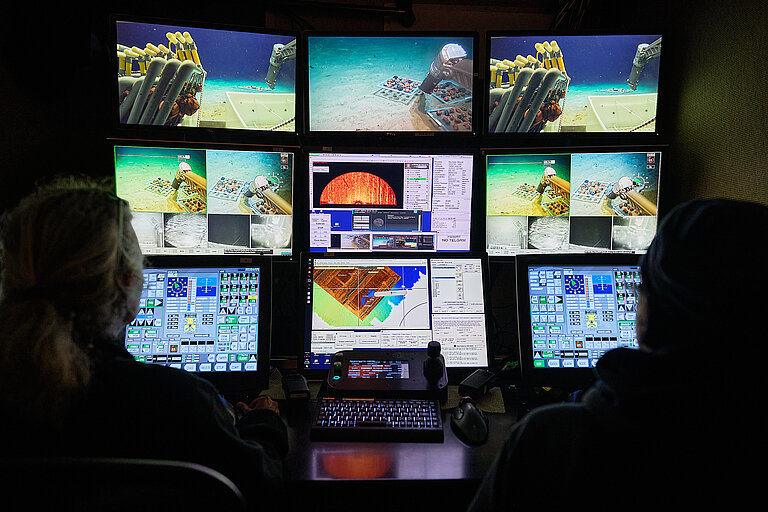
Researchers can monitor what the underwater robot sees on the seabed while on board the vessel. The expedition includes researchers from 17 institutions across seven European countries. Their disciplines range from biology and microbiology to chemistry, oceanography and geology.
Photo: Tim Kalvelage
