

Anna Niewerth
Phone: +49 (0) 431 600 2812
E-Mail: aniewerth(at)geomar.de
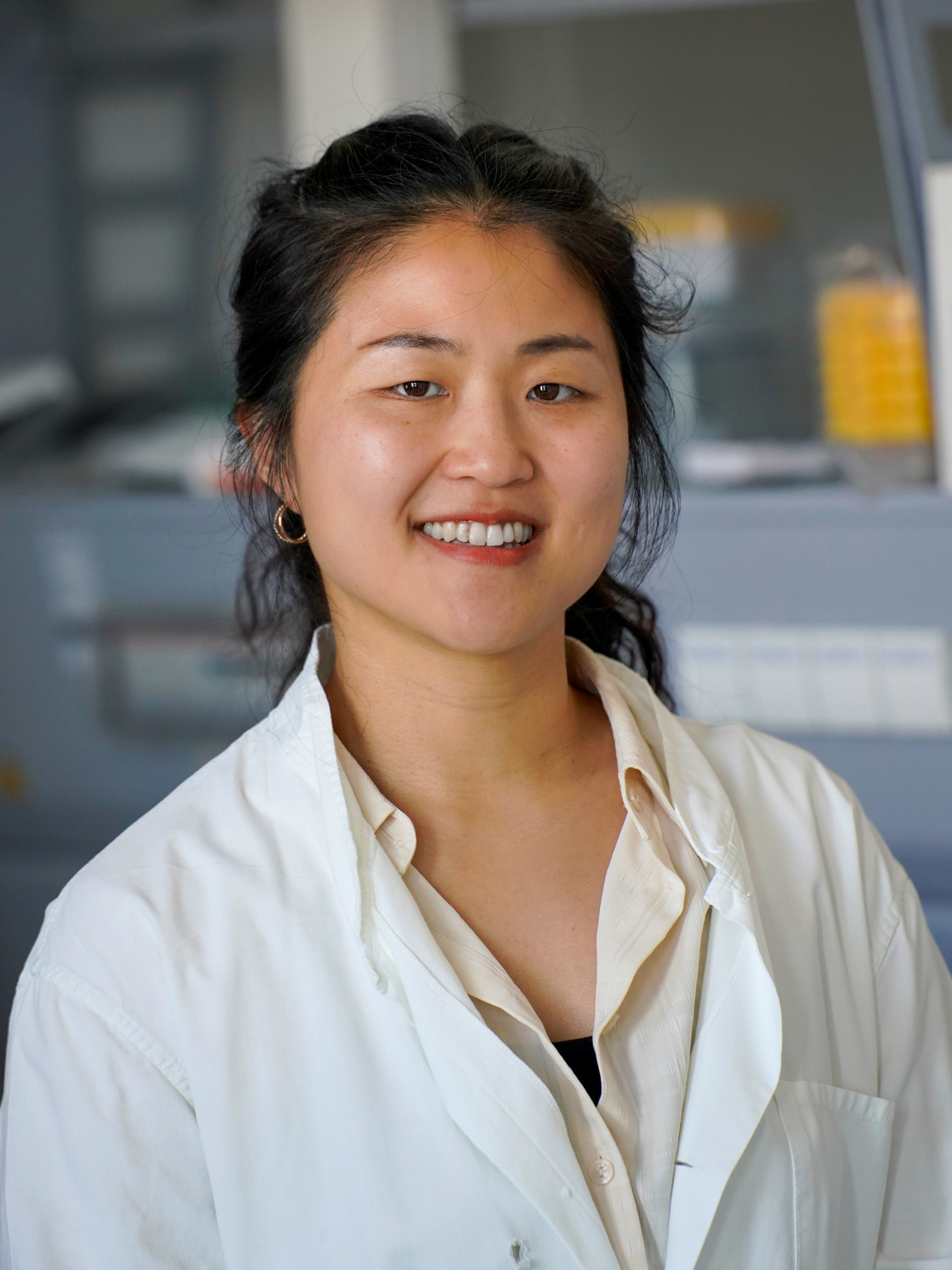
Kwi Young Han has been an Assistant Professor in the Marine Evolutionary Ecology Group at GEOMAR since May 2026. She investigates how marine species adapt genetically in response to environmental changes and human intervention.
Photo: Ilka Thomsen, GEOMAR
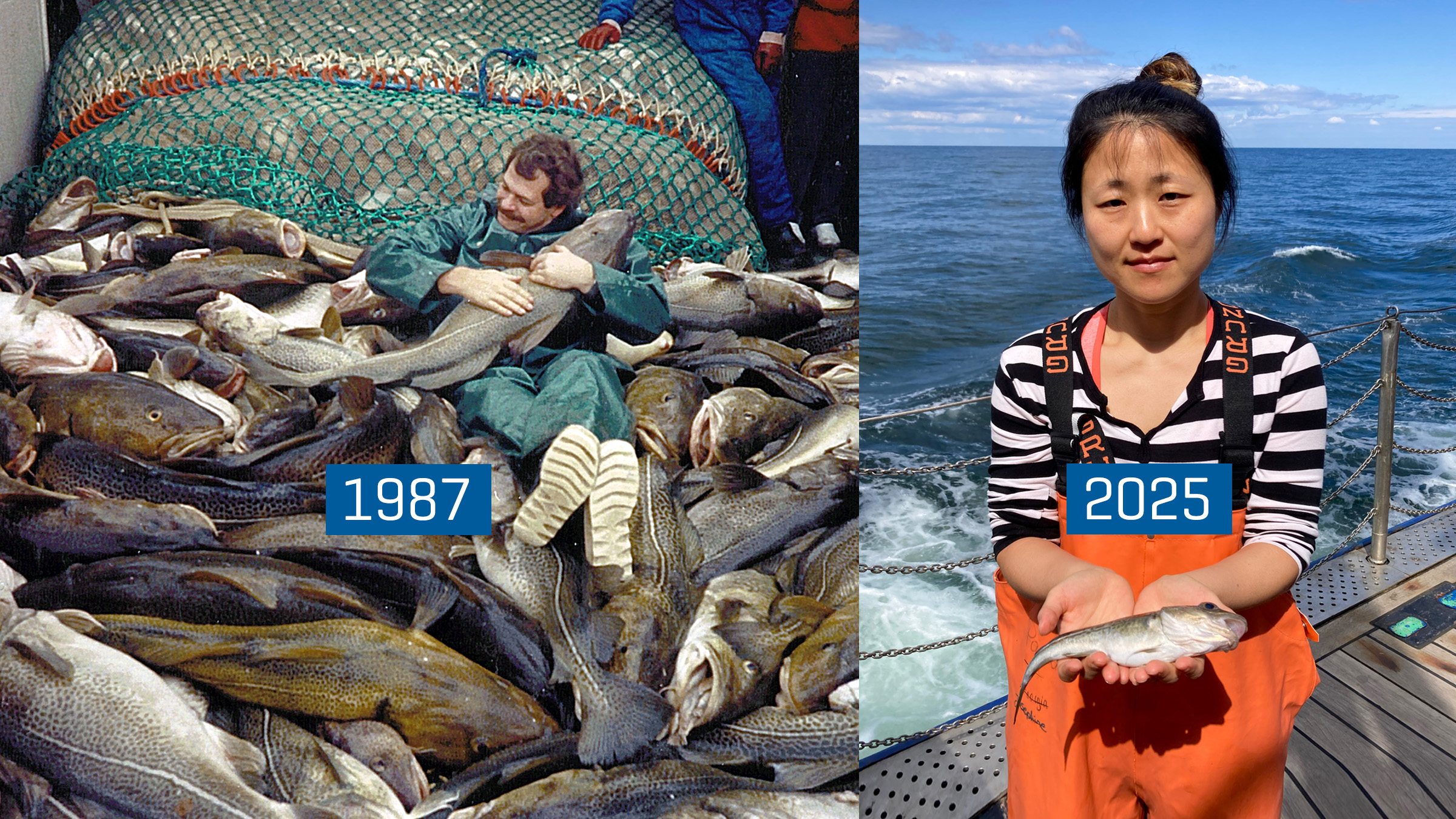
Kwi Young Han’s doctoral thesis on eastern Baltic cod attracted attention when she discovered that fishing has influenced the evolution of the species.
Photos: Jesper Bay, Danish Institute of Fisheries and Marine Research, March 1987 / Thorsten Reusch, GEOMAR
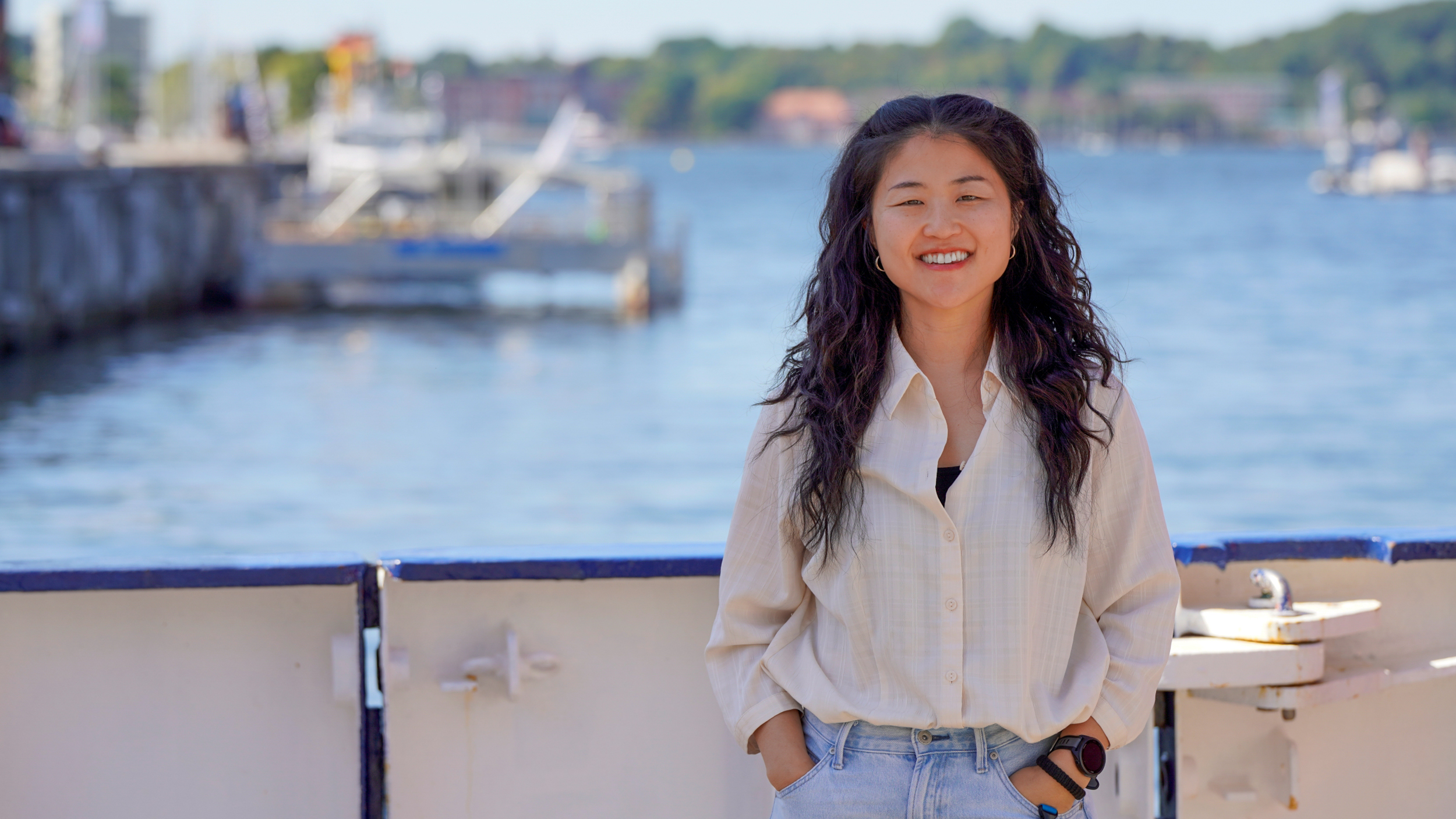
Kwi Young Han is from the south coast of South Korea, near Busan. She studied biology at Sungkyunkwan University near Seoul, graduating with a bachelor's degree in 2016 and a master's degree in 2018. She came to Kiel to pursue her doctorate.
Photo: Ilka Thomsen, GEOMAR
Curiosity in the genes
Kwi Young Han is GEOMAR’s new Junior Professor of Marine Evolutionary Ecology
Kwi Young Han has had an astonishing career. In just a few years, she went from working as a burrito maker in Berlin to becoming a professor at GEOMAR. Admittedly, she already had a Master‘s degree in biology when she started rolling burritos to order. Even so, hers is far from a conventional career path.
Let’s start at the beginning. Kwi Young Han comes from South Korea, near Busan. She studied biology at Sungkyunkwan University in Seoul, completing her Bachelor’s degree in 2016 and her Master’s in 2018. After graduating, she felt drawn to moving abroad. She went to Germany, to Berlin, where she supported herself by preparing burritos in a restaurant. When she came across a vacancy for a PhD position at GEOMAR, she applied and moved to Kiel. The topic of her research: fisheries-induced evolution in eastern Baltic cod.
“In Korea, there’s a lot of practical work involved in your degree,” she explains. She had worked with microalgae, gained experience in DNA sequencing and was well versed in evolutionary history. The post was a good fit, and she started at GEOMAR in 2020. “It was a very applied topic and, at the same time, basic research.”
PhD thesis on ‘shrunken’ cod
Four years later, Kwi Young Han defended her PhD thesis. In it, she had examined the genome of eastern Baltic Sea cod and found evidence that fishing had caused evolutionary changes in the stock. A discovery that attracted considerable attention. The New York Times ran the headline “Honey, we shrank the cod”, and media outlets around the world picked up on the story. Han hadn’t expected such a huge media response: “But it was great – after all, not many researchers get the chance to present their findings to such a wide audience.”
Her real motivation, however, clearly lies in science itself. When she talks about evolutionary biology, her eyes light up. She wants to know how things work, to keep answering new questions, to push into the unknown. Yet the huge response to her work also revealed another side to her role: “When all those interview requests came in, I realised that, as a scientist, my voice can carry.”
The path to marine ecology
Her path to becoming a marine scientist was not a foregone conclusion. The fact that she worked with marine organisms – specifically algae – during her Master’s degree was more of a coincidence. But she enjoyed it. Later, genomics came into the picture – that is, the analysis of genetic information. What initially fascinated her about this was the computer-based work: large datasets, patterns, analysis – a field in which methods and technologies are developing very rapidly.
What appeals to her most about biology is its diversity: there is never just one rule; there are always exceptions and variations, and these give rise to new questions. This suits the researcher down to the ground. Han: “I’ve always had all sorts of questions in my head. There are simply an infinite number of things to explore that spark my curiosity.”
Now a professor
After completing her PhD, Kwi Young Han remained at GEOMAR. She continued her work on eastern Baltic cod and taught courses. Then a professorship in the field of marine evolutionary ecology became available. They were looking for someone with a background in evolutionary genomics. It all fell into place.
She has now been an assistant professor since May 2026. “I’ve changed; I’ve learnt a lot,” she says. “I realise now that I’m capable of things I wouldn’t have trusted myself with before.”.” The work is now quite different. Research and teaching remain central, but there are additional tasks: writing grant applications, securing funding, planning finances – “The level of responsibility is different.”
She particularly enjoys teaching on the Master’s programme in Biological Oceanography. There, she explains, it’s not just about knowledge, but also about exchange. “We have lots of scientific discussions, which is great fun.”
And her family in South Korea? They probably hadn’t expected either that the young woman who moved to Berlin and took service jobs would become a professor in Germany just a few years later. “My family is very proud of me,” says Kwi Young Han. “They saw me leave, do my PhD, and now I’ve become a professor in a faraway country – that really impresses them.” Her smile widens slightly as she says this.
Kiel will remain her academic base for the foreseeable future. Has she got used to it? “Now that I know I’ll probably be here for longer, I’m even more wary of the North German winter,” she says with a laugh. But it also makes life more stable, more settled. Only her partner, she adds, will now probably have to look for a job in Kiel as well.
Kwi Young Han has been an Assistant Professor in the Marine Evolutionary Ecology Group at GEOMAR since May 2026. She investigates how marine species adapt genetically in response to environmental changes and human intervention.
Photo: Ilka Thomsen, GEOMAR
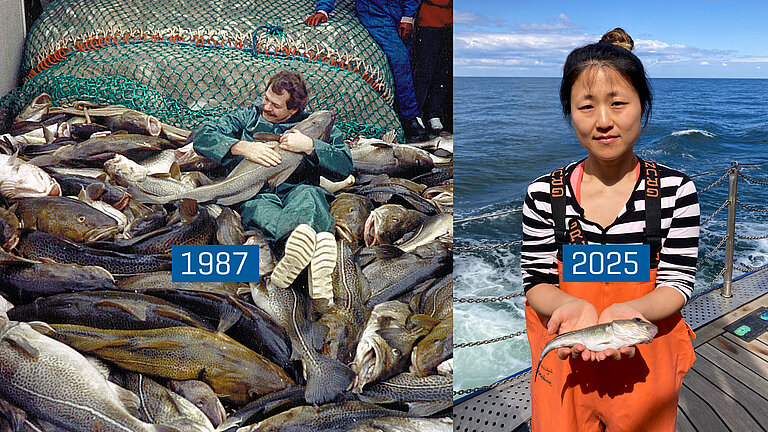
Kwi Young Han’s doctoral thesis on eastern Baltic cod attracted attention when she discovered that fishing has influenced the evolution of the species.
Photos: Jesper Bay, Danish Institute of Fisheries and Marine Research, March 1987 / Thorsten Reusch, GEOMAR
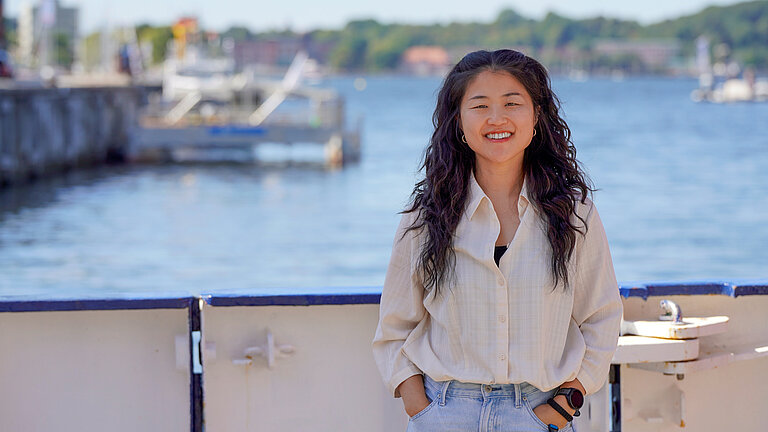
Kwi Young Han is from the south coast of South Korea, near Busan. She studied biology at Sungkyunkwan University near Seoul, graduating with a bachelor's degree in 2016 and a master's degree in 2018. She came to Kiel to pursue her doctorate.
Photo: Ilka Thomsen, GEOMAR
