Anna Niewerth
Phone: +49 (0) 431 600 2812
E-Mail: aniewerth(at)geomar.de
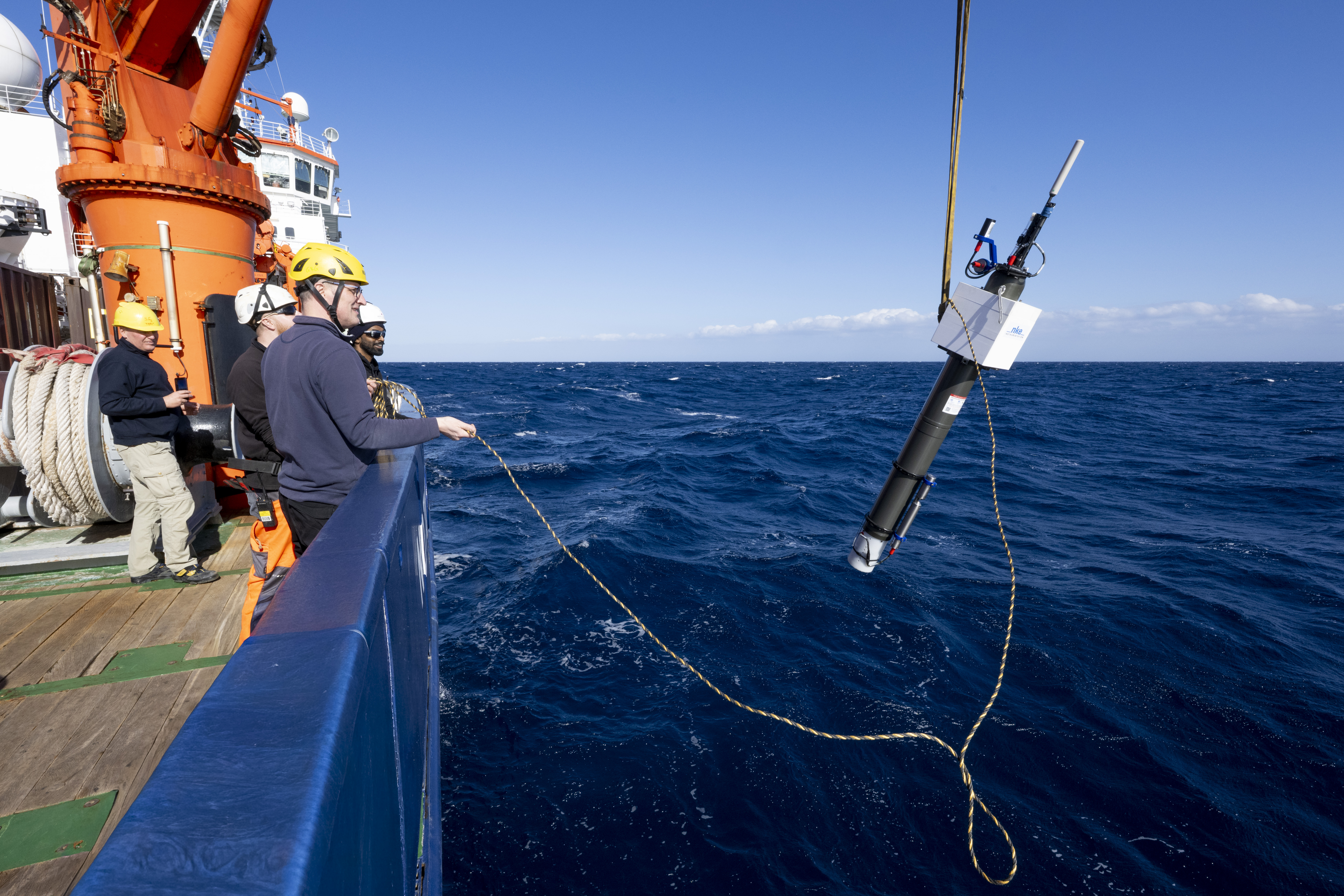
The latest Copernicus Ocean State Report emphasises the importance of long-term, continuous ocean observation. It is only through reliable time series of measurements that short-term extreme events can be distinguished from long-term changes.
Photo: Christian Clauwers

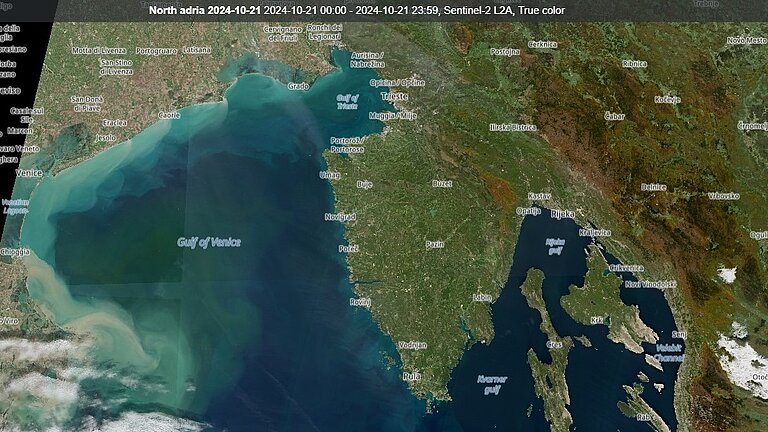
Satellite image of the northern Adriatic Sea, showing the Po Delta, at the end of October 2024: Following a series of extreme weather events involving heavy rainfall, more than twice the usual amount of freshwater flowed into the Mediterranean Sea here, causing the surface salinity to fall from around 35 to less than 15 grams per kilogram. Such a change can have far-reaching consequences for the marine environment.
Photo: Copernicus Sentinel data 2024
European coastal regions under pressure
10th Copernicus Ocean State Report highlights the value of ocean observation
The 10th Copernicus Ocean State Report (OSR10), published today, makes clear that the ocean is undergoing profound and accelerating change. Produced by Mercator Ocean International as part of the European Union’s Copernicus Marine Service, the report brings together contributions from 125 scientists from Europe and worldwide. Based on satellite observations, in situ measurements and modelling, it documents, among other findings, continuing ocean warming, rising sea levels, increasing acidification and the impacts of extreme events on marine ecosystems and coastal societies.
European regional seas under growing pressure
Europe’s regional seas are under particular pressure. For 2024, the report describes, among other events, marine heatwaves in the Mediterranean and Black Sea, severe storms along the Atlantic coast of Spain, and exceptional changes in water levels and salinity in European coastal waters.
At the same time, the report shows that hydrological conditions in the Mediterranean region may change as a result of climate change. Reduced snowfall, changing precipitation patterns and more frequent heavy rainfall events could cause rivers such as the Po to fluctuate more strongly between extremely low discharge and exceptional flood events in the future. This would have direct consequences for coastal dynamics, marine habitats, fisheries, aquaculture and coastal management.
Northern Adriatic: extreme discharge alters salinity and algal growth
GEOMAR scientist Dr Naomi Krauzig assesses developments in the northern Adriatic Sea: “The northern Adriatic Sea experienced a remarkable sequence of freshening events in 2023 and 2024. Following a series of extreme events involving heavy rainfall and high river discharge in autumn 2024, including storm ‘Boris’, surface salinity dropped from around 35 to less than 15 grams per kilogram. Such a change in coastal waters can have far-reaching impacts on the marine environment. Sustained and interoperable observing systems are therefore essential to support scientific research, early warnings and climate adaptation in vulnerable coastal regions.”
Long-term observation strengthens early warning and adaptation
OSR10 underlines the importance of long-term and continuous ocean observation. Only through reliable time series, operational forecasting systems and scientific collaboration is it possible to distinguish short-term extreme events from long-term change. This information provides an essential basis for policy-makers, authorities, coastal communities and maritime sectors to better assess risks and prepare for future changes.
Global trends show continuing ocean change
In addition to its focus on European seas, the report also examines global developments. Since 1960, ocean heat content has increased markedly; global mean sea level rose by an average of 3.8 millimetres per year between 1999 and 2025, and by 4.2 millimetres per year since 2012. In addition, the ocean became around 17 per cent more acidic between 1985 and 2025. Particularly vulnerable regions include Small Island Developing States, coral reefs and polar regions.
“Ten years after the first report, the Copernicus Ocean State Report offers more than a series of annual snapshots. It provides a growing scientific record of an ocean under increasing pressure,” says Dr Karina von Schuckmann, Director of the Copernicus Ocean State Report. “At the same time, it shows how sustained observation, modelling and forecasting, and scientific collaboration can help societies understand what is changing, where and why — and identify future risks early and prepare for their impacts.”
About: Copernicus Ocean State Report
As part of the Copernicus Marine Service, the annual Copernicus Ocean State Report (OSR) is the key tool of its ocean reporting framework. It reports on the state, variability and long-term changes in the global ocean and European regional seas over the past decades up to close to real time. Using remote sensing, in situ observations and ocean reanalysis data, the OSR provides a comprehensive four-dimensional analysis — latitude, longitude, depth and time — of the Blue Ocean (physical ocean), White Ocean (sea ice) and Green Ocean (biogeochemical and biological ocean). It is intended to serve as a reference for the scientific community, policy-makers and others with decision-making responsibilities.
About: Copernicus Marine Service
The Copernicus Marine Service is one of the six services of Copernicus, the European Union’s Earth Observation Programme. It provides regular, free and open-access ocean analyses, data and forecasts at both global and European scales. These products support marine protection, maritime safety, sustainable resource management, climate monitoring, weather forecasting, and EU and international policy-making. The service also helps make scientifically sound information on ocean issues accessible to the public and expert users.
About: Mercator Ocean
Mercator Ocean International, based in Toulouse, France, is one of the world’s leading ocean prediction centres and a key pillar of Europe’s digital ocean infrastructure. It is the entrusted entity of the European Commission for the implementation of the Copernicus Marine Service. Mercator Ocean also leads the development of the European Digital Twin Ocean, a flagship European initiative developed with partners under the leadership of the European Commission to support scenario-based ocean decision-making. In 2025, Mercator Ocean took a major step towards becoming an international organisation: twelve European countries endorsed the international convention establishing the Mercator International Centre for the Ocean.
Original publication:
Krauzig, Naomi & Coluccelli, Alessandro & Memmola, Francesco & Penna, Pierluigi & Moro, Fabrizio & Zambianchi, Enrico & Falco, Pierpaolo (2025): Insights into exceptional freshening events in the northern Adriatic Sea throughout 2023–2024. DOI: 10.5194/sp-2025-10
Insights into exceptional freshening events in the northern Adriatic Sea throughout 2023–2024
The latest Copernicus Ocean State Report emphasises the importance of long-term, continuous ocean observation. It is only through reliable time series of measurements that short-term extreme events can be distinguished from long-term changes.
Photo: Christian Clauwers
Satellite image of the northern Adriatic Sea, showing the Po Delta, at the end of October 2024: Following a series of extreme weather events involving heavy rainfall, more than twice the usual amount of freshwater flowed into the Mediterranean Sea here, causing the surface salinity to fall from around 35 to less than 15 grams per kilogram. Such a change can have far-reaching consequences for the marine environment.
Photo: Copernicus Sentinel data 2024