Anna Niewerth
Phone: +49 (0) 431 600 2812
E-Mail: aniewerth(at)geomar.de
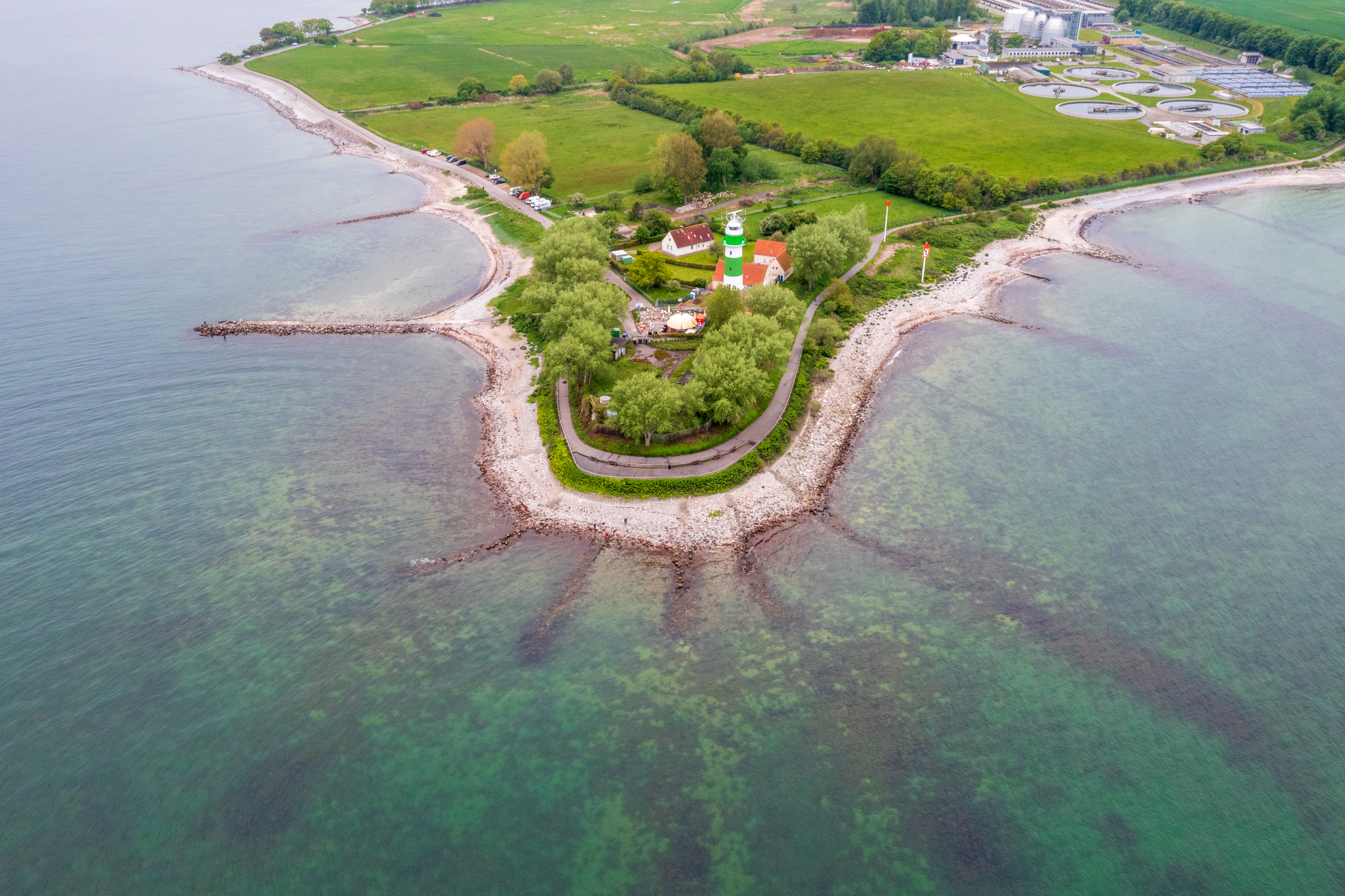
The Bülk lighthouse in Strande, with the sewage treatment works in the background. Here, biogas is produced from sewage sludge and used to generate energy. The CO2 released in the process is now set to be captured and converted into dissolved bicarbonate. This will increase the alkalinity (i.e. acid-neutralising capacity) of the water discharged into the Baltic Sea. GEOMAR is providing independent scientific monitoring, investigating the potential effects on the marine environment.
Photo: Matthias Süßen, CC BY-SA 4.0
Long-term CO2 sequestration: pilot project launched at the Bülk sewage treatment works
The state capital of Kiel and Planeteers are testing a method for storing carbon dioxide in the Baltic Sea, with GEOMAR providing scientific support
The state capital, Kiel, is collaborating with the Hamburg-based start-up Planeteers GmbH to trial a process that can sequester carbon dioxide in the long term and store it in the Baltic Sea. The planned pilot plant can capture and store up to 625 tonnes of CO2 annually. As part of the process, water with increased alkalinity – i.e. greater acid-neutralising capacity, typically associated with a higher pH value – enters the fjord. As part of a scientific monitoring programme, the GEOMAR Helmholtz Centre for Ocean Research Kiel is investigating whether the increase in alkalinity causes measurable changes in the marine environment. The research is funded by the Ministry for Energy Transition, Climate Protection, Environment and Nature of the State of Schleswig-Holstein (MEKUN).
“The pilot project could be another piece of the jigsaw towards a climate-neutral Bülk sewage treatment works. We want to make the most of the opportunities offered by the site, whilst at the same time promoting the development of new processes to protect the environment, without ruling out any particular technology. To become more climate-friendly, we must avoid emissions, but also explore new avenues. That is exactly what we are now doing in Bülk,” says Kiel’s Head of the Environment Department, Alke Voß.
State Secretary Joschka Knuth (MEKUN) explains: “In Schleswig-Holstein, our companies and start-ups are also leading the way with innovations in climate protection. For a long time now, we have been making a noticeable impact on climate protection nationwide through the expansion of renewable energies. To achieve our global climate targets, humanity will also have to permanently remove CO2 from the atmosphere. To do this, we need new processes – and pilot projects in which we can test them responsibly under real-world conditions. This is precisely what Planeteers is doing at the Bülk sewage treatment works. Independent scientific monitoring is essential here. That is why MEKUN is contributing to the funding of the monitoring programme carried out by GEOMAR, which is investigating potential impacts on marine ecosystems.”
Technically accelerated ‘weathering’ instead of CO2 emissions into the atmosphere
At the Bülk sewage treatment works, biogas is produced from the sewage sludge generated during wastewater treatment. This is used in the works’ own combined heat and power plant to generate energy (electricity and heat). However, the combustion of biogas also produces CO2. This is precisely where the process developed by Planeteers GmbH comes in: the CO2 is not released into the atmosphere, but is captured directly on site and chemically converted into a dissolved form that can remain in seawater for long periods of time.
The company is thus replicating a natural process – the weathering of carbonate rock (e.g. limestone): in nature, CO2 reacts with water to form carbonic acid. This can dissolve carbonate rock, and in the reaction the CO2 is converted into bicarbonate (HCO3⁻). This is naturally carried into the sea with the water. The Planeteers plant uses technology to accelerate this weathering process from geological timescales to a matter of minutes. The water treated in this way is then discharged into the Baltic Sea via the sewage treatment works’ existing outfall. There, the additional dissolved carbon – depending on mixing, currents and chemical equilibrium – can remain for periods of more than 1,000 years.
The Bülk site offers favourable conditions for the pilot project: the CO2 required for the process is produced directly at the combined heat and power plant. Furthermore, a suitable area and large quantities of water are available. For the initial operational phase, treated effluent from the sewage treatment work‘s outfall will be used. The limestone required will be sourced from quarries as close as possible.
What is the impact of additional alkalinity in the Baltic Sea?
The effects of the additional alkalinity on the Baltic Sea are being scientifically investigated. The effluent from the Bülk sewage treatment works already exhibits elevated alkalinity due to the hardness of the drinking water. At the existing discharge point, it is more than twice as high as the natural background level in the Baltic Sea. The Planeteers’ process is expected to increase this value by a maximum of nine per cent.
GEOMAR is carrying out independent monitoring of this, recording, for example, the chemical changes in the water, the spatial and temporal spread of the discharge, and possible effects on biological processes.
“From a scientific perspective, it is fascinating for us to investigate how the high alkalinity affects the regional marine environment. The results may provide important insights for research into alkalinity enhancement – an approach that could play a role in the future in removing CO2 from the atmosphere and thus in offsetting residual emissions that are difficult to avoid,” says Andreas Oschlies, Professor of Marine Biogeochemical Modelling at GEOMAR.
Increasing alkalinity is one of the options under discussion for storing CO2 in the ocean in the long term. At the same time, it counteracts ocean acidification. GEOMAR has many years’ experience in researching the marine carbon cycle and the consequences of changes in alkalinity – in the laboratory, in the field and using models. “Our role in this project is to provide independent scientific oversight,” emphasises Oschlies.
From test facility to pilot plant
The planned plant is a further development of an initial pilot plant, which was trialled at the Bülk sewage treatment works in early 2025 with a projected annual capacity of around 60 tonnes of CO2. Drawing on this experience, the plant now being planned has been developed with a nominal capture and storage capacity of up to 625 tonnes of CO2 per year. Planeteers has been operating a validated production plant on the site of the Hetlingen sewage treatment works (Pinneberg district) since the end of 2025.
“Climate protection becomes effective when technology is put into practice. Together with the City of Kiel and the sewage treatment works, we are creating the conditions for this and taking an important step towards scalable solutions,” says Dr Frank Rattey, founder and managing director of Planeteers GmbH.
The collaboration between the state capital, Kiel, and Planeteers GmbH has been formalised in a cooperation agreement. For the trial, the state capital, Kiel, is essentially making the sewage treatment plant’s existing infrastructure and resources available – in particular, land, CO2 and treated wastewater. The remaining services for the pilot plant will be provided by Planeteers GmbH. The company has obtained the necessary regulatory approvals for the pilot operation, which is initially scheduled to run for five years. The municipality of Strande, in whose area the Bülk sewage treatment works is located, has been informed about the pilot operation and the planned pilot plant.
The Bülk lighthouse in Strande, with the sewage treatment works in the background. Here, biogas is produced from sewage sludge and used to generate energy. The CO2 released in the process is now set to be captured and converted into dissolved bicarbonate. This will increase the alkalinity (i.e. acid-neutralising capacity) of the water discharged into the Baltic Sea. GEOMAR is providing independent scientific monitoring, investigating the potential effects on the marine environment.
Photo: Matthias Süßen, CC BY-SA 4.0