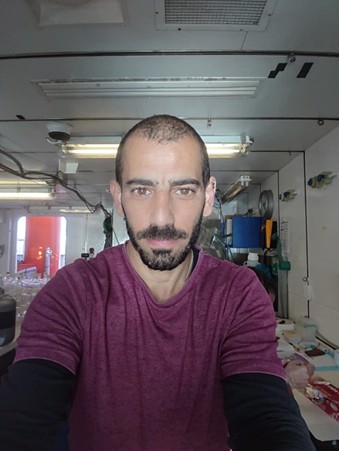
Tom Reich, PhD student at the University of Haifa.
There is nothing like being out on the water to truly understand how our oceans "breathe".
As a marine biologist, my focus is on the foundation of life: inorganic carbon assimilation. Phytoplankton are the MVPs of the sea, converting dissolved CO2 into organic carbon that fuels the entire food web. In our mission on board the R/V Meteor, we measured the phytoplankton photosynthetic rate of conversion (i.e. Primary Production (PP)) within the Eastern Mediterranean Sea’s nutrient-poor (ultra-oligotrophic) waters.
Here is the "dark" secret of our research: we aren't just looking at photosynthesis. We are also measuring Dark Carbon Fixation (DCF) — carbon fixed by chemoautotrophs in both the sunlit and deep, dark layers of the ocean. By combining PP and DCF, we get a much more accurate assessment of how much organic carbon is produced and exported to the deep sea.
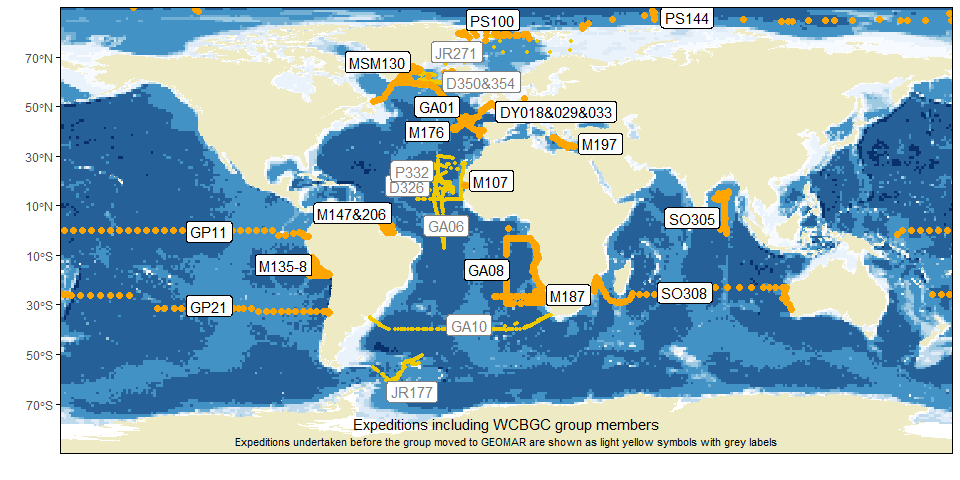
We conducted a month-long cruise from Cyprus to Sicily specifically to see how physical features such as eddies influence PP and DCF. In addition, we’ve also been running controlled experiments with natural marine populations from the Mediterranean Sea to see how rising temperatures, nutrient demands, and particle aggregation impact the processes of photosynthesis and dark carbon fixation.
Understanding these dynamics is vital for predicting how the oceanic carbon cycle will shift in a changing climate. Stay tuned for more updates from the lab!
A text by Tom Reich, PhD student at the University of Haifa.
Sensor Deployment on a Research Buoy to Monitor Carbonate Chemistry in the Eastern Mediterranean
Between 27th and 31st May 2025, Dr. Li Qiu deployed two commercial sensors for measuring partial pressure of CO₂ (pCO₂) and pH on a surface research buoy, owned by the Cyprus Marine & Maritime Institute (CMMI), located in Amathus Bay, off the coast of Limassol, Cyprus.
The Mediterranean Sea is particularly vulnerable to climate change and intensive human activity, making it a critical area for ocean carbon monitoring. The aim of this deployment is to collect continuous, full-season carbonate chemistry data to improve our understanding of how these environmental stressors affect the Eastern Mediterranean.
On 30th May 2025, with support from CMMI and SignalGeneriX Ltd., Dr. Qiu installed two state-of-the-art commercial sensors:
A CONTROS HydroC™ CO₂ sensor for pCO₂
An AquapHOx pH sensor for high-accuracy pH measurements
This initial deployment is expected to last 5 to 6 months, after which Dr. Qiu will return to retrieve the sensors, download the data, and perform necessary maintenance. A second deployment is planned for the following half-year to ensure year-round data coverage.
These observations will contribute to the EMS FORE Project and support regional efforts to better understand and model the oceanic carbon cycle under changing environmental conditions.
Dr. Li Qiu prepares the sensors
CONTROS HydroC™ CO₂ sensor
Research buoy of the Cyprus Marine & Maritime Institute (CMMI)
AquapHOx pH sensor
Research team with Dr. Li Qiu
EMS-FORE Workshop
A digital EMS-FORE workshop took place on 15.05.2025. The following exciting presentations were on the agenda:
Nis Hansen: Vertical and horizontal community structures of gelatinous zooplankton in the EMS and CMS
Revital Bookman: Understanding sediment deposition and burial processes in the EMS
Jana Blanke: Impact of mesoscale features on particle fluxes in the eastern Mediterranean Sea
David Moncayo Guzman: Phytoplankton modelling: Parameter’s temperature dependence
Angèle Nicolas: Trace metal cycles in the EMS (preliminary results from M197)
Merav Gilboa: Zooplankton ecology in mesoscale eddies
Barak Herut: Aerosols chemistry, seawater interactions and Prokaryotes variability
Henriette Wilckens: Physical distribution of high frequency weakly nonlinear internal gravity waves and mesoscale eddies across the eastern Mediterranean Sea
Mike Krom: Longer term nutrient dynamics studies from the off shore pelagic station
German-Israeli Alliance Symposium
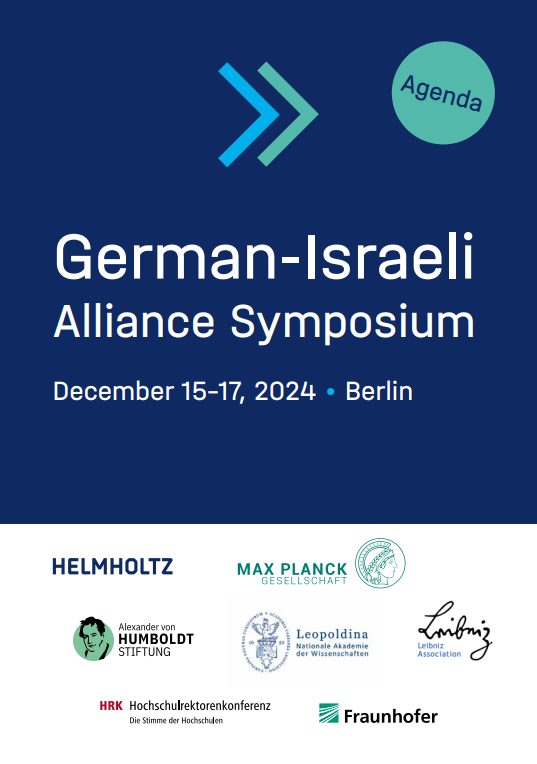
At December 2024, we had the honor of participating in an important scientific event in Berlin, organized and hosted by major German research foundations: the Helmholtz Association and the Max Planck Society, and supported by other German associations: the Leopoldina Academy, the Leibniz Association, and the Fraunhofer Society. The symposium was aimed at supporting Israeli-German collaborations and showcased cutting-edge science from German-Israeli partnerships that presented their work in diverse fields including earth and life sciences, AI, astrophysics, quantum computing, and sustainability. We were privileged to present our Helmholtz-supported project: "The Eastern Mediterranean Sea Centre – An Early-Warning Model-System for our Future Ocean." This project was selected to represent Helmholtz's sustainability initiatives and was the sole project from the University of Haifa. Proud to represent our collaborative German-Israeli team were Dr. Martha Gledhill (GEOMAR Helmholtz Centre for Ocean Research), Prof. Yizhaq Makovski, Dr. Or Bialik, and Prof. Ilana Berman-Frank from the University of Haifa’s Charney School of Marine Sciences. This event underscored the strength and potential of international scientific collaboration, highlighting the importance of partnerships that transcend borders and disciplines to generate excellent science, and most importantly the unwavering support from our German colleagues during these challenging times.
Prof. Ilana Berman-Frank at the German-Israeli Alliance Symposium
Prof. Yizhaq Makovski at the German-Israeli Alliance Symposium
We use cookies to give you the best possible experience on our website. Some cookies are technically necessary, others help us to improve our services. You decide which cookies you allow.
Required for the basic functions of the website, e.g. to store your cookie settings. These cannot be switched off.
OffOn
Help us understand how the website is used so that we can improve it. The analysis runs anonymously on our own servers.
Details about Matomo analysisShowHide
If you consent to our analysis using the Matomo program, we will collect, store, and evaluate the following:
Information about the device type, browser type, and version used.
The user’s operating system
Type and Status of HTML Requests to the GEOMAR Website
The IP address of the user’s device. The full IP address is collected, used for analysis, and stored. However, it is displayed only in anonymized form in the analysis.
Date and time of access
Websites from which the user’s device accessed the GEOMAR website.
The addresses (URLs) visited on the GEOMAR website