Ocean Sciences Meeting 2026 in Glasgow
![[Translate to English:] Ocean Science Meeting](/fileadmin/content/forschen/fb1/po/news/OSM1.jpg)
Contributions from the Physical Oceanography Department
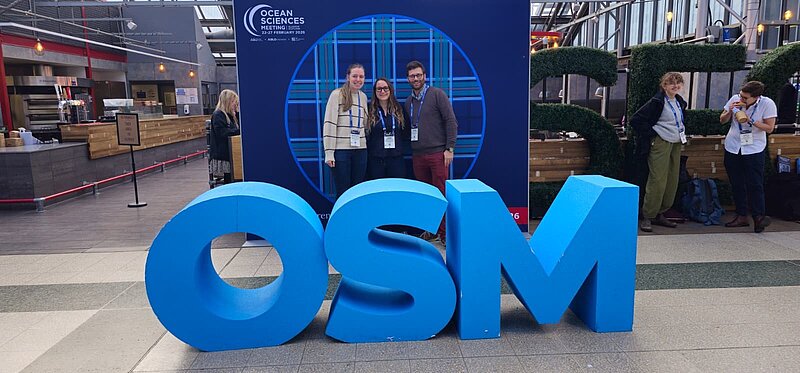
At the Ocean Sciences Meeting 2026 in Glasgow, researchers of the Physical Oceanography Department presented the latest findings from their work. Their contributions showcased key aspects of modern ocean science – from large-scale circulation dynamics of the Atlantic Meridional Overturning Circulation (AMOC) to small-scale mixing processes at topographic features such as islands and seamounts, and on to innovative ocean observation technologies and analyses. Through talks and posters, the scientists demonstrated the tight connection between physical processes, ecosystem dynamics, and innovative methodologies.
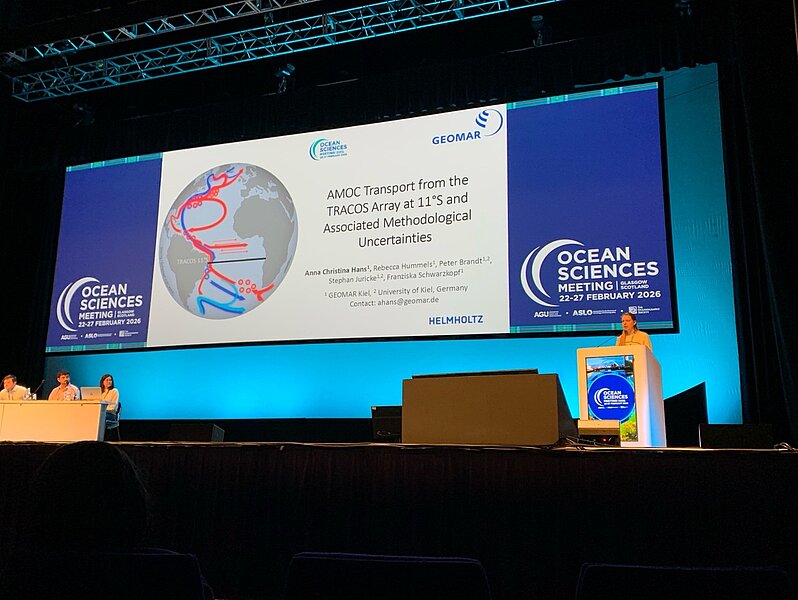
Uncertainties of AMOC Observations at 11°S – Talk by Anna Christina Hans
![[Translate to English:] AMOC](/fileadmin/content/forschen/fb1/po/news/OSM2.jpg)
Anna Christina Hans‘s talk centered on the Atlantic Meridional Overturning Circulation (AMOC) – a key component of the global climate system. She presented results about the upper branch of the AMOC at 11°S, gathered by the TRACOS observation array (Tropical Atlantic Circulation and Overturning at 11°S). The array combines pressure-equipped inverted echosounders (PIES), moored instruments, and ship data, supplemented by Argo floats and satellite information.
Using a high-resolution ocean model (VIKING20X), the team ran so-called Observing System Simulation Experiments (OSSEs) to investigate how sensitive the transport calculations are to measurement arrangement and methodological assumptions. The results show that despite relatively sparse instrumentation, more than 70% of high-frequency and 60% of low-frequency AMOC variability can be reconstructed. The seasonal cycle dominates the signal with fluctuations of around 20 Sverdrup. At the same time, Anna Christina Hans and her colleagues identified opportunities to improve the array design to capture AMOC variability more robustly.
Microstructure Measurements with Gliders – Contribution by Naomi Krauzig
![[Translate to English:] Turbulenzmessungen](/fileadmin/content/forschen/fb1/po/news/OSM3.jpg)
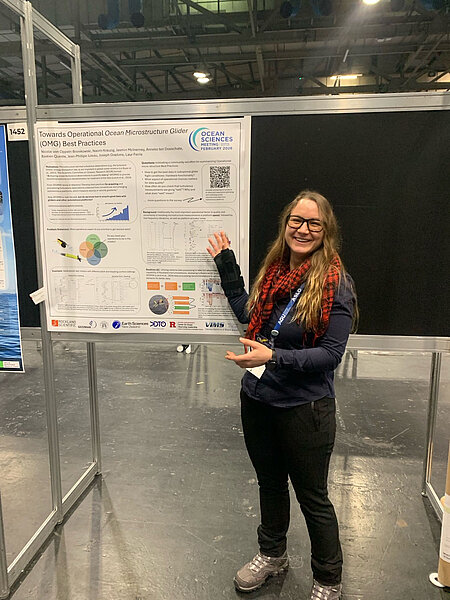
Turbulence and dissipation measurements remain a critical observational gap in the global ocean observing system. Advancing international collaboration, Naomi Krauzig contributes to a community project developing operational best practices for oceanic microstructure measurements using autonomous gliders, particularly the widely used SeaExplorer and Slocum platforms.
The presented poster focused on key aspects affecting data quality, including platform configuration, piloting strategies, and quality assurance procedures across different deployment environments—from continental shelves to the open ocean and polar regions.
Through an international survey, operational experiences from diverse research groups are being collected to compile practical recommendations and improve the quality and comparability of glider-based turbulence observations.
UN Ocean Decade – Early Career Ocean Professionals (ECOP)
Additionally, Naomi Krauzig showcased the opportunities and benefits available to Early Career Ocean Professionals (ECOPs) during a town hall event on the ECOP Programme of the UN Ocean Decade. The endorsed network supports early-career researchers worldwide through professonal development, networking, visibility, and training opportunities, strengthening their role and engagement in marine research and Ocean Decade initiatives.
Under-ice Argo Floats in the Eastern Ross Sea
In another poster co-authored by Naomi Krauzig, the first year-round observations from Argo floats deployed in the eastern Ross Sea were presented. Collected in one of the least sampled regions of the Southern Ocean, the data provide new insights into winter intrusions of relatively warm Circumpolar Deep Water and the spreading of Ice Shelf Water. These observations have important implications for the formation of dense shelf waters and Antarctic Bottom Water, ocean–ice interactions, and the stability of Antarctica’s largest ice shelf.
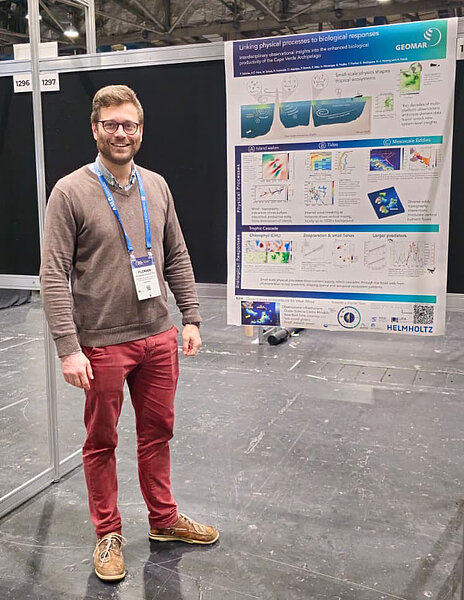
Physics Meets Biology: Productivity Hotspot Around Cabo Verde – Poster by Florian Schütte
![[Translate to English:] Datengetriebene Ozean-Emulation](/fileadmin/content/forschen/fb1/po/news/OSM4.jpg)
Florian Schütte’s poster showed a striking example of how physical processes shape biodiversity. Drawing on 20 years of interdisciplinary research around the Cape Verde Archipelago, he and his international team showed how different physical processes influence biological productivity in an otherwise nutrient-poor region of the tropical Atlantic.
The team identified three key processes:
- Atmospherically generated island wakes: Wind flows over the islands' topography create eddy fields that enhance local mixing and nutrient supply
- Mesoscale eddies from West Africa: Nitrate-rich eddies interact with islands and shallow topography, intensifying submesoscale dynamics and vertical mixing.
- Tides and internal waves: Breaking internal waves lead to mixing rates up to a thousand times higher compared to the open ocean.
These processes increase the nitrate flux into the euphotic zone (the upper ~100 m where photosynthesis occurs) and thus promote primary production. Zooplankton and mesopelagic fish increase three- to tenfold in hotspots. Moreover, fish landings (mackerel, tuna) and the occurrence of humpback whales correlate positively with chlorophyll concentration. The study powerfully illustrates how small‑scale physical processes structure marine biodiversity and food webs.
Data-Driven Ocean Emulation
In another poster contribution, Florian Schütte and his colleagues from the Ocean Dynamics Department showed how kilometer-scale ocean simulations can be used to develop cost-efficient data-driven models of the three-dimensional ocean state using deep learning. The researchers aim to generate physically consistent ocean ensembles with significantly reduced computational effort – a promising approach for future ocean forecasting.
Conclusion
With contributions spanning the key aspects of modern ocean research, scientists from the Physical Oceanography Department showcased GEOMAR’s high-quality research. The Ocean Sciences Meeting 2026 in Glasgow provided an important platform for international exchange and highlighted the central role of integrated observation systems for understanding the climate system and marine ecosystems.