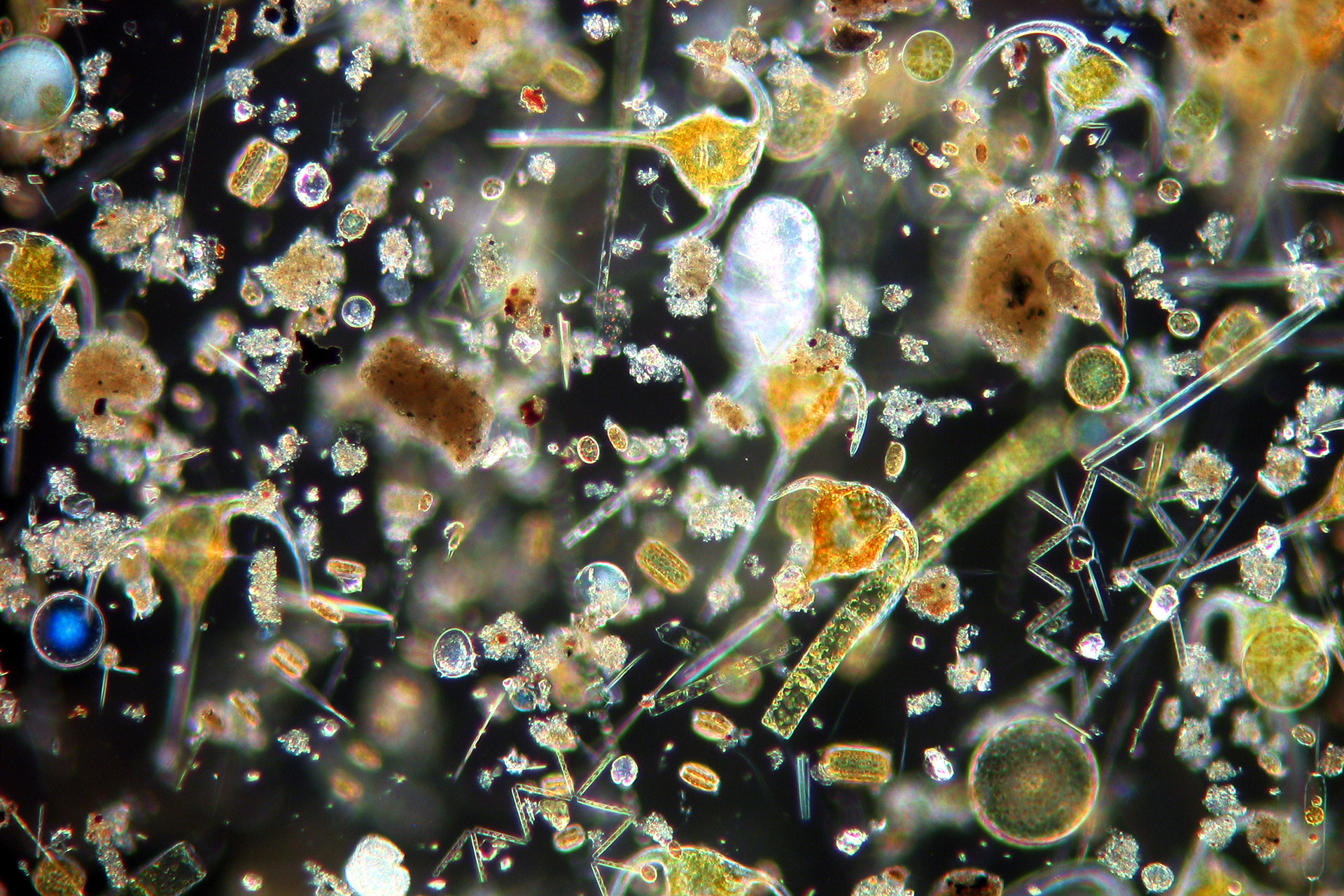
Observing marine microalgae, the phytoplankton, in the Baltic Sea with an Utermöhl microscope.
Shown are dinoflagellates, diatoms (silica-encysted algae), filamentous green algae, and filamentous cyanobacteria (blue algae). Photo: Annegret Stuhr, GEOMAR.
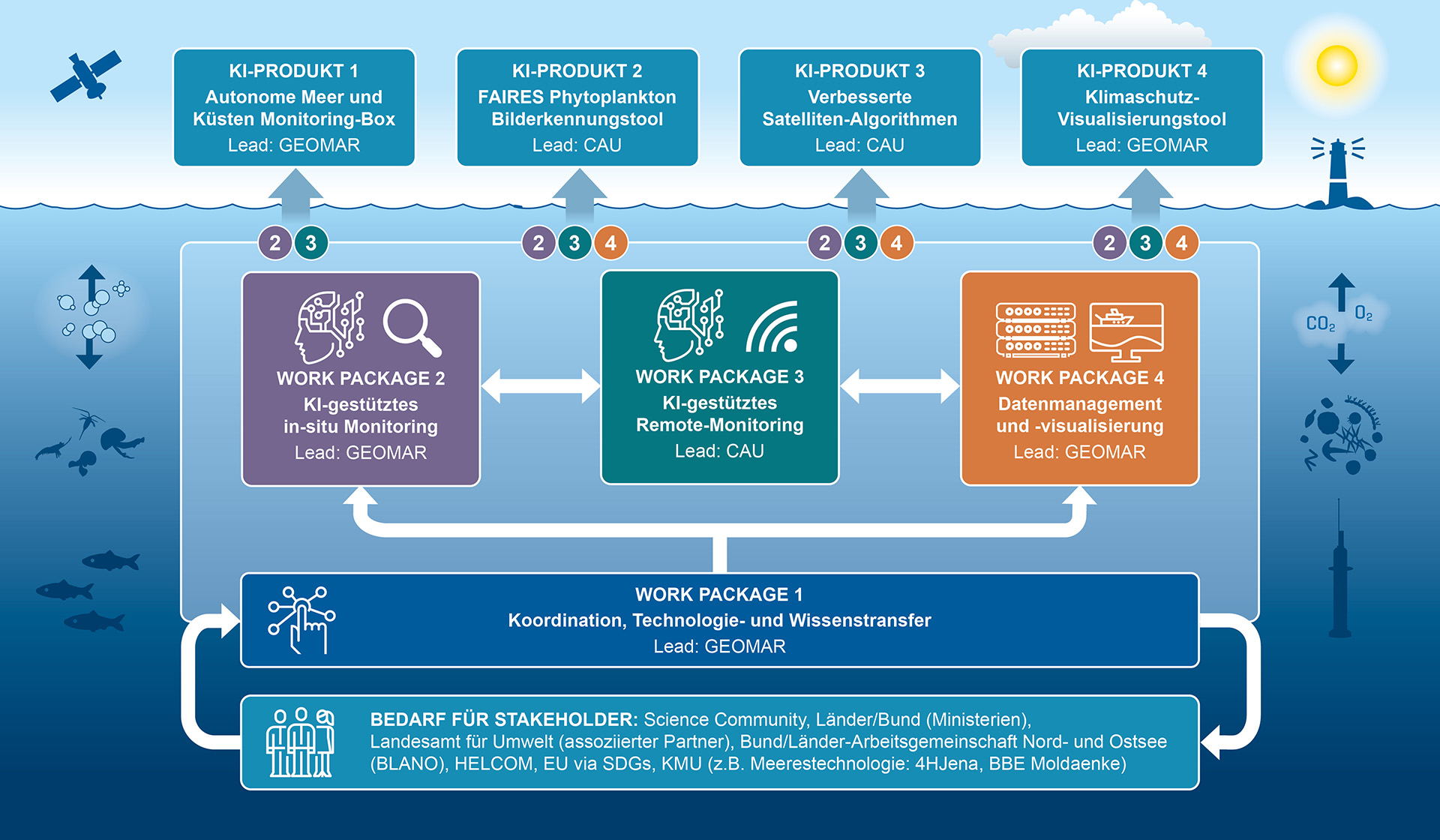
KIMMCO-Project Scheme:
The work packages collaborate closely to develop four AI-based products that enable more efficient, cost-effective, and long-term stable measurement of microalgae and their CO2 uptake. Illustration: Christoph Kersten, GEOMAR.
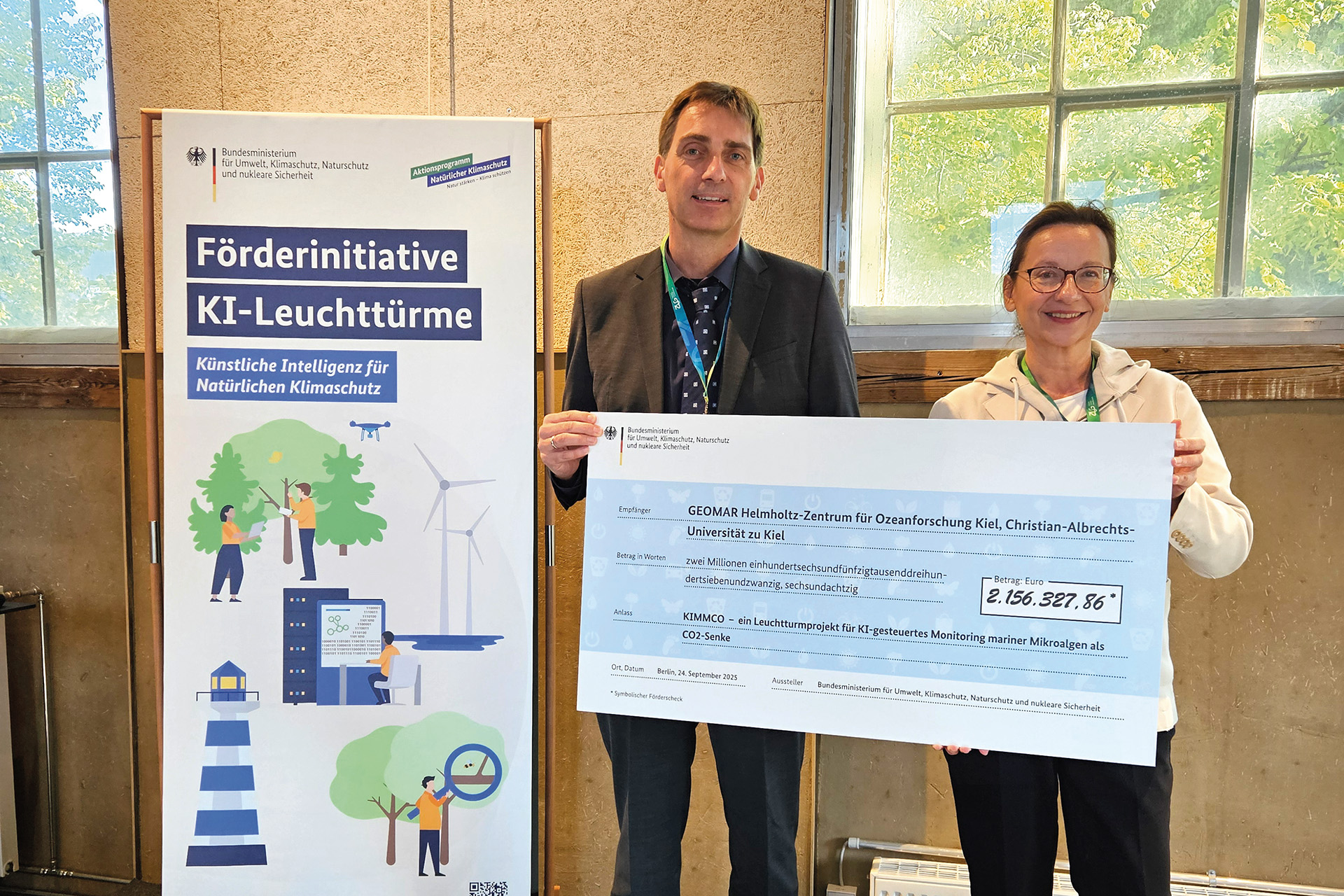
Project Kickoff!
Anja Engel and Kevin Köser accepted the grant from the ZUG gGmbH of over 2 million Euros on 24.09.25 in Berlin. The project runs from 01.07.2025 to 31.12.2027. Photo: GEOMAR.
KIMMCO – A flagship project for AI-driven monitoring of marine microalgae as a CO2 sink
What functions do marine microalgae perform?
- The ocean absorbs 31% of anthropogenic CO₂ emissions and is one of the largest global CO₂ sinks. Although marine microalgae comprise only a small part of plant biomass, they are responsible for 40% of CO2 uptake by all primary producers, playing a disproportionate role in natural climate protection.
- The preservation of marine primary productivity is crucial for maintaining phytoplankton diversity, ensuring the presence of highly productive species. Since phytoplankton form the base of the food web, biodiversity among higher organisms is also ensured.
- Monitoring and adapting coastal ecosystems to the impacts of climate change requires precise knowledge of phytoplankton. Inadequate monitoring can lead to the undetected presence of toxic algal species, which can have devastating consequences for higher organisms.
- KIMMCO addresses how AI applications can assess and improve the state of marine ecosystems. The project supports preserving and strengthening the ocean's natural CO₂ sink function and reducing the release of climate-relevant gases, such as CO₂ and methane, particularly in cases of poor ecological status. The project contributes to developing new action options and measures to strengthen natural climate protection.
Starting situation: How is the biodiversity of marine microalgae currently assessed?
- Several indicators of the Water Framework Directive (WFD), the Maritime Strategy Framework Directive (MSFD), and HELCOM regarding phytoplankton biomass and diversity in the Baltic Sea are currently determined using time-consuming and cost-intensive methods.
- Whilst fluorescence- and HPLC-based (High-Performance Liquid Chromatography) measurements of chlorophyll a (Chl a) are used to gauge the amount of phytoplankton biomass, microscopy is used to determine its biodiversity. Microscopy requires long-term comparable taxonomic and analytical capabilities. Both methods are very time- and energy-consuming.
- Very small plankton is difficult to grasp microscopically, although it makes up a significant portion of primary production.
- The CO₂ sink function of phytoplankton is not assessed at the regulatory level. The idea: What contribution can AI specifically make? The project's goal is to provide a real-time evaluation of the ecosystem's status and an assessment of phytoplankton's role as a natural greenhouse gas sink in the Baltic Sea coast.
KIMMCO will develop a reliable and cost-effective monitoring system based on:
- Sensor-driven methods that measure phytoplankton biomass both temporally and spatially at high frequency, detect functional groups, and allow for continuous measurement of greenhouse gases CO2 and methane, validated by point laboratory measurements.
- Camera-based methods that enable the capture of individual phytoplankton species in high temporal and spatial resolution, and through AI-based image recognition ensure continuity in species identification.
- Satellite-based monitoring that enables the non-invasive capture and tracking of phytoplankton biomass changes on various scales (102 - 105 m), and changes in ocean color caused by optically active substances (sediments, CDOM).
- New AI applications that analyze, link, and show connections between comprehensive environmental data, quantify indicators, and help determine new indicators.
![[Translate to English:] KIMMCO Logo](/fileadmin/_processed_/0/b/csm_KIMMCO-Logo-ed_d223bfcd57.png)
-
Project lead: Prof. Dr. Anja Engel
GEOMAR Helmholtz Centre
for Ocean Research Kiel
Wischhofstraße 1 - 3, D-24148 Kiel
Phone: +49 431 600-1510
Mail: aengel(at)geomar.deProject coordination: Dr. Frauke Pescheck
GEOMAR Helmholtz Centre
for Ocean Research Kiel
Wischhofstraße 1 - 3, D-24148 Kiel
Phone: +49 431 600-1510
Mail: kimmco(at)geomar.de