Anna Niewerth
Phone: +49 (0) 431 600 2812
E-Mail: aniewerth(at)geomar.de
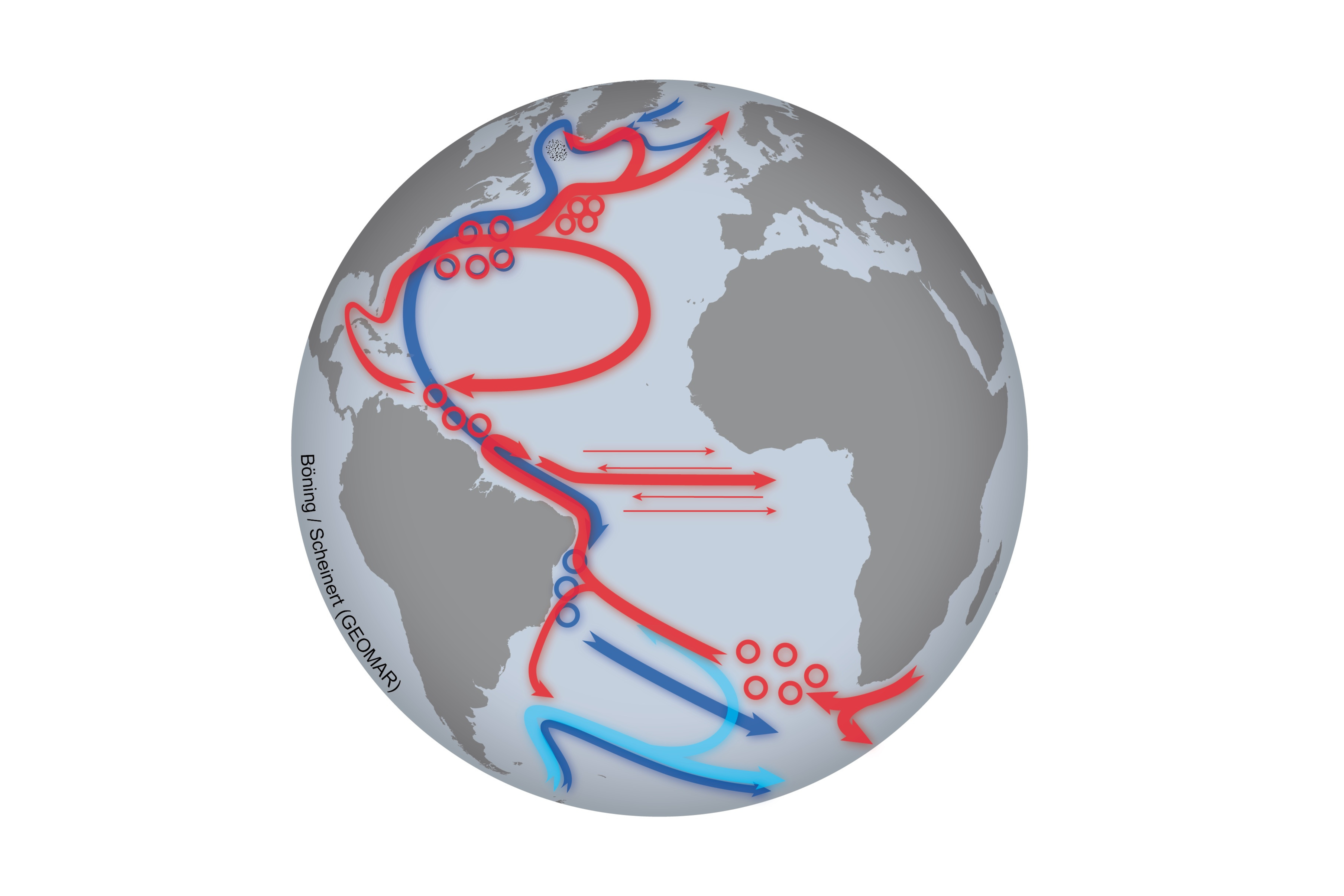
The Atlantic Meridional Overturning Circulation (AMOC) spans the entire Atlantic Ocean. Warm (near-surface) currents are shown in red, cold deep-water currents in blue. The small circles indicate areas of strong eddy activity. The dotted area in the Labrador Sea shows the region of deep convection, where cooled water masses sink to depths of several kilometres.
Graphic: C. Böning/M. Scheinert, GEOMAR
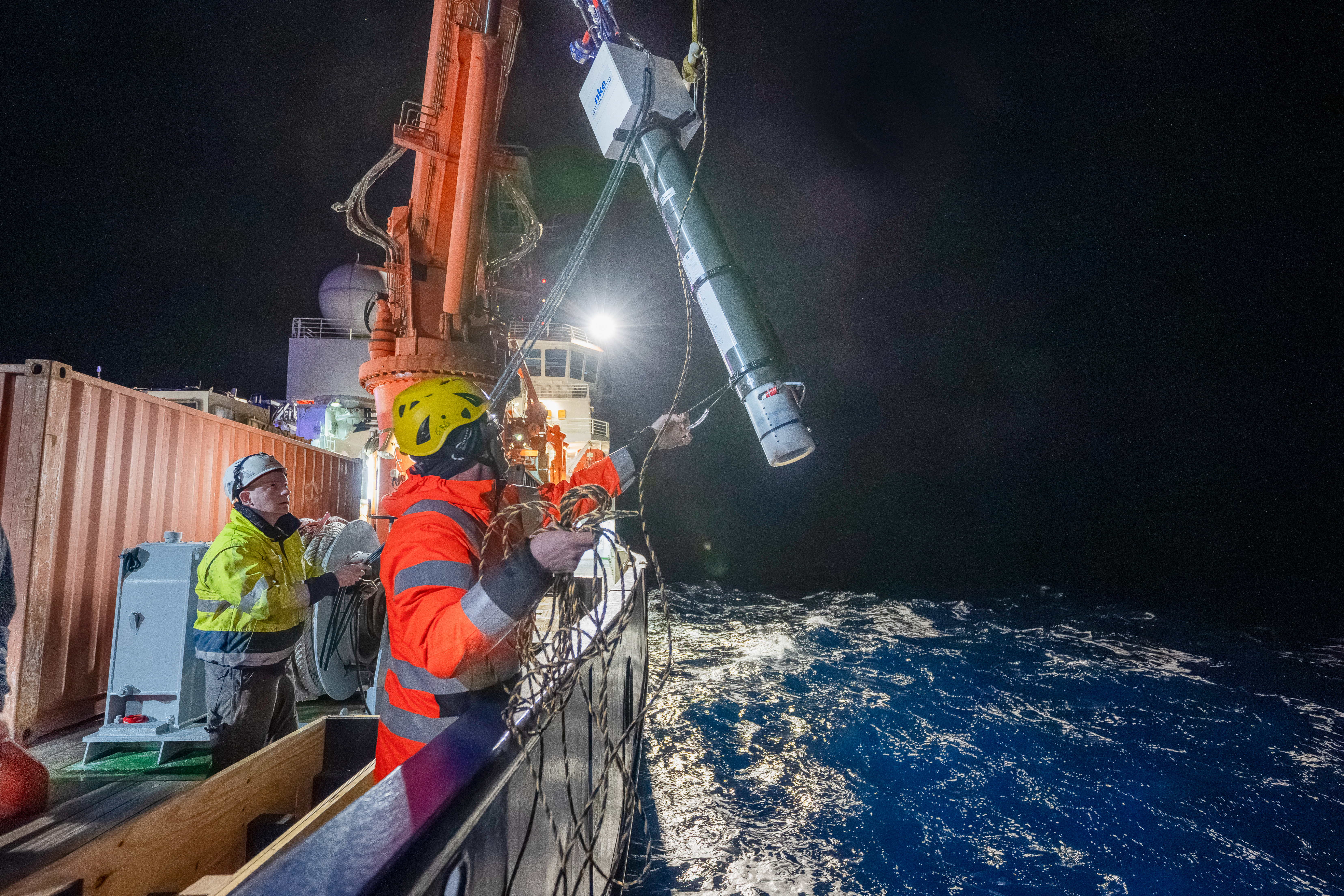
For over 20 years, around 4,000 autonomous Argo buoys have been drifting through the world’s oceans. They regularly dive to depths of up to 2,000 metres and, as they rise, record data on temperature, salinity and pressure.
Photo: Christian Clauwers
Artificial Intelligence Looks into the Ocean
Can the global Argo programme monitor the AMOC?
For more than twenty years, around four thousand autonomous profiling floats have been drifting through the ocean. They form part of the international Argo programme (Argo – global array of profiling floats). At regular intervals, they descend to a depth of 2,000 metres and, as they rise, measure parameters such as temperature, salinity and pressure. Once they have reached the sea surface again, they transmit this data via satellite to the Argo network, which is available to researchers worldwide. Hardly any other observation system has transformed ocean research so profoundly in recent decades.
Thousands of Measuring Buoys, a Global Perspective
Now, a study shows that this data can be analysed far beyond its original intended use. “We wanted to know whether we could use the scattered Argo measurements to gain insights into large-scale circulation systems that, until now, could only be recorded through very extensive measurement campaigns,” says Dr Yannick Wölker, lead author of the study and until recently a PhD student in the Ocean Dynamics research unit at GEOMAR and the research group Archaeoinformatics – Data Science at Kiel University. “Artificial intelligence opens up new possibilities here. Combining machine learning with established physical models allows us to get more out of existing measurement data and better understand how key circulation systems work.”
Why the Atlantic Circulation Is So Important
The study focuses on the Atlantic Meridional Overturning Circulation, or AMOC for short. This vast circulation system acts like a conveyor belt, transporting warm surface water northwards, where it cools, sinks into the depths and flows back south as cold deep water. The AMOC transports large amounts of heat and influences weather and climate, including in Europe. How stable this system is and how it is changing under the influence of climate change is one of the key questions currently discussed in climate research. So far, however, direct observations have relied on just a few fixed measurement series in the Atlantic, which are technically challenging and expensive to carry out.
Learning from Simulations
To tackle this problem, the researchers combined two approaches: observational data and model calculations. They trained a machine learning algorithm (a subfield of artificial intelligence in which computers recognise patterns in data) using high-resolution ocean simulations. In the process, the model learnt how typical ocean current patterns correlate with temperature and salinity profiles. They then applied this knowledge to real Argo data from the Atlantic. This approach makes it possible to infer large-scale current strengths from point measurements – in particular the so-called geostrophic component of the circulation (determined by the distribution of temperature and salinity), which has hitherto been difficult to measure continuously.
Promising Results, but Also Clear Limitations
The results show that the estimates calculated from the Argo data agree well with established observational series and model simulations. The study thus provides an important methodological building block for ocean observations.
At the same time, the authors emphasise the limitations of their approach. The method is based on model assumptions and only covers specific time windows. Very short-term fluctuations, as well as the long-term decline in the AMOC, can only be determined to a limited extent. The new methodology is therefore not intended to replace existing measurement systems, but rather to complement and optimise them effectively.
“Our approach is no substitute for direct measurements in the ocean,” says Yannick Wölker. “But it can help to make better use of existing data and bridge gaps in observations.”
Implications for Future Observation Strategies
The method could play an important role in planning future observation networks. It demonstrates how global programmes such as Argo can gain greater significance through modern data analysis – – and how additional infrastructure in the ocean can be strategically deployed.
“Particularly with regard to long-term climate monitoring, we need to consider how to design observations that are efficient, robust and internationally coordinated,” says Prof. Dr Arne Biastoch, a professor at GEOMAR and co-author of the study. “Artificial intelligence methods can help to ensure regarding future ocean measurements are made in the best possible way that strategic decisions.”
The work was carried out in collaboration as part of the Helmholtz School for Marine Data Science (MarDATA), a PhD programme involving researchers in Kiel and Bremen, in which PhD students are supervised by marine scientists and computer scientists jointly.
Original Publication:
Wölker, Y., W. Rath, M. Renz, and A. Biastoch, 2025: Estimating the AMOC from Argo Profiles with Machine Learning Trained on Ocean Simulations, Ocean Sci., 21, 3541–3562, doi.org/10.5194/os-21-3541-2025.
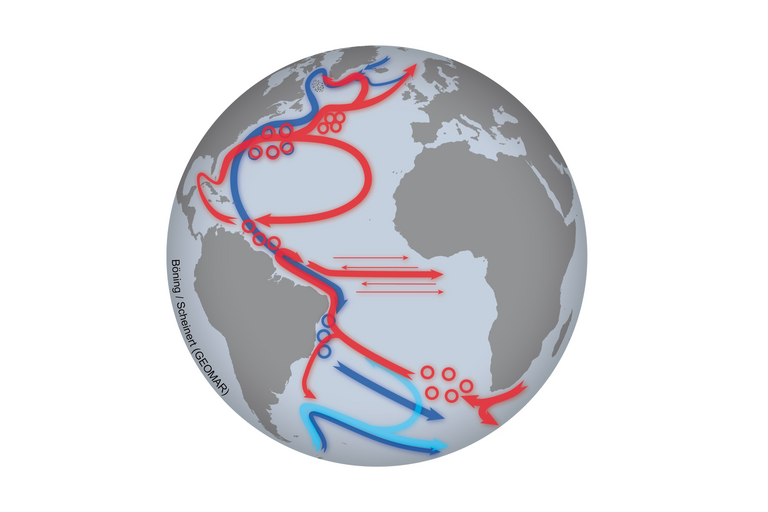
The Atlantic Meridional Overturning Circulation (AMOC) spans the entire Atlantic Ocean. Warm (near-surface) currents are shown in red, cold deep-water currents in blue. The small circles indicate areas of strong eddy activity. The dotted area in the Labrador Sea shows the region of deep convection, where cooled water masses sink to depths of several kilometres.
Graphic: C. Böning/M. Scheinert, GEOMAR
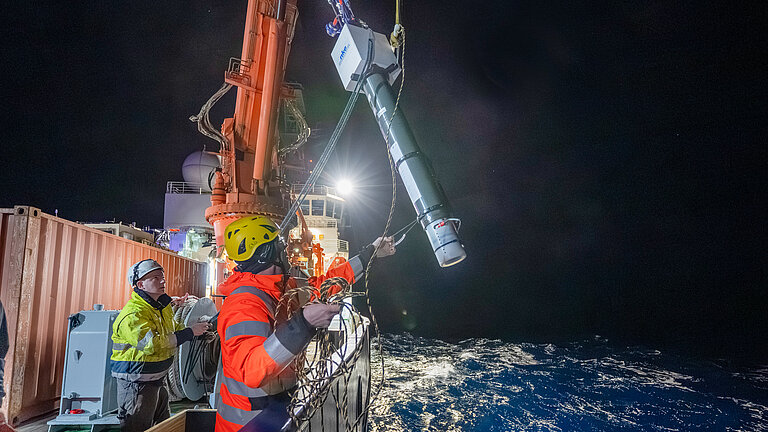
For over 20 years, around 4,000 autonomous Argo buoys have been drifting through the world’s oceans. They regularly dive to depths of up to 2,000 metres and, as they rise, record data on temperature, salinity and pressure.
Photo: Christian Clauwers