Anna Niewerth
Phone: +49 (0) 431 600 2812
E-Mail: aniewerth(at)geomar.de
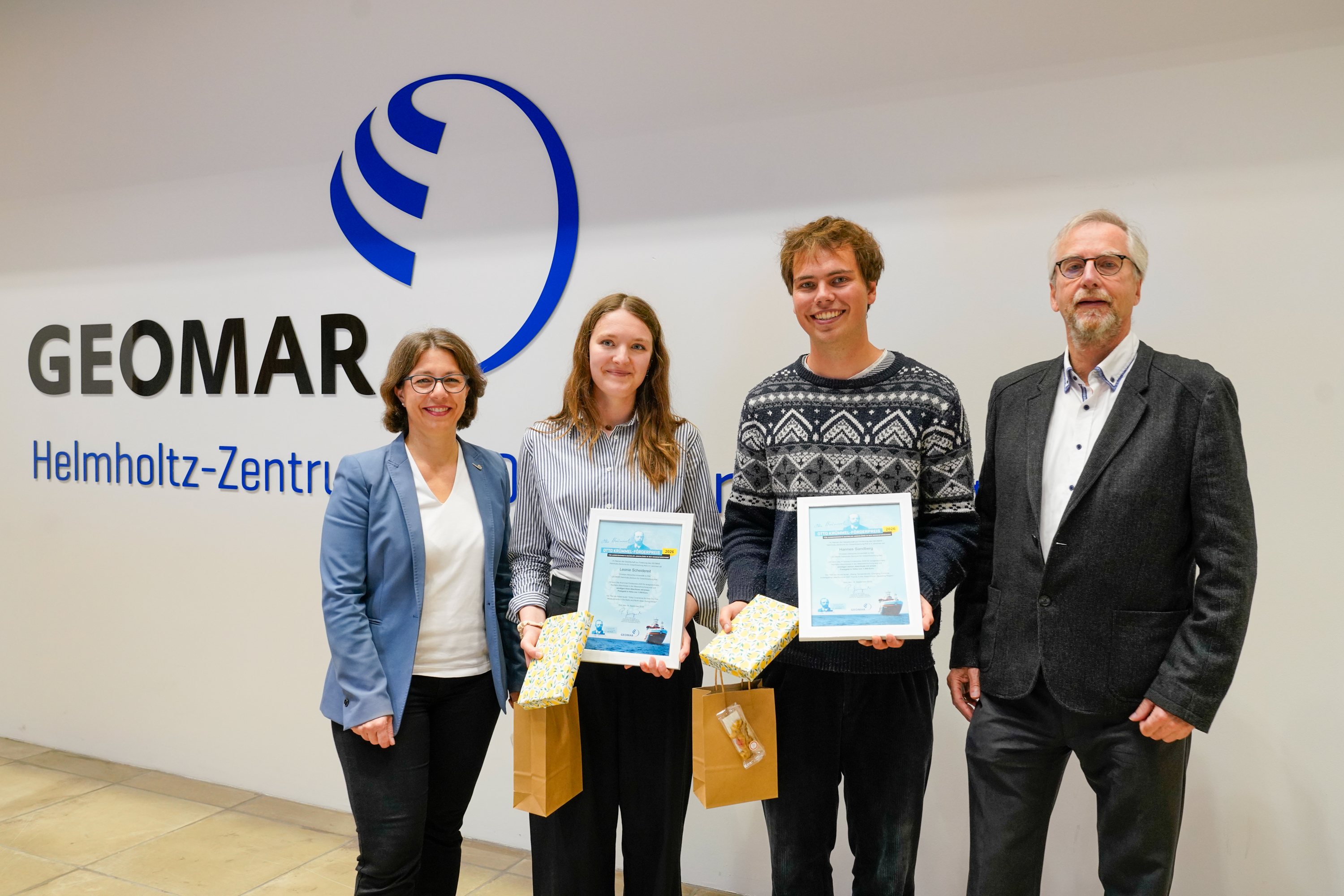
Presentation of the 2026 Otto-Krümmel-Förderpreis: Leonie Scheidereit (2nd from left) and Hannes Sandberg (3rd from left) were honoured for their Bachelor’s theses at the CAU and GEOMAR. Prof. Dr Katja Matthes (left) and Dr Peter Gimpel (right) offered their congratulations.
Photo: Pia Steinke, GEOMAR
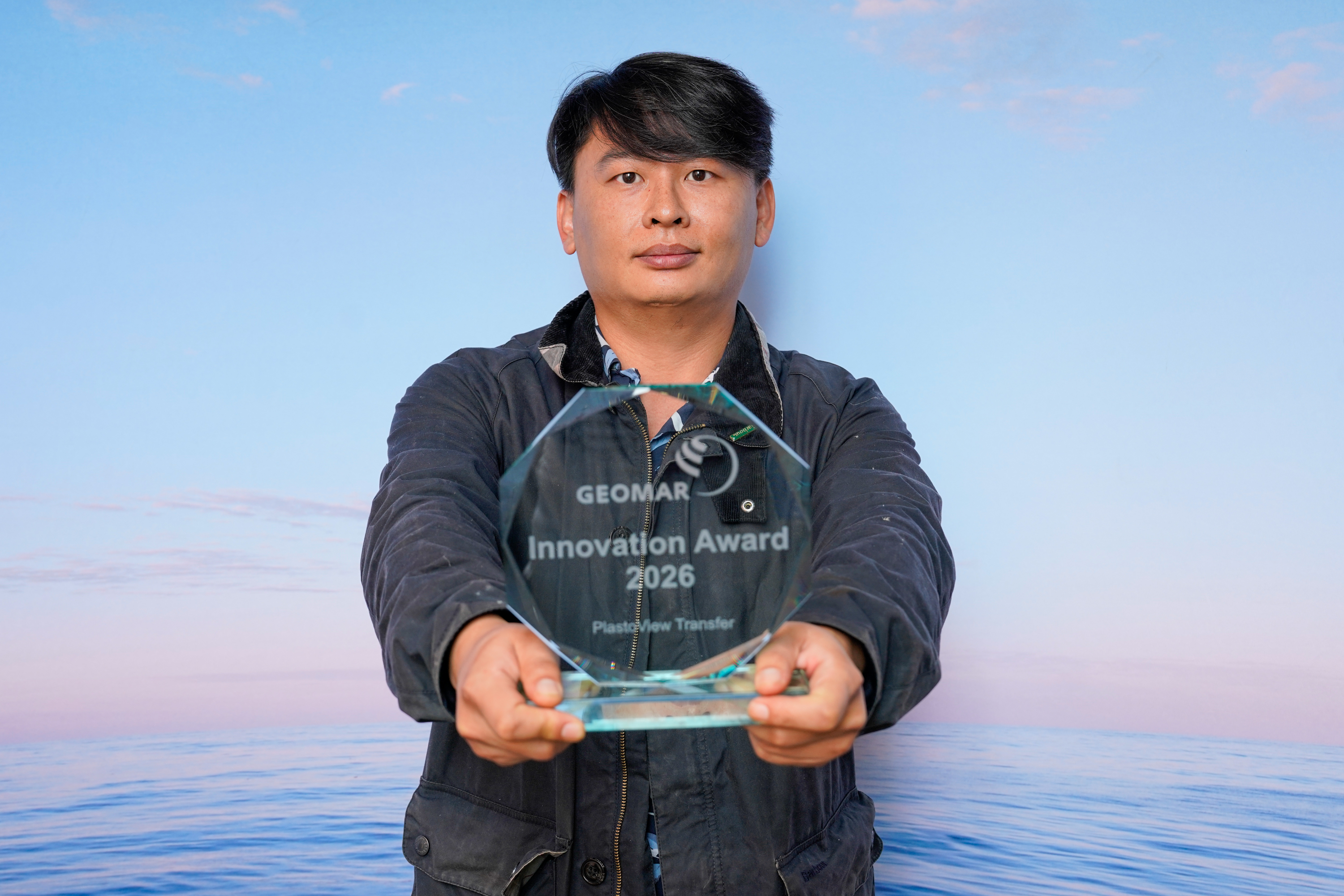
Dr Xiangyu Weng from the Marine Biogeochemistry research division and his PlastoView project team won the Innovation Award.
Photo: Pia Steinke, GEOMAR
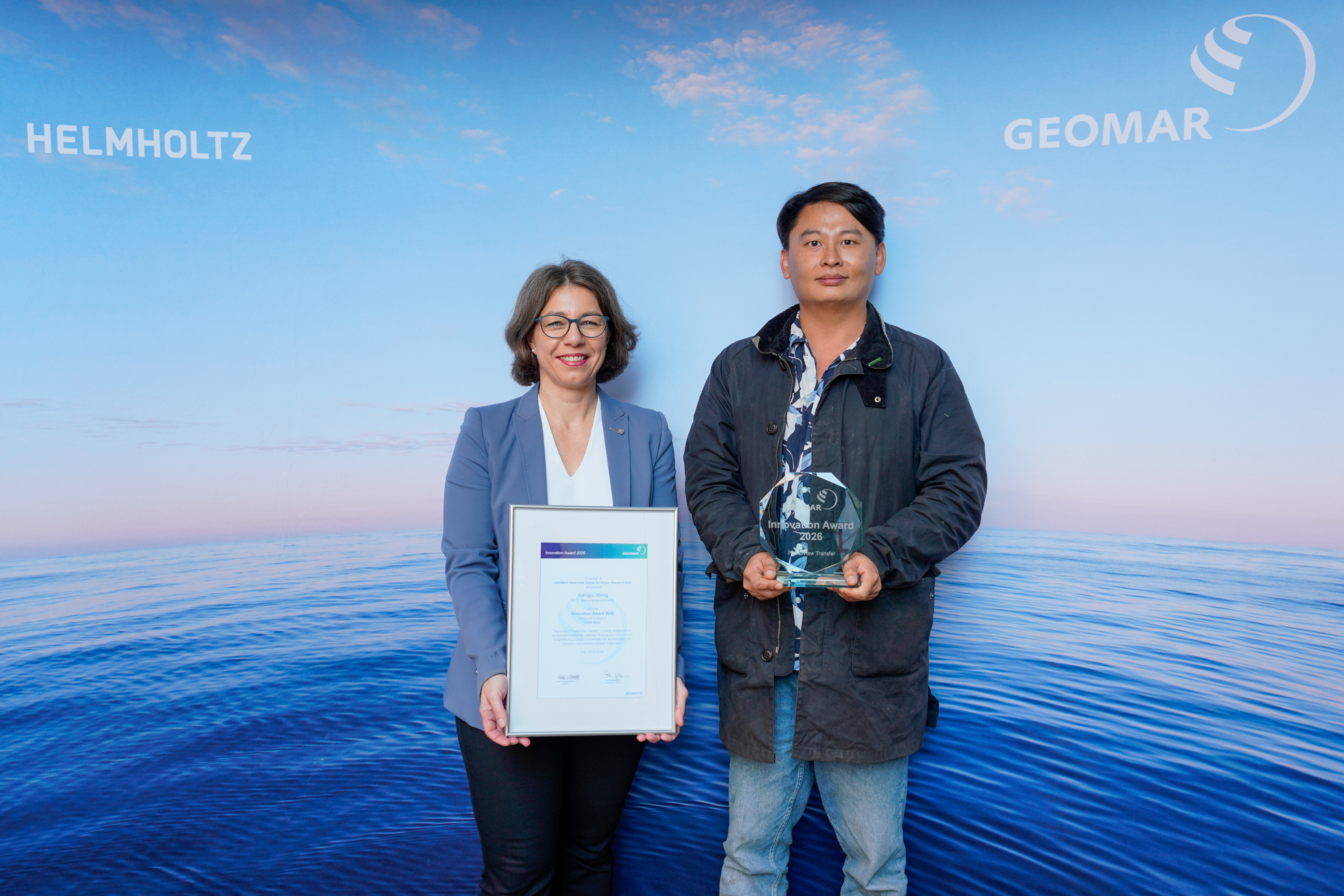
Director Katja Matthes congratulates the award winner. The PlastoView project, which won the award, is developing a compact, automated system for analysing particles in water. The project's goal is to automatically detect, distinguish between, and characterise microplastics and plankton in water samples.
Photo: Pia Steinke, GEOMAR
Two Outstanding Bachelor’s Theses Honoured
The 2026 Otto Krümmel Award goes to Hannes Sandberg and Leonie Scheidereit
As part of today’s GEOMAR Science Day, the 2026 Otto Krümmel Prize was awarded to two students from Christian-Albrechts-University of Kiel (CAU): Hannes Christian Sandberg and Leonie Scheidereit both completed the Physics of the Earth System degree programme at CAU and GEOMAR with a grade of 1.0 and have been studying on the Climate Physics Master’s programme since 2025. They share this year’s award, the prize money for which has been increased to a total of 2,000 euros.
Recognition of Bachelor’s degrees
“With Hannes Sandberg and Leonie Scheidereit, we are honouring two students this year for their outstanding scientific work,” says Dr Peter Gimpel, Chair of the Society for the Promotion of GEOMAR. “Both pieces of work demonstrate just how much independent research is already possible at Bachelor’s level. It is precisely these achievements that we wish to highlight and recognise with the Otto Krümmel Award.”
“The Otto Krümmel Research Award is an important honour for young researchers and, at the same time, recognition of their first independent scientific work,” says Prof. Dr Katja Matthes, Director of GEOMAR. “The fact that we are awarding the prize to two people this year underlines the high quality of the submitted work. We are delighted that Hannes Sandberg and Leonie Scheidereit are enriching the scientific dialogue here at GEOMAR with their research topics.”
Captain Klaus Küper of the Briese shipping company, which donates the prize money together with the funding association, also emphasised the significance of the award in his video message: “Research requires not only good ideas, but also the opportunity to put them into practice under real-world conditions. We are delighted to support young researchers on their journey through the Otto Krümmel Research Prize. The work of Hannes Sandberg and Leonie Scheidereit impressively demonstrates how observations at sea and scientific analysis lead to new insights into the ocean.”
The ocean off West Africa is getting warmer after the upwelling season
In his bachelor’s thesis, ‘Rising Temperatures, Changing Currents: Investigating Late-Summer SST Trends in the West African Upwelling Region’, Hannes Sandberg shows that the sea to the south-west of Cape Blanc has warmed significantly in late summer since 1993. The sea surface temperature rose by an average of 0.33 degrees Celsius per decade, and locally by as much as 0.7 degrees Celsius per decade in September. It is striking that the warming occurs primarily between August and October, when seasonal upwelling subsides. During the actual upwelling season, however, no corresponding warming trend is evident. The analyses suggest that a stronger surface current of the Mauritanian Current plays an important role in this: since 1993, the current has strengthened by around 0.01 metres per second per decade and is therefore thought to be transporting more warm water from more southerly regions to the north. The heat fluxes between the atmosphere and the ocean that were investigated also suggest that it is primarily this transport of warm water – rather than increased local warming by the atmosphere – that is causing the observed trend.
The laudatory address for Hannes Sandberg was delivered by Prof. Dr Florian Schütte, Professor of Physical Oceanography at GEOMAR, who supervised the bachelor’s thesis.
New measurements reveal weaknesses in standard CO2 calculations
Leonie Scheidereit investigated the air-sea exchange of carbon dioxide in her Bachelor’s thesis ‘Eddy Covariance Air-Sea CO2 Flux Measurements in the Baltic and North Seas During Winter. She compared the results oft he Eddy Covariance method with standard calculation methods, which estimate carbon dioxide exchange primarily on the basis of wind speed. Despite difficult conditions during the winter cruise, her work yielded important insights into the measurement method and led to an improved measurement setup. Preliminary analyses of a follow-up measurement campaign conducted with the ALKOR in May and June 2025 show significantly lower carbon dioxide fluxes than expected by the standard calculation methods. This suggests that, when calculating carbon dioxide exchange in coastal seas, other influencing factors must be taken into account to a greater extent alongside wind speed.
The laudatory speech was delivered by her principal supervisor, PD Dr Christa Marandino, in whose ‘Trace Gas Air-Sea Exchange’ research group Scheidereit has been working since 2022.
Innovation Award 2026: Compact System for Monitoring Microplastics and Plankton
The Innovation Award was also presented as part of GEOMAR Science Day. Initiated by the Research Funding and Transfer Unit, the prize recognises outstanding inventions with particular application potential. GEOMAR Director, Professor Dr Katja Matthes, presented the trophy and certificate to Dr Xiangyu Weng, who works as an automation and optical measurement technology engineer in the Marine Biogeochemistry Research Division at GEOMAR, and his PlastoView project team.
PlastoView is developing a compact, automated system for analysing particles in water. The system aims to automatically detect, distinguish between and characterise microplastics and plankton within water samples on site.
The system addresses two key challenges: Firstly, measuring microplastics is often time-consuming and labour-intensive, as samples must be taken and filtered, and the particles analysed in a laboratory. Secondly, plankton play a crucial role in food chains and the carbon cycle in the sea. However, many established methods only provide partial information; for example, they may capture 2D images or work with preserved samples. PlastoView is designed to enable rapid, practical and reliable analysis, which is an important prerequisite for regularly monitoring water bodies, such as at sewage treatment works or in marine research.
About: Otto-Krümmel-Förderpreis
Every year, the Society for the Promotion of GEOMAR awards the Otto Krümmel Prize to recognise outstanding Bachelor’s theses in the field of marine research. The aim is to strengthen the Bachelor’s degree as an independent and important step in scientific training. As the prize is being awarded to two students this year, the prize money has been increased to a total of 2,000 euros. It is funded in equal parts by the Society for the Promotion of GEOMAR and the Briese shipping company.
Otto Krümmel (1854-1912) is regarded as a pioneer of modern oceanography in Germany. As a professor at Kiel University, he headed the former Kiel Research Institute for Marine Science – a predecessor of today’s GEOMAR – for many years.
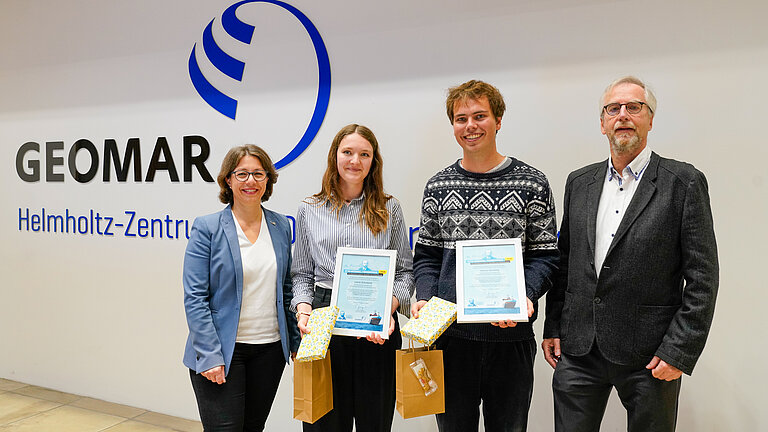
Presentation of the 2026 Otto-Krümmel-Förderpreis: Leonie Scheidereit (2nd from left) and Hannes Sandberg (3rd from left) were honoured for their Bachelor’s theses at the CAU and GEOMAR. Prof. Dr Katja Matthes (left) and Dr Peter Gimpel (right) offered their congratulations.
Photo: Pia Steinke, GEOMAR
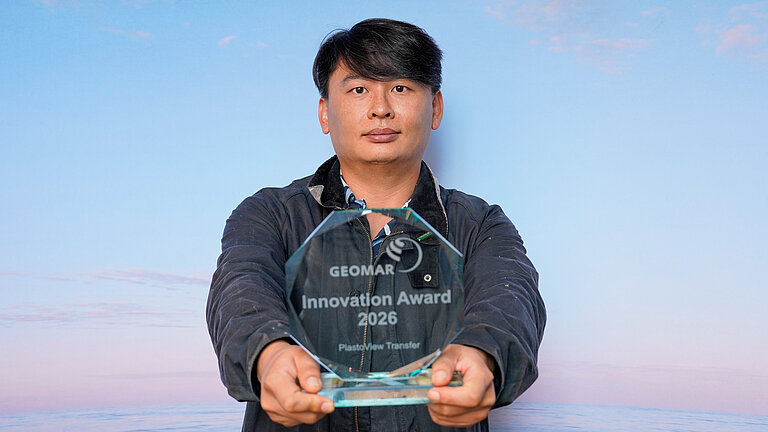
Dr Xiangyu Weng from the Marine Biogeochemistry research division and his PlastoView project team won the Innovation Award.
Photo: Pia Steinke, GEOMAR
Director Katja Matthes congratulates the award winner. The PlastoView project, which won the award, is developing a compact, automated system for analysing particles in water. The project's goal is to automatically detect, distinguish between, and characterise microplastics and plankton in water samples.
Photo: Pia Steinke, GEOMAR