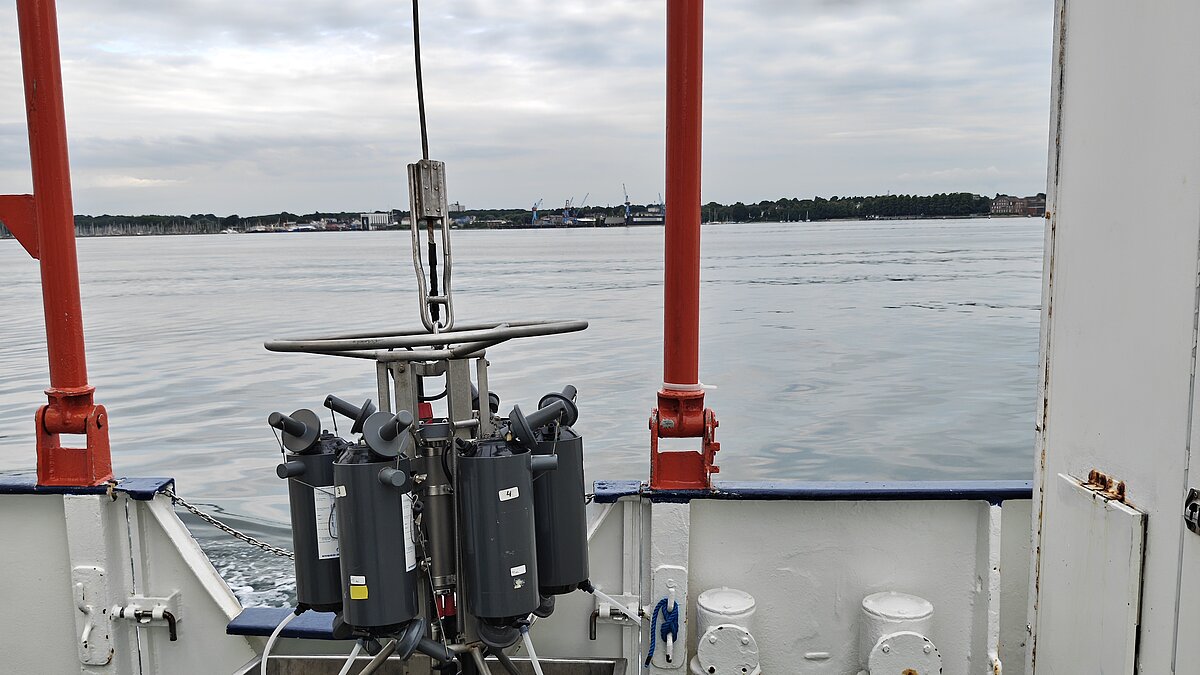
Mini CTD for sampling the water column on board the RV Littorina
In this project, we aim to help shape supply security for Germany by providing key elements that are essential for the energy transition from domestic resources. To this end, the interdisciplinary joint project LiMare is developing a highly efficient, practicable process that allows critical raw materials to be extracted from seawater selectively and in an environmentally friendly way. They are to be adsorbed as selectively as possible onto functionalized magnetic nanoparticles (MNPs) in a continouous-flow magnetic levitation reactor.
Subproject "Determination of the Effects on the Marine Ecosystem"
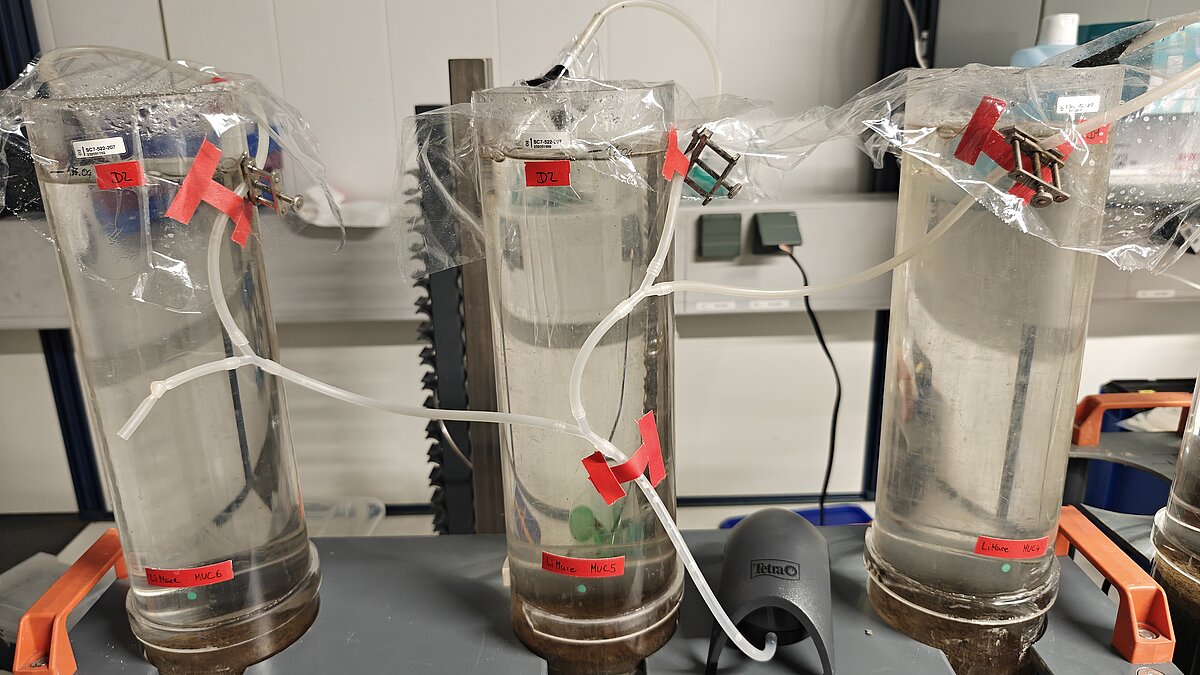
The aim of this subproject is to provide a risk assessment for the new technology. Scenarios will be simulated in which MNP crown ethers escape from the reactors into the environment. In addition, environmental effects associated with the ion-depleted seawater that is discharged from the reactors will be investigated. The focus is on changes in microbial communities and their metabolic pathways in the water column and in marine sediments, and on how these changes alter biogeochemical cycles. Different types of incubation experiments with sediment cores and the overlying water column will be carried out in order to classify possible risks in the event of reactor leakage and the effects of iron-depleted water. These will include: a) incubation experiments in which MNPs, as well as MNPs functionalized with crown ether, are added to the water column and settling to the seafloor is simulated. The toxicity of these particles in the water column and in the sediment to the microbial community, as well as possible shifts in biogeochemical cycles, will be examined. At the same time, b) dilution series with these MNPs will be carried out to determine the threshold of possible toxicity. Furthermore, c) the effects of the seawater that flows through the reactors, is depleted of irons there and is then released back into the environment on naturally occurring microbial consortia, and thus on the biogeochemical cycle, will be investigated.
Head of the research group "Benthic Geomicrobiology":
Prof. Dr. Mirjam Perner GEOMAR Helmholtz Centre for Ocean Research Kiel Building 12 Wischhofstrasse 1-3 D-24148 Kiel Tel.: +49 (0) 431-600-2837 Fax: +49 (0) 431-600-2941 E-mail: mperner(at)geomar.de
!!! Bachelor and Master Theses !!! There are numerous exciting projects available in our working group raising questions that can also be investigated in the context of bachelor and master theses. Feel free to contact us and find a suitable topic for your thesis together with us!
March 2021 <<< Dr. Katja Laufer published her new paper on the importance of Fe cycling in Arctic fjord sediments and the potential impacts of glacial retreat inNature Communications >>>
March 2021 <<<Our new project Emden FM has been kicked-off. We are looking forward to exciting research in a great consortia (coordinator: Julia Gebert, TUDelft )>>>
We use cookies to give you the best possible experience on our website. Some cookies are technically necessary, others help us to improve our services. You decide which cookies you allow.
Required for the basic functions of the website, e.g. to store your cookie settings. These cannot be switched off.
OffOn
Help us understand how the website is used so that we can improve it. The analysis runs anonymously on our own servers.
Details about Matomo analysisShowHide
If you consent to our analysis using the Matomo program, we will collect, store, and evaluate the following:
Information about the device type, browser type, and version used.
The user’s operating system
Type and Status of HTML Requests to the GEOMAR Website
The IP address of the user’s device. The full IP address is collected, used for analysis, and stored. However, it is displayed only in anonymized form in the analysis.
Date and time of access
Websites from which the user’s device accessed the GEOMAR website.
The addresses (URLs) visited on the GEOMAR website