Kiel Indoor Benthocosms
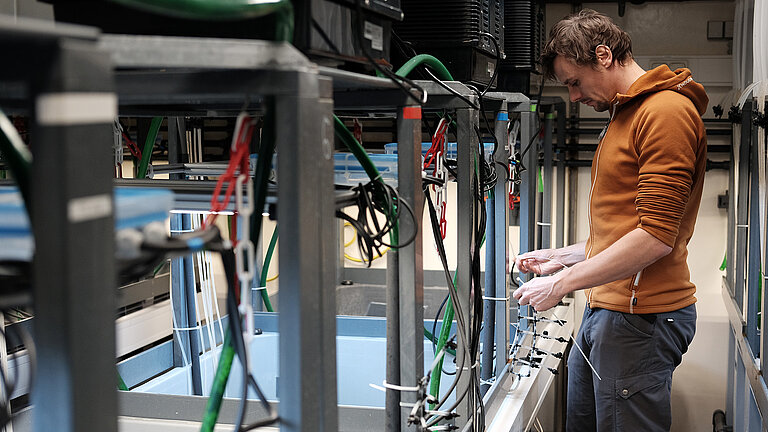
The Kiel indoor benthocosms in the climate chamber in the GEOMAR West Shore Building. Photo: Jan Steffen/GEOMAR
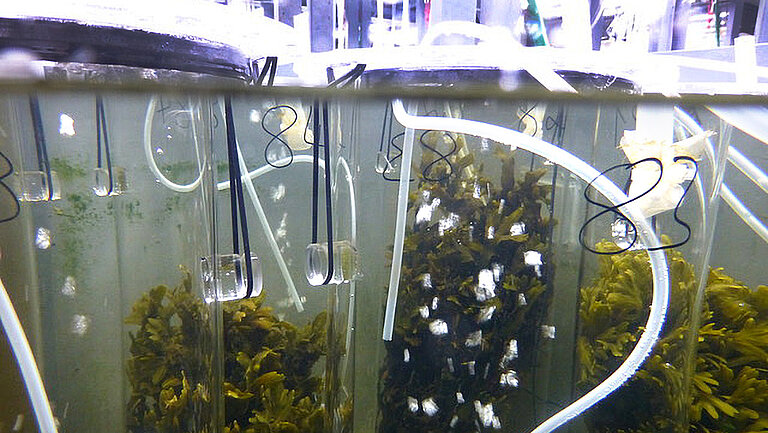
Kiel Indoor Benthocosms: Experiment on the influence of temperature fluctuations on kelp. Photo: Fabian Wolf/GEOMAR
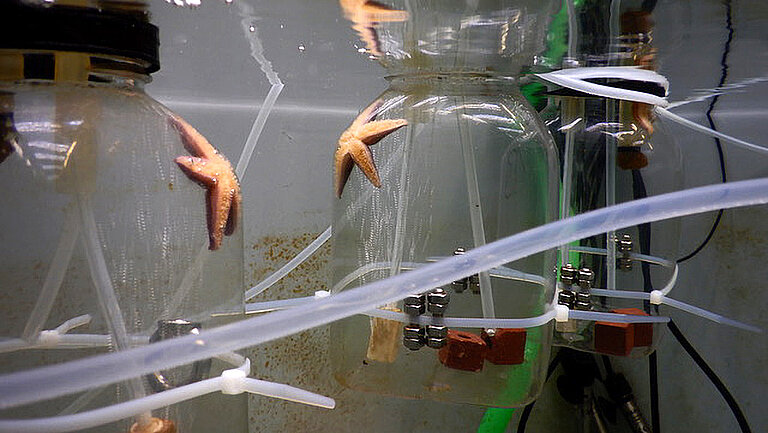
Kiel Indoor Benthocosms: Experiment on the influence of heat waves and oxygen depletion on the feeding pressure of starfish on blue mussels. Photo: Sarah Rühmkorff/GEOMAR
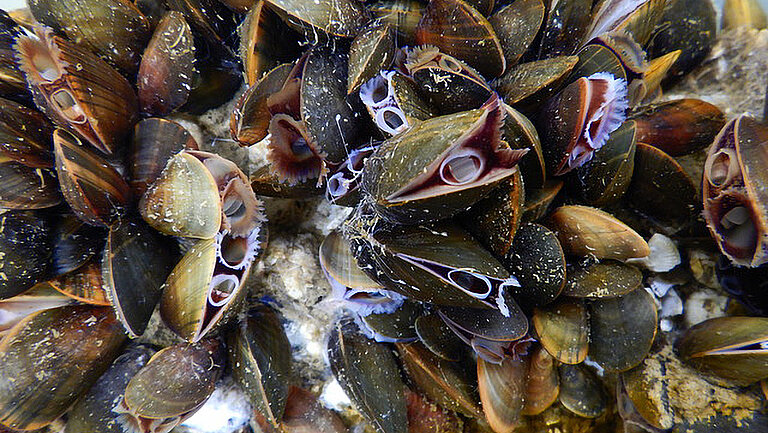
Kiel Indoor Benthocosms: Mussels on settlement plates. Photo: Christian Pansch/GEOMAR
The focus of the indoor benthocosms in the GEOMAR building, which went into operation in 2017, is - similar as with the Outdoor Benthocosms - on the behavior of individual organisms, as well as smaller biological communities in the Baltic Sea, in response to environmental fluctuations. To this end, parameters such as temperature, salinity, pH and oxygen can be adjusted in a controlled manner in the 12 experimental units, each with a water capacity of 600 liters. The novelty of these experimental units, which were also developed in Kiel, is that they can also simulate environmental fluctuations, i.e. not necessarily average changes that affect organisms and ecosystems in the Baltic Sea, but rather extreme events, from daily fluctuations to weeks-long heat waves in summer. To ensure that the conditions for the experiments are realistic but also reproducible, "real" seawater from the Kiel Fjord is used as a basis. The lighting can be simulated almost true to life in the diurnal and annual cycle via an LED lighting system, so that future underwater lighting regimes can also be simulated.
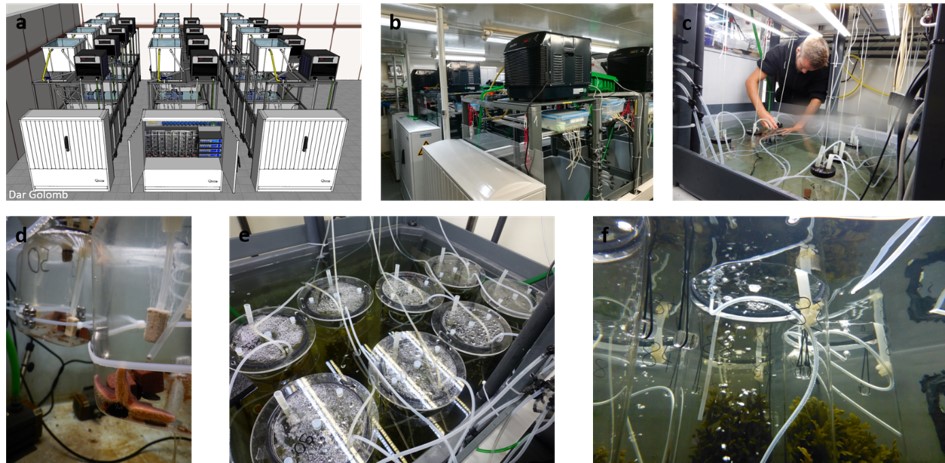
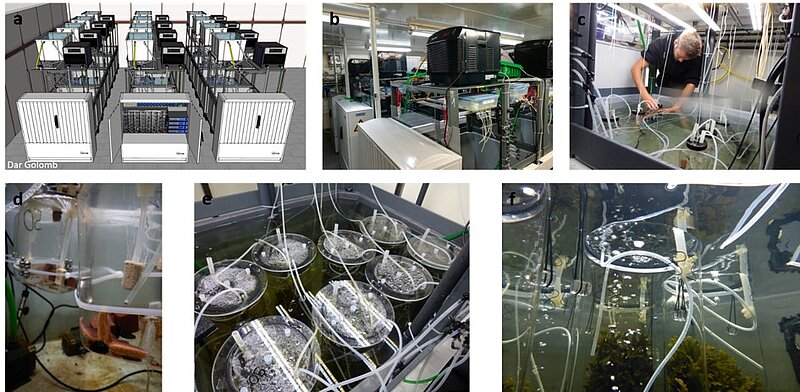
[Schematic Overview of the Kiel Indoor Benthocosms (KIBs; a), overview of the climate room with the KIBs (b), Fabian Wolf working at one of the tanks (c), Kautex bottle as experimental unit with Asterias rubens (d) and, Plexiglass cylinders with Fucus vesiculosus (e and f). © Dar Golomb (a), Sarah Rühmkorff (c) and Fabian Wolf (b, d-f).]
The Kiel Indoor Benthocosms (KIBs; Pansch and Hiebenthal 2019) are a highly sophisticated mesocosm system that is comprised out of twelve 600 L tanks (Fig. 1a and b), which can either serve as experimental units for large communities or as water bath for several smaller experimental units (Figs. 1c-f). A temperature sensor is connected to a GHL Profilux computer and thus, checks the desired temperature against the current temperature. The temperature inside the tanks is then automatically controlled via heaters and chillers. Therefore, any kind of temperature profile can be used as treatment regime. Furthermore, two light sources (one with blue and one with yellow light) can be dimmed separately, so that day and night cycles with sunset and rise can be simulated. Additionally, manipulations pH, salinity and oxygen are possible as well, which makes the KIBs to an excellent facility in experimental stress ecology. For more detailed information, please see Pansch and Hiebenthal (2019).
References:
Pansch, Christian, and Claas Hiebenthal. ‘A New Mesocosm System to Study the Effects of Environmental Variability on Marine Species and Communities’. Limnology and Oceanography: Methods 17, no. 2 (February 2019): 145–62. https://doi.org/10.1002/lom3.10306.
Contact:
![[Translate to English:] Claas Hiebenthal](/fileadmin/_processed_/f/e/csm_me_ausschnitt_7bd84596f8.jpg)