(Andreas Oschlies, Markus Schartau)
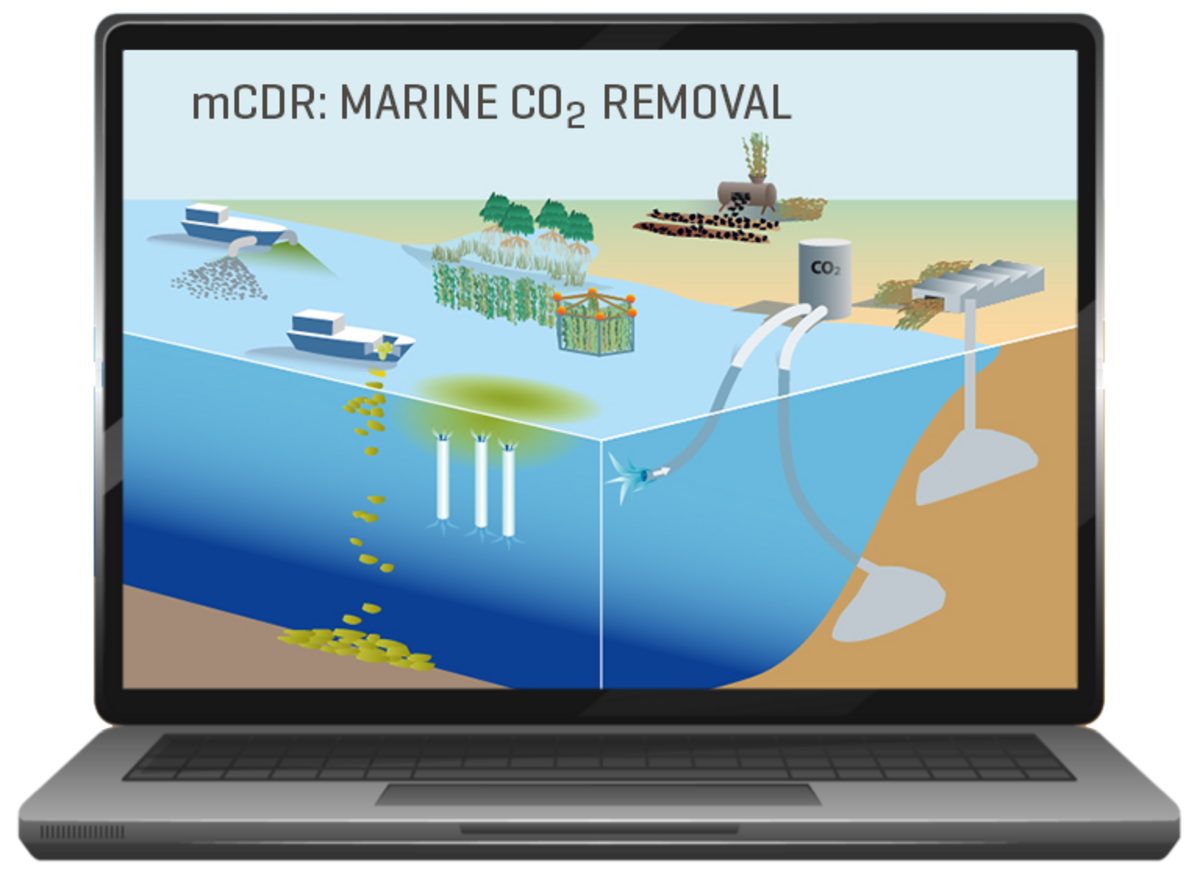
Even with ambitious climate mitigation policies following net-zero greenhouse gas (GHG) claims, humanity is expected to release residual amounts of carbon dioxide (CO2) or other GHG emissions in the future, thereby continuing to drive global warming. Carbon Dioxide Removal (CDR) options - like bioenergy combined with carbon capture and geological storage, ocean alkalinity enhancement, or ecosystem management and expansion - offer the possibility to support emission reduction efforts and offset remaining GHG emissions, thereby enabling net-zero targets. Furthermore, CDR is key to providing net-negative emissions to reduce atmospheric CO2 concentrations in order to reverse a carbon budget or temperature overshoot.
This group aims to further our understanding of the Earth systems response to such (partly novel) anthropogenic activities, to net-zero (i.e. no/low forcing) and to overshoot (i.e. negative anthropogenic forcing) scenarios using Earth system models of various complexities (FOCI, UVic ESCM 2.9 & 2.10), as well as multi-model ensembles from CMIP (CDRMIP, ZECMIP). Through interdisciplinary collaboration, we contribute to comprehensive assessment activities for CDR options.
Research foci include:
- model studies to understand potential, risks, benefits, and monitoring strategies for (marine) CDR options, including ocean alkalinity enhancement, blue carbon ecosystem management and expansion (CDRmare consortia: RETAKE, Sea4Society; RESCUE; SeaO2-CDR; Ocean ALK-ALIGN)
- comprehensive assessment of (marine) CDR options (CDRmare consortium: ASMASYS; OceanNETs; CDRSynTra; GESAMP WG41)
- uncertainty assessment and process understanding of net-zero and temperature overshoot scenarios concerning carbon cycle and climate dynamics (RESCUE).
Contributors:
- Andreas Oschlies: Co-chair CDRmare, Earth system modelling with models of medium complexity (RETAKE [project coordinator], ASMASYS, CDRSynTra, SeaO2-CDR, Ocean ALK-ALIGN, GESAMP WG41)
- Markus Schartau: Evaluation of the CDR efficiency of different scales and frequencies of ocean alkalisation at local sites and simulation of the corresponding potential responses of plankton dynamics (OceanNETs)
- Sandy (Alexandra) Avrutin: Using the Flexible Ocean and Climate infrastructure (FOCI) to examine monitoring, reporting and verification
- Claudia Eisenring: Assessing marine CDR options with an Earth system model (Ocean ALK-ALIGN)
- Natalia Sudarchikova: works on parametrisation of coastal vegetated systems (CVEs) in FOCI to simulate and assess their ability of carbon sequestration under different climate scenarios (Sea4Society) and development of an ML model for searching potentially suitable places for planting CVEs.
- Vanessa Teske: Evaluating the carbon uptake efficiency of ocean alkalinity enhancement (OAE) as a marine-base CDR in coastal regions of Europe and North America with FOCI (Ocean ALK-ALIGN)
- Mathias Zeller: Assessing the potential and climate/environmental feedbacks of ocean alkalinity enhancement as a CDR measure in a complex high-resolution Earth system model (Ocean ALK-ALIGN)
We seek to conduct responsible research using models. All of the data and code used in our studies is publicly available and follows good data management practices. We strive to indicate the assumptions built into our models and the process by which these assumptions were reached. We also strive to make explicit current limits on our ability to simulate the climate and CDR approaches. Those of us that conduct research on CDR would like to note that we view CDR as a complement, never a substitute, for large reductions in greenhouse gas emissions. For more information on responsible CDR research, which we aspire to adhere to, see A Code of Conduct for Marine Carbon Dioxide Removal.
If you are interested in collaborations or joining the group please do not hesitate to get in touch (aoschlies@geomar.de)!