

Asymmetry in Earth system responses to emissions vs removal pulses at varying climate states
Tier 1:
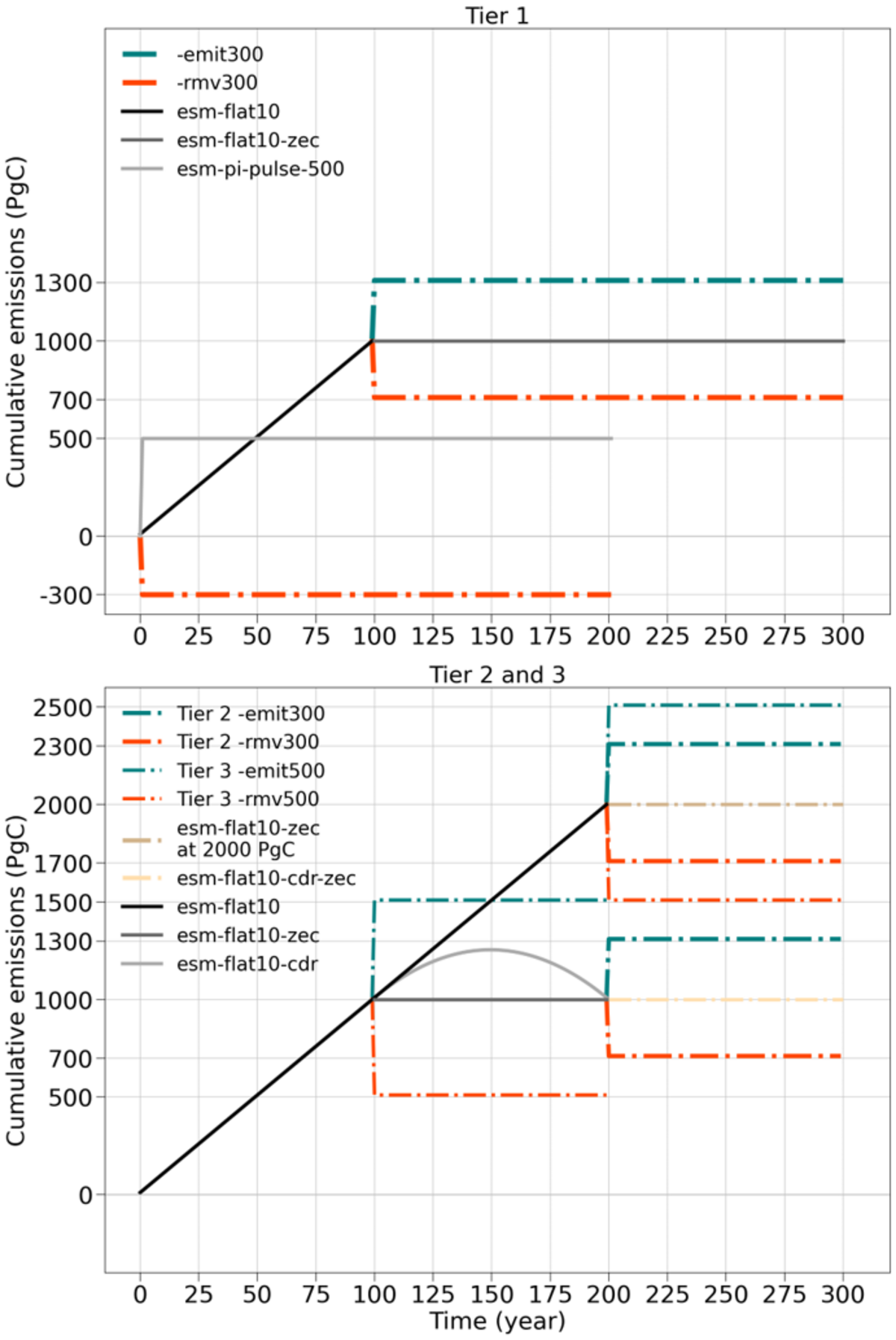
- from esm-piControl (i.e. at 0 PgC emitted), we request a pulse of 300 PgC to be removed from the atmosphere, over the course of a year
- after 100 years of esm-flat10 (i.e. at 1000 PgC emitted), we request a pulse of 300 PgC to be emitted to and removed from the atmosphere, over the course of a year
Tier 2:
- after 200 years of esm-flat10 (i.e. at 2000 PgC emitted), we request a pulse of 300 PgC to be emitted to and removed from the atmosphere, over the course of a year
- after 100 years of esm-flat10-cdr (i.e. at 1000 PgC budget), we request a pulse of 300 PgC to be emitted to and removed from the atmosphere, over the course of a year
- we request also 100 years zero emissions experiments at both points of branching
Tier 3:
- we request 500 PgC emissions and removal pulses from esm-flat10 at 1000 PgC and 2000 PgC emitted, over the course of a year
CO2 removal efficiency of individual, activity-driven CDR measures for varying climates
Tier 1:
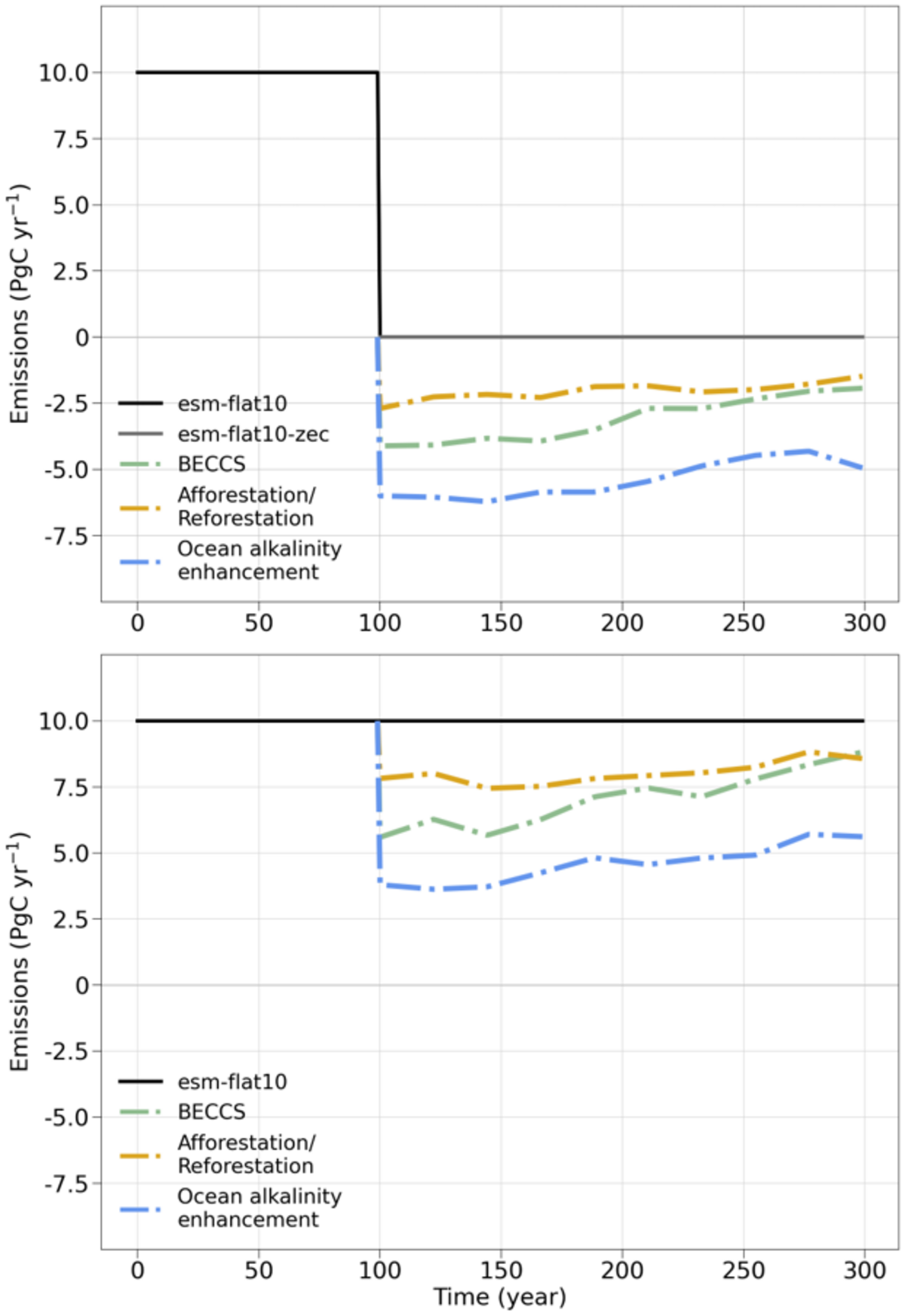
- prescribing CO2 concentrations from esm-flat10-zec, we suggest to add activity-driven CDR implementations, with a focus on BECCS, AR, OAE
- BECCS and AR require simulating the esm-flat10 with a historical compressed land-use pattern, followed by esm-flat10-zec with constant land-use pattern for 100 years
- BECCS is implemented during the phase of zero emissions by converting a percentage of all agricultural area (cropland and pasture) and grassland to BECCS within the first year of implementation with the goal to reach a total area of 400 Mha
- BECCS is implemented during the phase of zero emissions by converting a percentage of all agricultural area (cropland and pasture) and grassland to dominant forest type, within the first year of implementation with the goal to reach a total area of 400 Mha of afforested and reforested areas
- OAE is implemented by annually repeating coastal uniform additions of alkalinity following the OAEMIP mask, where alkalinity is added within 300 km from the shore or above 1000 m water depth, whichever occurs first, excluding ice-covered areas
- prescribing CO2 concentrations from an extended esm-flat10 for another 100 years, we suggest to add activity-driven CDR implementations, with a focus on BECCS, AR, OAE, in the same way described for the simulations based on esm-flat10-zec
Tier 3:
- adding more CDR options (DOR, MOS, ERW, …)
Activity-driven CDR implementations of IAM-developed scenarios
Tier 1:
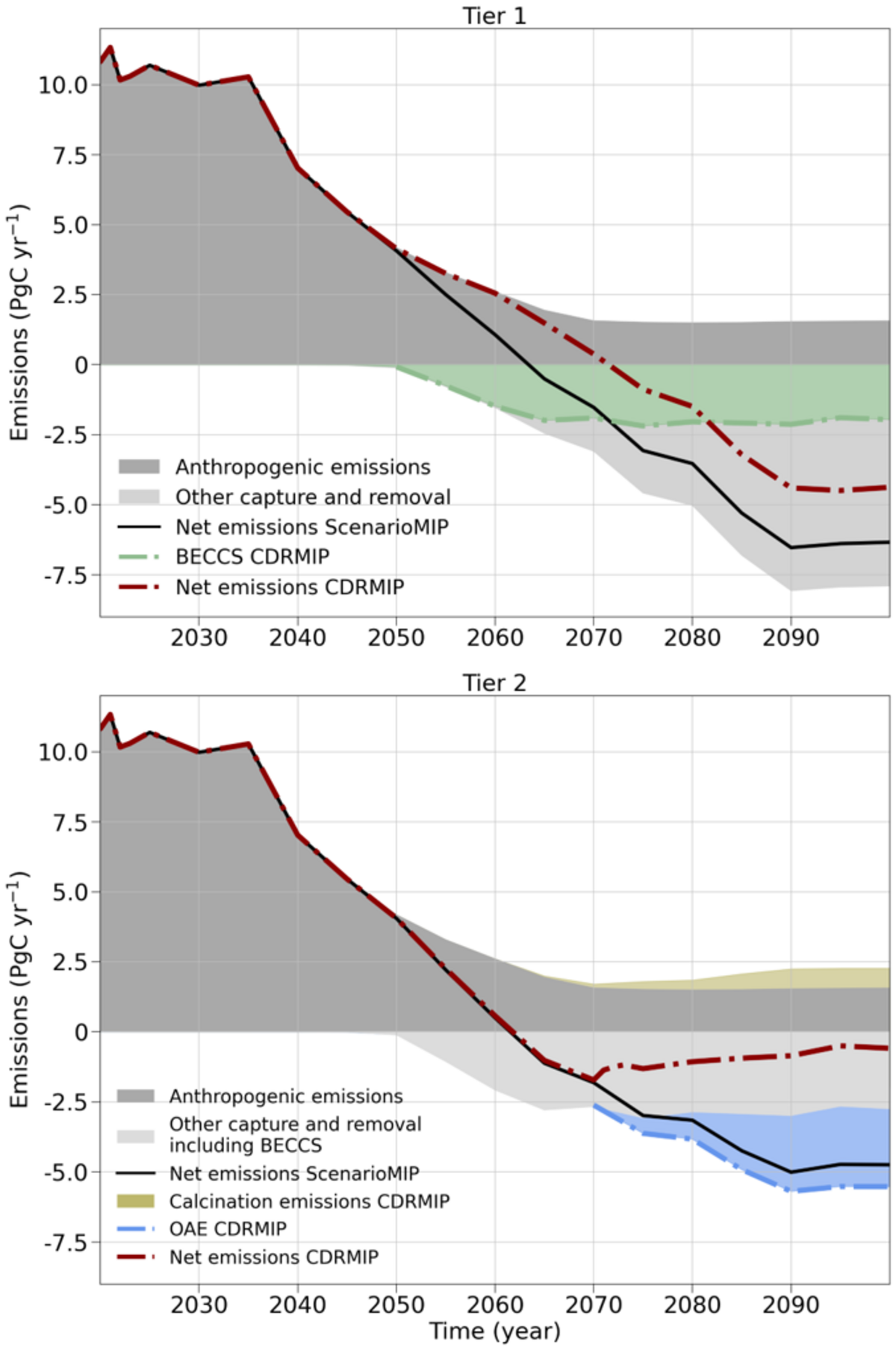
- we request to re-run the ScenarioMIP-LN (Low-to-Negative) experiment with activity-driven BECCS (i.e., yields from bioenergy crops will be stored in permanent carbon pool), while omitting negative BECCS emissions in the ESM forcing
Tier 2:
- we request to run the ScenarioMIP-LN (low to negative) experiment with activity-driven OAE (i.e. including gross emissions from calcification and spatially resolved OAE implementation)
- this experiment requires two additional no-OAE counterfactual baselines simulations together with this scenario to isolate CDR efficiency from the gross system removal including carbon and climate feedbacks: an emissions-driven scenario without OAE, a concentration-driven scenario without OAE with atmospheric CO2 concentration prescribed from the scenario simulation in which OAE is explicitly represented