

Central seawater facilities

The seawater is provided from 20 qm seawater tanks in the central seawater storage facility of the GEOMAR building.
The central seawater storing facility is the ’heart of the seawater supply’ of the new GEOMAR building. From here, 3 types of seawater (Baltic, North Sea and artificial seawater) are provided to the scientist working at GEOMAR. While up to 80 qm of North Sea water can be delivered by ship, 20 qm of artificial seawater can by mixed. The Baltic seawater, however, is continuosly delivery by a pipeline from Kiel fjord. The seawater is kept clean, cool and airated by sediment filters, UV clearer and protein skimmers and delivered to the laboratories and climated culture rooms by a seawater tube system circulating through the building.
Additionally, ‘special’ seawater types taken to Kiel from all over the world can be stored in three 10 qm tanks.

The seawater ist kept clean and fresh by extensive filtering facilities.

3 seawater types can be collected from taps in laboratories and climate culture rooms.
The GEOMAR seawater pipeline:

The pump and filtering station at the Kiel fjord.
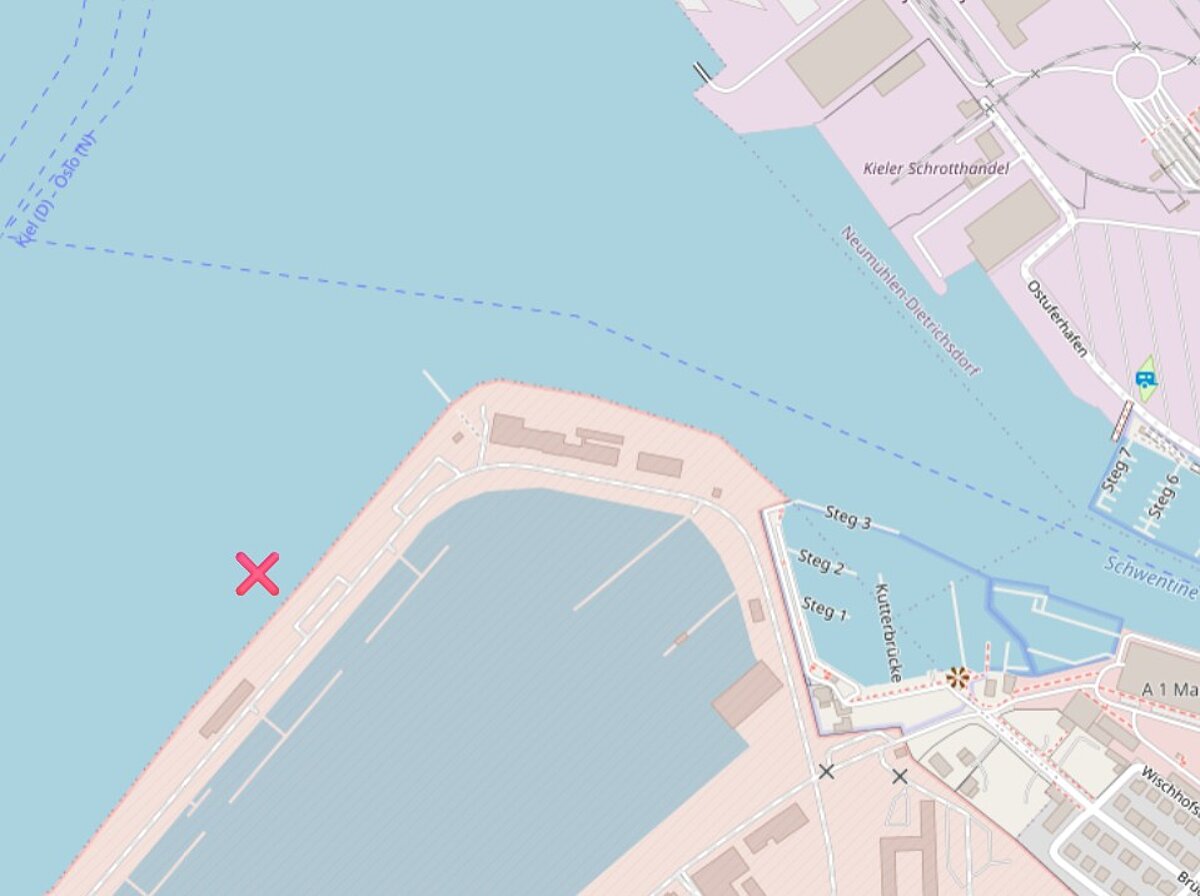
The water is drawn in south of the Schwentine estuary at a depth of 5.5 - 6.5 m (excerpt: OpenStreetMap).

Baltic Seawater is pumped through these pipes from Kiel fjord.

Before being sent through the pipeline the seawater is filtered in a filter station built at the sea shore of Kiel fjord.

Buried in the bottom, the pipeline reaches for ~1.4 km all the way through the Schwentine river to the GEOMAR.
Facts about the seawater pipeline:
- Seawater is drawn in at a depth of 5.5 to 6.5 meters south of the mouth of the Schwentine River into the Kiel Fjord.
- Filtering is carried out using a drum filter and a sediment filter (finest filter granules 0.4–1 mm).
- Transport in the bottom of the Schwentine River via a pipeline approximately 1.4 km long to the GEOMAR building at the fish market.
- Maximum capacity: 20 m³ per hour.

