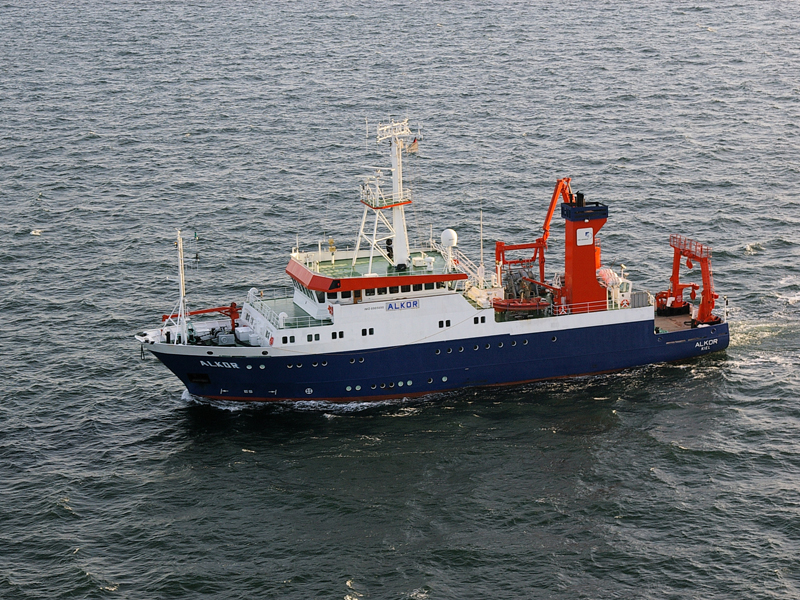
ALKOR AL646
- Area:
- Gotlandbecken
- Time:
-
06.02.2026 - 01.03.2026
- Institution:
- Chief scientist:
- Nicole Adam-Beyer
To mitigate ongoing anthropogenically induced changes to Earth’s climate and achieve the goals of the 2015 UN agreement, anthrophonic CO2 emissions must be actively removed from the atmosphere and stored over long-time scales. The RETAKE project (part of the CDRmare mission "Marine carbon sinks in decarbonisation pathways") will assess the potential, feasibility and side effects of various forms of marine alkalinity enhancement (AE) as a means to reliably and sustainably remove carbon dioxide (CO2) from the atmosphere. The second phase of RETAKE started in August 2024 and will investigate the extent to which rock weathering (a natural CO2 sink) and subsequent storage of carbon in seawater can be accelerated by the additional input of suitable rocks or alkaline solutions. The essential goal of RETAKE is to provide scientifically sound information regarding whether and in what form marine AE can be a feasible process in permanently removing significant amounts of CO2 from the atmosphere, in an environmentally sustainable and socially responsible manner.
The proposed cruise Seafloor AE II is the second of two cruises that will investigate the efficiency of alkalinity enhancement after calcite addition in the field in the Baltic Sea. The effects of this AE will be tested in benthic flux chambers under conditions of oxic and permanently anoxic bottom waters. In situ experiments are vital at this stage, since our current experimental data exhibits significant artifacts related to incubation of sediments under laboratory conditions as well as with regard to differences to the predictions from numerical models.
The specific goals of the requested cruise are to:
(i) Quantify alkalinity enhancement under anoxic and oxic conditions following addition of calcite,
(ii) Quantify the CO2 removal potential of OAE
(iii) Assess the impact of microbial activity for accelerating or hindering alkalinity enhancement
(iv) Asses impacts of alkalinity enhancement on benthic infauna and/or microbial communities and thus effects on biogeochemical cycling.
For the proposed cruise, experiments will be conducted with the GEOMAR BIGO type lander (Biogeochemical Observatory), where surface sediments will be incubated in closed benthic chambers and supplemented with calcite in situ. During the incubations, in situ sensor measurements of dissolved O2 and pH and subsequent geochemical and biological analyses will enable to assess the feedbacks associated with artificial alkalinity enhancement and its CO2 removal capacity under oxic and permanently anoxic bottom water conditions.