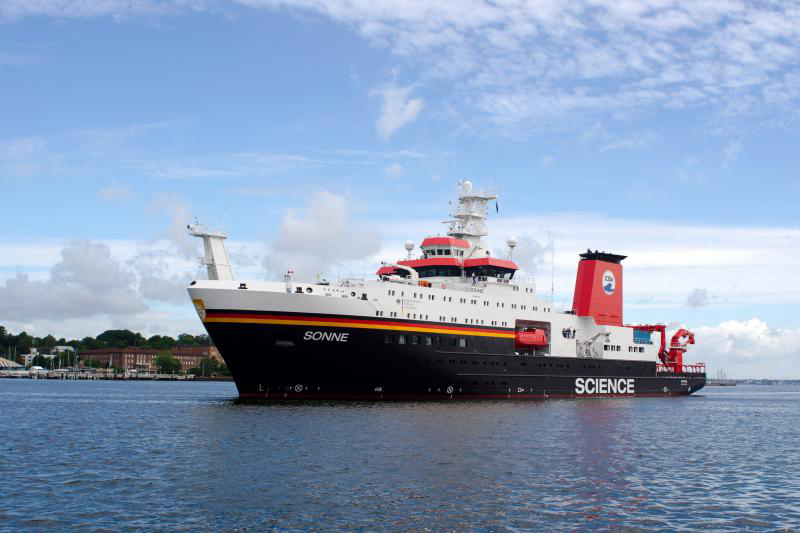
SONNE SO320/1
- Area:
- Pacific Ocean
- Time:
-
15.05.2026 - 16.06.2026
- Institution:
- GEOMAR
- Chief scientist:
- Anke Dannowski
The SO320 expedition comprises two legs, SO320/1 and SO320/2, and is set to carry out geophysical and geological work on the Hess Rise, an oceanic volcanic plateau located in the north-western Pacific Ocean.
These oceanic plateaus are large-scale magmatic areas (Large Igneous Provinces, or LIPs), and are among the least understood forms of volcanism on Earth. Key questions regarding their formation, structure, and geodynamic relationships remain unresolved. Hess Rise, with an estimated volume of 9.1 × 10⁶ km³, is considered one of the largest oceanic plateaus in the North Pacific, yet it is also one of the least explored.
It extends over more than 1,000 kilometres in an east-west direction and can be divided roughly into a western ridge, a central platform, and an eastern ridge. Based on earlier studies, Hess Rise formed in the Middle Cretaceous period (around 100–110 million years ago). Most models interpret Hess Rise as an oceanic plateau that formed in the southern hemisphere near the Pacific-Farallon spreading centre, probably at a 'triple junction' (where three tectonic plates meet). However, the additional involvement of a mantle plume (hot material rising from the Earth’s mantle) to explain the excessive volcanism is controversial.
According to classical plume theory, oceanic plateaus form when a large, mushroom-shaped plume 'head' arrives at the base of the lithosphere, triggering widespread and simultaneous plateau volcanism without the need for a spreading centre. Subsequently, plate movement over the narrow plume 'stem' creates a much narrower, linear, age-progressive hotspot trail.
The main objective of SO320 is to test competing models for the formation of the Hess Rise: 1) along the path of a migrating 'triple junction', 2) at the Pacific–Farallon spreading centre or 3) as a purely intraplate plateau generated solely by a mantle plume. Regarding the first two scenarios, we also intend to investigate whether the Hess Rise could have formed exclusively through shallow plate tectonic processes, i.e. through the migration of a spreading centre over regions of the upper mantle with an anomalous composition (e.g. a higher melting point). Regarding the third scenario, we will test whether the Hess Rise formed as a result of a second pulse from the same hotspot that is believed to have generated the nearby Shatsky Rise around 30 million years earlier.
Finally, we aim to investigate whether a late stage of alkaline basalt volcanism occurred after the formation of the main plateau. This could potentially explain the presence of some solitary seamounts on the plateau. Such a late phase of volcanism is also evident in other oceanic plateaus, although the cause remains unclear. It is often speculated that gravitational spreading/faulting or lithospheric stresses due to loading at the edges of the plateaus may lead to decompression melting in the upper mantle or lithosphere. It is thought that the resulting small-volume melts utilise the deep-seated faults for their ascent.
To address these questions from a geophysical perspective during Leg 1, we will deploy up to 40 ocean-floor seismometers along three profiles over the southern and central Hess Rise at depths of 2000–5000 metres. Air-cushion cannons towed by the ship will serve as the seismic source. In parallel, a multi-channel streamer will be towed behind the ship to investigate the sediment cover and the uppermost crustal regions. Velocity models for compressional and shear waves are expected to provide insights into the composition and depth structure of the Hess Rise.
These seismic surveys will be supplemented by ship-based gravimetry and a towed magnetometer, as well as seabed mapping using the ship's own EM122 multibeam echo sounder.