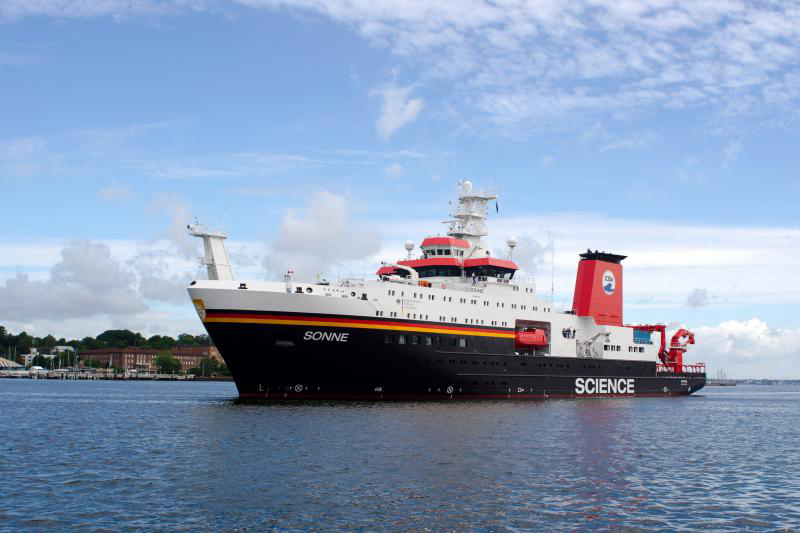
SONNE SO321/1
- Area:
- Eastern Pacific Ocean
- Time:
-
07.08.2026 - 23.08.2026
- Institution:
- GEOMAR
- Chief scientist:
- Christian Timm
Time series are the archives of Earth system research. They show how processes on Earth change over long periods of time. One important time series is the record of the climate, such as changes in sea level. Climate archives document the transitions between ice ages and interglacial periods – phases in which there was an enormous transfer of mass between continents (ice mass) and oceans.
Model calculations suggest that changes in sea level could also influence volcanism along the Mid-Oceanic Ridges (MOR). Changes there could manifest, for example, in the thickness of the Earth’s crust, the composition of the lava, or hydrothermal activity. Evidence for this link from data is still lacking, as MOR time series are difficult to collect.
The ERC Synergy Project T-SECTOR aims to establish geochemical, geophysical and paleo-oceanographic time series at fast- to slow-spreading MORs.
At the Cleft segment of the Juan de Fuca Ridge (north-eastern Pacific), these time series will be used to investigate variations in crustal thickness, magmatic behaviour and hydrothermal activity over the last 1.5 million years.
Through intensive sampling of the seabed using gravity logs and drill cores perpendicular to the ridge axis, we aim to establish high-resolution time series of variations in mantle melting (based on the chemistry of volcanic glasses from the sediments and the crusts of the drilled lavas) and hydrothermal activity (based on metal contents and their isotopic composition in the sediment). Seismic measurements will reveal the temporal changes in crustal thickness. The integration of these unprecedented 1.5-million-year time series will enable us to characterise the temporal evolution of oceanic crust formation at a mid-ocean ridge with a moderate spreading rate and to investigate the controversial relationship between climate (glacial cycles) and solid Earth processes (oceanic crust formation).