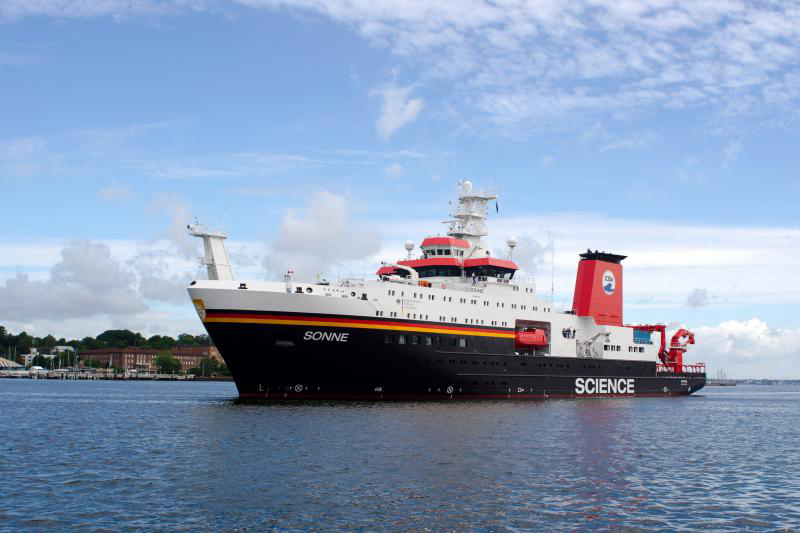
SONNE SO321/3
- Area:
- Time:
-
03.10.2026 - 13.10.2026
- Institution:
- GEOMAR
- Chief scientist:
- Sebastian Hölz
As part of the Solid Carbon research project, funded by Canada’s New Frontiers in Research Fund (NFRF), a study is being conducted off the Canadian Pacific coast in collaboration with the Canadian marine research institute Ocean Networks Canada (ONC) and other Canadian and international partners to investigate whether CO₂ can be safely stored in subsea basalt.
The goal of Expedition SO321/3 is to map the subsurface as accurately as possible prior to a planned CO₂ injection. The data collected will later serve as a baseline for monitoring changes during and after CO₂ storage.
To this end, GEOMAR is conducting a CSEM (controlled-source electromagnetic) experiment using the CAGEM transmitter, which it developed in-house. Together with twelve receiver stations on the seafloor (OBEMs), the electrical resistivity of the subsurface is being investigated to depths of several hundred meters. The goal is to determine the structure of the basalt rock, variations within the storage area, and potential pathways for the future migration of CO₂.
The measurements provide important data for a permanent electromagnetic monitoring system at the site, which is still to be developed. In addition, the results can be compared with data from previous studies, including the MSM140 expedition off the coast of Norway, and existing borehole data from IODP borehole U1362 in the current study area. This is intended to improve our understanding of how different basaltic rock formations are suitable as CO₂ storage sites.